

The UF Provost’s Office removed Melissa Johnson from her role as interim director of the UF Honors Program in November 2025. It’s the second time in just four years the university has removed an Honors leader, leaving lingering questions about the program’s future and its usefulness to participating students.
The university provided Johnson with a notice of nonrenewal Nov. 18, 2025, according to an internal email obtained by The Alligator. Kellie Roberts, a formerly retired UF professor, took over the role of acting director Jan. 16.
Leadership changes
Johnson served as interim director for three years after Honors Program Director Mark Law was fired in August 2022. At the time, UF Provost Joe Glover took responsibility for the decision and said he lost trust in Law and his vision for the program.
Yet Law said the UF Board of Trustees, not the provost, made the decision to fire him. The termination, which he said came with no stated reason, “bitterly disappointed” him, he wrote in an email to students Aug. 15, 2022.
Law kept his position at UF as a professor in the Wertheim College of Engineering, but his salary was halved after his position loss, according to previous reporting from The Alligator. Law had been making another $240,000 a year on top of his salary as a professor.
Law declined to comment on his firing and the Honors program for this story.
Johnson's departure from the interim director role also came with a salary decrease of more than 25%. She was earning over $161,000 as of Fall 2025, according to publicly available UF salary data. Her salary was reduced to $120,000 after her removal from the Honors Program, according to the obtained emails.
It’s unclear whether Johnson is still a UF employee following her removal from the Honors role. She is not registered to teach any classes in Spring 2026 or Fall 2026. The memo did not provide a reason for Johnson’s removal.
Johnson did not respond to multiple requests for comment via phone call, text message, email and a letter left at her home address.
In the memo, Interim Associate Provost Matthew Jacobs told Johnson her final day of employment with the university would be Dec. 31, 2026, and that her position would become 100% remote in her final year.
Johnson began as an adviser with UF Honors in 2005 and maintained a hands-on presence with the program throughout her three years as interim director. Johnson sent a weekly “Honors on Wednesday” email, taught classes ranging from professional development to a lyrical analysis of Jimmy Buffett and hosted Honors on Thursday, or “H.O.T.,” coffee chats with students.
In a LinkedIn post Jan. 14, 2025, Johnson wrote she jokingly refers to her time as interim as “my term as the fake director.”
“20 years is a long time, right?” she wrote of her years at UF. “Never imagined I would be here this long - and who knows how long it will last. I get regular inquiries from search firms about open honors positions - some I entertain, and others I do not (always nice to be contacted though - validation that someone out there values my experience). But for now, we're pushing onward to year 21…”
In another post, dated Aug. 21, 2025, she called the first day of Fall classes her fourth “& final” as interim director.
UF spokesperson Cynthia Roldán said the university does not comment on personnel matters in a statement to The Alligator.
Kellie Roberts, the current acting director of the honors program as of January, clarified in an email that she’s helping the program with day-to-day activities until a permanent director is appointed, “likely within the next six months or so,” she wrote. Roberts wrote she has no plans to become the permanent director of the program.
‘Don’t really see the benefits’
The UF Honors program is structured in two parts: the First-Year Honors Program — for incoming freshmen — and the University Honors Program, for current UF students.
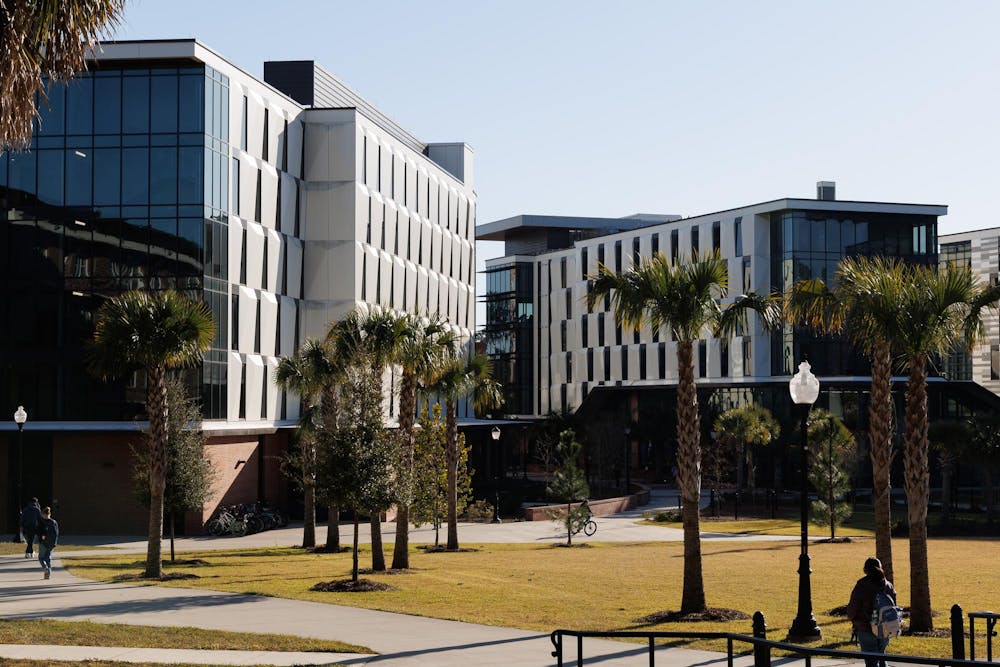
Any honors student can receive tailored advising, unique courses, early registration privileges and priority housing in the new Honors Village dorm.
The program has become increasingly competitive in recent years alongside general admissions. Only 9% of applicants were admitted to Honors in the 2025-2026 cycle, according to the program’s website. Five years ago, the rate was above 13%.
In order to graduate from the program, students must earn “academic points” by taking classes specifically catered to Honors students and “enrichment points” by completing extracurricular opportunities like studying abroad or volunteering. Successful students earn an Honors Medallion in a special ceremony at the end of four years.
Yet the number of students who actually receive the medallion is low. The program accepts about 700 to 750 students each year, according to its website. Last Spring, 285 students received their medallions — a program completion rate of about 38% to 41%.
Mallory Tyler, a 22-year-old UF data science senior and Honors student, said she’s noticed many of her peers don't use the program to its full extent.
“I guess they just don't really see the benefits of going through with it,” she said.
Personally, she doesn’t take full advantage of the five full-time advisers employed by the program and “may have had one” sit-down meeting with them during her time at UF, she said.
Adiana Reyes, a UF 19-year-old microbiology freshman, believes the problem with the Honors Program comes from the lack of diversity of honors classes offered.
“I feel like … they don’t really have a lot of options for a wide variety of classes,” Reyes said. “I don’t meet a lot of humanities people around here.”
Honors-specific courses — those being the smaller honors sections of courses — are largely STEM, with about half of the 17 courses offered during Spring 2026 being in STEM fields, including Physics 1 and Physics 2.
Honors also offers unique courses that focus on a wider variety of topics than regular courses, many of which focus on particular books or film genres. There are about 57 IDH courses, many only one credit each, for both semesters. They range in subjects from health to history to business.
Honors programs increasingly relevant
Honors programs are becoming increasingly common in U.S. higher education. Eleven out of 12 state universities in Florida, including UF, offer special honors studies.
But the programs differ in their intensity and structure, with some being fully fledged colleges and others, like UF’s, remaining as programs.
In 2026, Florida State University, Florida Atlantic University, the University of Central Florida and the University of South Florida made College Transition’s first-ever list of the top 50 honors colleges nationwide. UF didn’t make the cut.
Many of the state’s honors programs offer similar benefits, like early registration, exclusive housing and scholarship opportunities. Of the 11 honors opportunities across state universities, only those at UF, Florida Gulf Coast University and the University of North Florida are currently led by interims.
When honors programs lack permanent leadership, keeping momentum and focusing on the best ways to support students becomes more difficult, said Tiffany Sippial, the dean of the University of Alabama’s honors program.
When Sippial was hired, UA was experiencing a period of high turnover for its honors program, similar to UF, she said.
“It's hard to keep momentum and focus when there's that amount of turnover,” she said. "You're always in this kind of holding pattern for the next new leader that would be coming in with potentially a new vision for the direction of the college.”
Sippial said honors colleges can be important to students when they choose their universities, because they can give students, especially those at large schools, the big college environment while also having small and more personal classes.
Philip T. McCreanor, the director of Mercer University’s engineering honors program, said students tend to drop out of the program during their second year, as that's when engineering gets “real serious.” The private university in Macon, Georgia, accepts about 110 students into the program each year.
McCreanor has made community in the program a priority, he said, because he believes it’s what contributes to a strong honors program.
McCreanor also said he hopes collaboration in a student-to-student mentor program gives new students the confidence to continue through the program and seniors the last burst of energy they need to make it to the end.
Not having a permanent leader can influence the direction of the program, he said.
“If you don’t have leadership, what path your honors program is taking is unclear,” he said. “How are students being managed and shepherded through? You know, that’s the way I see it.”
Despite this, Esha Gokulram, a 19-year-old UF computer science sophomore, believes UF's program lives up to its promises. While Gokulram is still new to the honors program, she has taken classes such as UnCommon Reads, which are book club-style classes focusing on one book per semester.
“It encourages me to do more and … helps me reflect on what I’ve done,” Gokulram said. “I feel like it does help you a lot with all academic opportunities.”
Contact Nevaeh at nbakerharris@alligator.org. Follow her on X @nbakerharris.
Nevaeh Baker Harris is a first-year sports and media journalism major and The Alligator's Spring 2026 Student Government reporter. In her free time, she enjoys watching medical dramas, reading horror novels, and listening to 90s rock music.


