

Nearly 92% of rural counties in the U.S. lack enough primary care physicians needed to serve their populations, leaving some communities without a single doctor.
In Florida, 23 counties qualify as “rural,” according to a study from The Commonwealth Fund using 2023 data. At least part of every rural county was designated a health professional shortage area — and in 12 of them, the entire county received that designation.
Researchers at UF believe artificial intelligence could help close the gap.
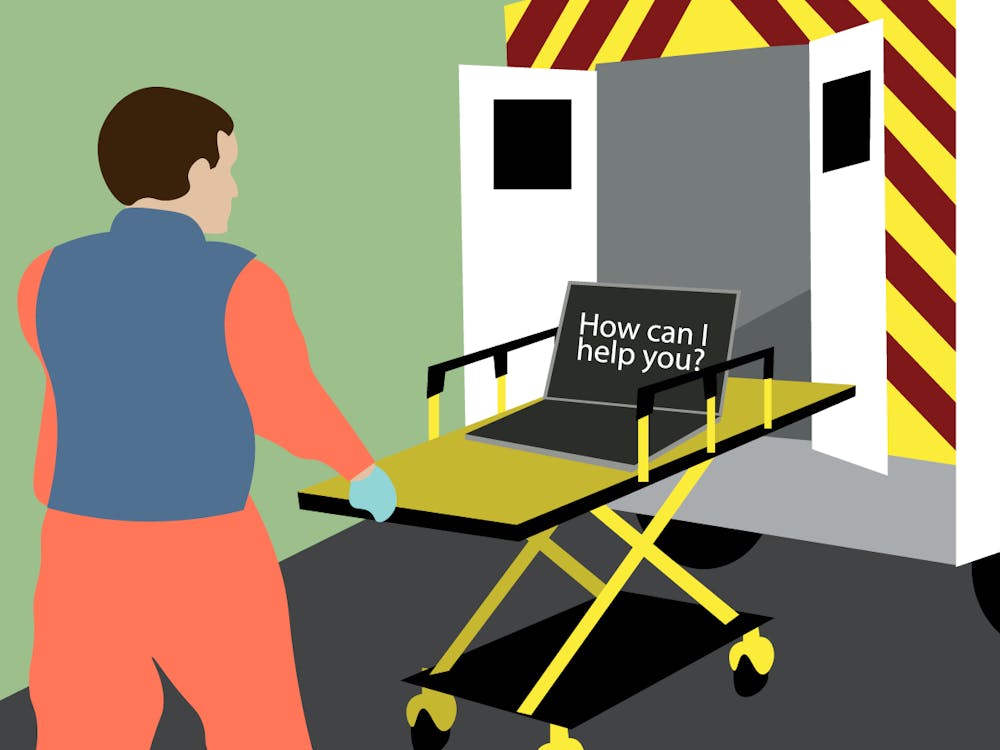
One year into a federally funded research initiative, UF scientists say they have developed an AI system that can guide nonspecialists through basic medical tests — a step toward creating mobile clinics capable of delivering hospital-level care in remote areas.
The program, called the Platform Accelerating Rural Access to Distributed and Integrated Medical Care, or PARADIGM, aims to build a fleet of mobile medical units equipped with diagnostic tools and AI systems designed to assist patients, social workers and community health staff.
But before those clinics can reach rural communities, researchers must solve several challenges, including limited computing power inside the vehicles, unreliable internet connections and strict privacy regulations governing medical data.
A growing rural care gap
Rural physician shortages have intensified in recent years.
Federal workforce data show rural areas average one physician for every 2,881 residents, and roughly 20 counties have no primary doctor at all.
Those shortages often force patients to travel long distances or delay care altogether.
Urban areas have nearly three times as many physicians per capita as rural communities, according to national research.
Alachua County, which is not considered rural, doesn't face the same shortage and has the highest ratio of physicians to residents in Florida. Local workforce data show roughly 730 physicians for every 100,000 residents.
But the same can’t be said for surrounding rural counties like Levy, which has about 26 physicians for every 100,000 residents, and Gilchrist, which has 30.
Training AI to guide medical procedures
UF researchers and their partners are developing an AI platform trained to recognize medical terminology, lab procedures and images.
The system aims to guide nonspecialists through tests that normally require trained clinicians.
“We were able to deliver an AI system that can automatically instruct family members or social workers to perform [a] blood draw on the chemical analyzer,” said Yonghui Wu, a lead researcher on the UF team.
The system builds on GatorTron, UF’s clinical language model, expanding it into a multimodal system capable of processing both medical language and visual data.
“So we can instruct the patients,” Wu said. “If they have questions, they can ask the AI.”
The program receives funding from the Advanced Research Projects Agency for Health, a federal agency that supports high-risk biomedical research. Wu declined to disclose the project’s total funding.
Over the past year, researchers trained the system using simulated procedures, including artificial arms with embedded vessels. The team has since incorporated clinical data from Mayo Clinic’s Jacksonville campus.
Building the mobile clinic
While the AI software has advanced quickly, partner institutions like California-based research center SRI and Mayo Clinic Jacksonville continue building the project’s physical infrastructure.
Five teams are responsible for developing different components, including compact CT scanners, ultrasound devices and the mobile clinic vehicle itself.
Wu said hardware development takes longer than software development, and integrating all components will take several years.
Under the current timeline, researchers expect to complete system integration in four years. Clinical testing would begin in rural regions — including sites in Utah — in the fifth year.
The mobile units have limited electrical capacity, which may prevent the largest AI models from running at full capacity. Lighting conditions inside the vehicles could also affect camera accuracy if they differ from the data used to train the system.
To address those limitations, the team is considering satellite-based connections that would allow more powerful AI models to run remotely in the cloud.
But reliable internet access remains inconsistent in many rural areas.
Regulatory hurdles
AI-based medical technologies are typically regulated as medical devices by the U.S. Food and Drug Administration, which evaluates their safety and effectiveness before clinical deployment. This means the technology would have undergone a formal assessment process to ensure it meets safety and quality standards and is not a source of risk to patients or users.
Wu said the PARADIGM system will follow the same regulatory pathway.
Researchers say the goal is to expand access to care, not replace health care workers.
“What happens is not AI replacing people,” Wu said. “It’s people who are good at using AI replacing people who don’t use AI.”
Researchers expect that process to begin after the project’s prototype phase.
Patient privacy and development limitations
While researchers say the project is advancing well, they said there remained several challenges that arose during the process, especially concerning protection of patient privacy.
“You cannot provide patient information to commercial models,” said Mengxian Lyu, a doctoral researcher on the project developing a companion system that focuses on language and clinical decision support for health care workers.
Federal regulations such as the Health Insurance Portability and Accountability Act, or HIPAA, restrict how medical data can be shared or stored.
Those restrictions can limit the amount of clinical data researchers can use to train advanced AI systems.
The model links medical images and text with natural-language guidance, Lyu said, allowing clinicians to confirm which steps are necessary for a procedure.
However, deploying these tools in a mobile environment requires balancing computing power with strict privacy protections.
Another challenge that came up, Lyu said, was the training of the AI system. Researchers are currently working with health care providers to expand the system’s knowledge base.
“With only limited knowledge,” Lyu said, “we cannot build a very powerful AI system.”
Lyu said “using an AI system to assist, we build an AI system” after collecting data from health care providers.
This creates what Lyu called a “loop.” Once the first model exists, the AI then helps speed up the training process and the cycle continues.
“We try to train the AI to help us further view the AI,” Lyu said.
Testing the concept in real clinics
For community health workers who already operate mobile clinics, the technology could expand what nonspecialists can do in the field.
Mya Maybank, a 21-year-old UF public health graduate student, works as a community health worker with UF Street Medicine and Mobile Outreach Clinic.
The clinic provides rapid hepatitis C testing for residents experiencing homelessness in Gainesville, including outreach at encampments and GRACE Marketplace.
Workers conduct initial screenings and then connect patients who test positive with treatment.
Maybank said most workers don’t have medical backgrounds, which limits the procedures they can perform.
Some equipment requires training from medical professionals, and only a small number of staff receive that instruction.
She said an AI system capable of guiding workers through technical steps could make mobile clinics more efficient. Still, she said AI should remain a support tool rather than replace health care workers.
Contact Swasthi Maharaj at smaharaj@alligator.org. Follow her on X @s_maharaj1611.

Swasthi Maharaj is a political science and politics, philosophy, economics and law (PPEL) junior at UF. This is Swasthi's fourth semester at The Alligator, and her third semester on the university desk. She's also reported on the enterprise desk. Swasthi loves coffee, reading, going to concerts, baking and taking long walks.


