

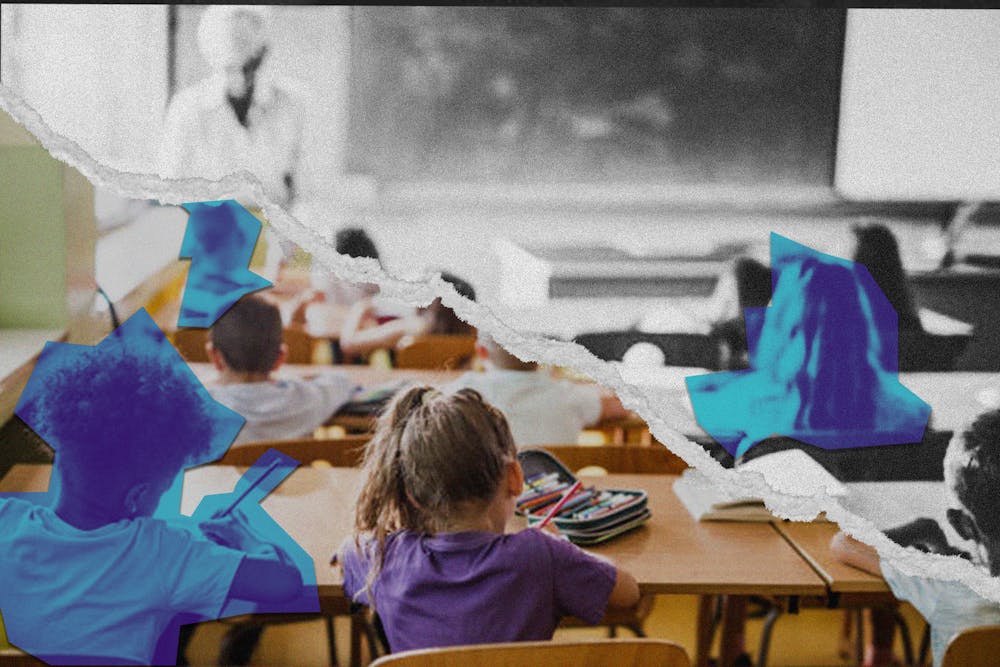
On the first day of kindergarten, teacher Caitlin Gallingane recalls stark differences among her students: Some could read full sentences, while others had never held a pencil.
While the 49-year-old now works as a clinical associate professor in UF’s College of Education, she previously taught in the early 2000s at what’s now Duval Early Learning Academy in East Gainesville.
For decades, Alachua County’s schools have faced scrutiny over stark racial achievement gaps that have proven difficult to narrow. Despite various initiatives, community members and education experts say disparities persist — shaped by ineffective state policy, high staff turnover and historic inequities.
Almost a decade ago, Alachua County held the state’s largest achievement gap between Black and white students, prompting the district to address those disparities with an equity plan in 2018.
The plan aimed to narrow or eliminate the achievement gap between white and Black students by 2028. It included raising the reading achievement of Black learners and participation in advanced programs.
To do this, schools in Alachua County implemented college readiness classes, credit retrieval programs and individual learning plans for students who aren’t on track to graduate.
Nearly eight years after the equity plan was introduced, those gaps remain among the largest in the state.
In 2025, Alachua County had the second-highest achievement gap statewide between white and Black students in ELA achievement and is tied for the second-highest in math, according to the most recent data from the Florida Department of Education. The data was measured from mandatory state exams.
Learning disparities start young
During Gallingane’s final year teaching at Duval in 2004, two kindergarten classes swelled to nearly 28 students each for two weeks until the district hired another teacher — far above the Florida class size maximum of 18 for pre-K through third grade classes.
Many of her students, she said, had never attended pre-K.
“Not only are you trying to teach them, starting on day one, academics, but you are also teaching them how to be at school,” Gallingane said.
In Florida, where pre-K is voluntary and hours-based, the quality and accessibility of its program may present challenges to working parents. Although free pre-K programs started in Florida in fall 2005, funding has historically lagged behind other states.
Gallingane said her class at the East Gainesville school was mostly Black, and many families faced economic hardship. She recalls students not having access to school supplies or needing health screenings at school.
About 70% of the school’s students were Black as of the 2024-25 school year, according to the National Center for Education Statistics.
“There were things that presented challenges to my kids that I had never even considered before,” she said. “It was very humbling.”
East Gainesville is home to several predominantly Black neighborhoods and faces higher rates of poverty compared to the west, a disparity often linked to historic housing segregation, redlining and uneven investment in infrastructure and economic opportunities.
Researchers say those structural factors often shape the educational resources available to children long before they enter a classroom.
Susan B. Neuman, a childhood and early literacy professor at New York University who previously served as assistant secretary in the U.S. Department of Education, said poverty is one of the strongest predictors of student success.
According to Neuman, poverty affects learning in many ways, including food insecurity and housing instability.
“It’s not just money — it’s books, opportunities for children to be read to,” she said. “Some of the benefits we expect children to get in those very early years.”
Steven Barnett, the founder of the National Institute for Early Education Research at Rutgers University, said Florida’s Voluntary Prekindergarten Education Program, or VPK, is underfunded.
Barnett compared Florida’s program to higher-funded early education programs in other states, such as New Jersey, where the state spends nearly $18,000 per child in pre-K — far more than Florida’s $2,838.
“What can we expect with about $2,800 bucks in Florida?” he said. “The answer would be not very much.”
Early education programs need sufficient funding to have long-term impacts, Barnett said. Higher funding allows for smaller class sizes and ongoing professional development for teachers. By contrast, Florida teachers have low salaries and limited classroom support, he said.
Across Florida, there are 30 early learning coalitions that work with the state to provide access to Florida’s VPK program and other early childhood readiness curriculum.
Alachua County spends about $2,700 per child on VPK. It ranks 24th out of the 30 coalitions in the state for per-pupil spending, according to data from the Florida Department of Education.
Teachers in Alachua County have a median salary of around $51,000, placing the county among the lower third in teacher pay in the state.
Policy pressures strain schools
Alachua County School Board member Tina Certain called the district’s achievement gap “cyclical.”
Appointed in 2018, Certain became involved in local advocacy after volunteering at Williams Elementary, a Title I school in East Gainesville, where she saw disparities compared to her own children’s education in west Gainesville, she said.
She said schools in East Gainesville had older facilities compared to the west and experienced frequent turnover in leadership and staff.
The instability in staff retention, which Certain attributes to state policy surrounding teacher evaluation, limits the district’s ability to close racial achievement gaps, she said.
Under Florida state law, teachers are evaluated every year on factors including student testing and classroom observation. In low-performing schools, students may enter already behind — putting their teachers at a disadvantage as they work to improve their test scores.
Teachers who score poorly on these annual evaluations can be removed from their schools.
Generally, research shows that low-performing and high-poverty schools experience significantly higher teacher turnover — especially under state accountability policy — and have difficulties replacing teachers with equally effective ones, creating ongoing instability.
Four Alachua County schools — Lake Forest Elementary, W.A. Metcalfe Elementary, Chester Shell Elementary and Idylwild Elementary — have been identified by the Florida Department of Education as persistently low-performing.
According to Certain, two years ago, the entire third grade teaching staff at Marjorie K. Rawlings Elementary was replaced due to low performance ratings, leaving students with a substitute teacher for about a month. A 2023 “turnaround plan” for the school said its third grade teaching staff faced several challenges because “there were many changes in staff.”
The following year, Certain said, the same cohort of students experienced another round of teacher turnover after moving into fourth grade.
“There’s no continuity in those high-need schools,” Certain said. “If you’re constantly changing the teaching staff, constantly changing the principal, the principal cannot make and build relationships with their staff.”
Who gets in?
The most recent Department of Education enrollment data, from the 2024-25 school year, shows 29% of graduating white students participated in the Cambridge AICE program, compared to 13% of Black students.
Similar trends appear in student enrollment in International Baccalaureate and dual enrollment programs.
Nasseeka Denis, the interim supporting executive director of Aces in Motion, a nonprofit that provides academic support and resources to middle and high school students, said she mostly works with Black students in East Gainesville.
From her work at AIM, Denis said, she’s seen schools struggle to build relationships with families. Caregivers are often unaware of available resources and intimidated by the schools themselves.
“The misconception is that the students don’t want to learn, when in reality, for a lot of students, it’s survival,” she said.
She recalled visiting a middle school in East Gainesville for her thesis project, when she said she noticed the magnet side of the school looked more appealing than the general side — creating a divide between students.
“Talking to the students, interviewing them, I’m like, ‘Hey, why do you think that is?’” Denis said. “They’re like, ‘Well, Ms. Nasseeka, that’s for the smart kids.’”
Denis’s observations reflect a longer history in the district: Following desegregation, advanced programs were often placed in historically Black schools to attract white students.
Nancy Dowd, a retired UF law professor, said even decades after desegregation, the structure of gifted and magnet programs create “islands” of white students within predominantly Black schools, mirroring historic divides of segregation.
“You're operating against a context that is not designed to achieve equality,” she said. “It's designed to perpetuate hierarchy, and that hierarchy is a racial hierarchy.”
Contact Julianna Bendeck at jbendeck@alligator.org.
Julianna Bendeck is a first-year journalism student and the Summer 2026 criminal justice reporter. She previously worked as a contributing writer and race and equity reporter at The Alligator. Outside the newsroom, she enjoys reading, surfing the web and playing video games.