
Read other stories from the "These stories were not AI-generated" special edition here.
Every month, Kayla Sharp’s son excitedly awaits a book delivered to him by mail. He’s not just excited for the words on the page, but for the adventures he’ll follow along with on his tablet.
Sharp’s son is enrolled in New Worlds Reading Initiative, a program designed to improve literacy skills in young readers by providing them with free monthly books.
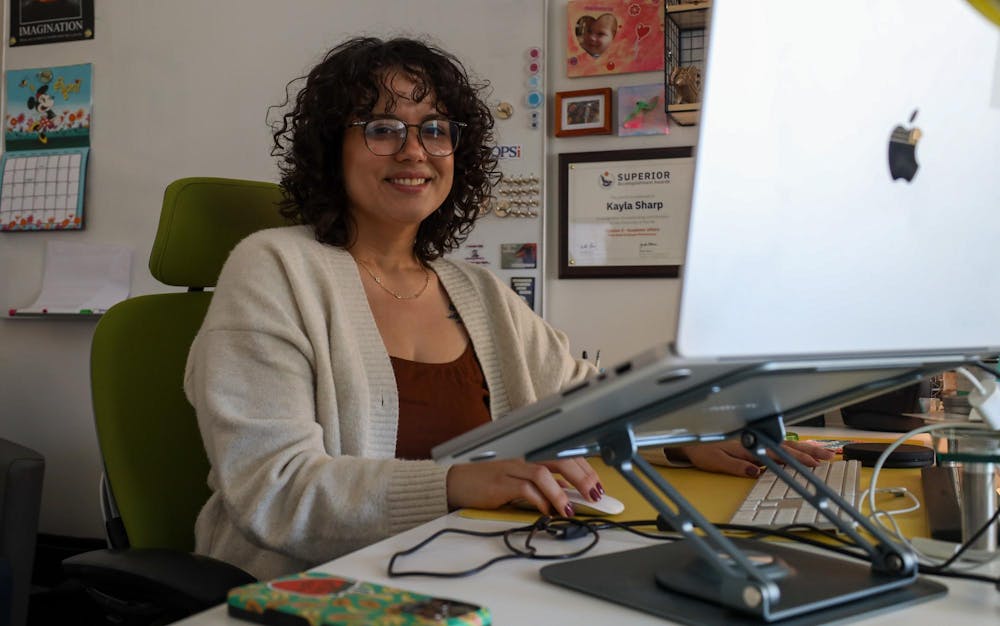
Motivated by her son’s excitement, Sharp took on a roughly two-and-a-half-year project to design an artificial intelligence-integrated app that helps young readers develop literacy skills.
The project provides greater insight into how AI fits into the literary and educational spaces, Sharp said. As education funding — particularly for K-12 teacher salaries — remains low in Florida and Alachua County, experts and community members say they’re increasingly looking to resources like the app to fill in learning gaps.
“As we move into a space of AI becoming more readily accessible, more built into things that we use every day, it's important to stop and consider not just how can we use AI, but how can we use AI in a strategic way that improves the impact of what we're doing?” Sharp said.
UF College of Education’s E-Learning, Technology and Communications Team designed the app in partnership with the UF Lastinger Center for Education’s New Worlds Reading Initiative. Sharp is the assistant director of operations for the technology team.
The app, AR Expeditions, features four augmented reality experiences based on books provided by the initiative. Students can engage with an array of topics, ranging from marine life to superheroes, while improving their reading comprehension skills.
The app combines real-world surroundings with 3D animated characters like sea creatures. Students can view the world around them through the camera feature, with various characters and games appearing on the screen.
Also crucial to the design process was the use of AI, which was integrated in all steps of development, Sharp said. From brainstorming to coding and proofreading, AI helped facilitate the process.
The app is meant to excite and motivate young readers like her son, Sharp said.
“The ultimate goal of this app was to improve motivation for children who may not necessarily feel excited about reading, because reading is hard,” Sharp said. “It's a new skill that they're learning, and like any new skill, there's a learning curve, and sometimes it takes a little bit of motivation and fun to make that learning curve seem less daunting.”
With students at the core of the project, the developers relied on feedback from “mini-researchers,” or third grade students who tested the app.
Their input was crucial to the design process, Sharp said.
“Even though they are children, they still have different needs to be able to access that type of technology,” she said. “Meeting them at their level was very important.”
The app’s development comes amid an ongoing conversation about the role of AI in childhood development.
Anand Rao, the director of the Center for AI and the Liberal Arts at University of Mary Washington, currently works with middle and high schools to improve AI literacy education. The goal is to teach students how AI works, discuss its limitations and show them how to use it responsibly, Rao said.
“If students are taught how to use it [AI] responsibly, they can think about using it for brainstorming,” he said. “They can use it in a Socratic dialogue, where it will ask questions and guide students.”
AI-based outside resources can provide more personalized learning experiences for students falling behind, Rao said, but these resources cannot replace a teacher.
To promote a healthy relationship between AI and education, parents should learn more about AI to facilitate open discussions with their children about how to responsibly use it, Rao said.
According to a 2024 study from Pew Research Center, just over a third of adults said AI is more likely to have a negative impact on K-12 education. About 24% of adults said the impact would be positive, and 23% said it would be both positive and negative.
AI can be used to improve literacy rates, researcher Ying Xu found in a 2024 article published by the Harvard Graduate School of Education. AI companions can ask questions during reading that improve comprehension and vocabulary.
However, AI fails to simulate personalized instruction offered by teachers and tutors. Xu’s study found that while children were quite talkative with AI, they were even more engaged when speaking with a human — steering the conversation, asking follow-ups and sharing thoughts.
Interactivity boosts enthusiasm for literacy in the AR Expeditions app, according to its leaders. Shaunté Duggins, the New Worlds Reading Initiative’s associate director, said the program aims to offer interactive resources to excite hesitant readers.
“We wanted to think about how we embed something that's more interactive, that helps children to be engaged and also to increase their literacy skill,” Duggins said.
Within the marine life portion of the app, students can play a bubble game, where they answer questions about fish by popping a bubble with the right answer. They can then read facts about the animals. Other games include vocabulary fishing and coloring fish to build an aquarium.
The hope is the app will excite users to engage with topics present in the program’s books, Duggins said.
Through the program, eligible pre-K through fifth grade students receive a free monthly book from October to July. The books are selected in partnership with the Florida Department of Education and Scholastic, a children’s book distributor.
In addition to books, New Worlds Reading Initiative provides caregivers with family reading guides and teachers with professional development programs to help them become better facilitators of learning.
“We are part of the solution,” Duggins said. “We're contributing to meeting the needs of students who need some additional support, their teachers that need support, the families that need support.”
The program has served over 500,000 students, Duggins said, delivering more than 13 million books since its inception in 2021.
Just over half of students in Florida read on grade level in 2024, according to a literacy needs assessment conducted by the UF Lastinger Learning Center for Education in conjunction with the Children’s Trust of Alachua County. Literacy rates in Alachua County in 2024 were the same, with half of all K-12 students reading on grade level.
Standardized language arts test results for the 2024-25 school year reveal 55% of students in Alachua County passed with a three or higher. That’s just below the state’s 57% achievement rate.
In turn, tutors like Jaklynn Rivero are in high demand. Rivero said it's because schools are exhausted of resources.
Rivero, a 31-year-old biological agriculture environmental engineer for the U.S. Department of Agriculture, started tutoring a couple of months ago.
Based in Alachua County, Rivero offers private tutoring for students in an array of subjects, including math and reading. She finds many of her students are working below grade level. She attributes their educational difficulties to a lack of school funding.
In 2023, the average amount spent per student in the U.S. was roughly $16,500. In Florida, less than $13,000 was spent per student. The state ranked 46th in spending per student, according to the Education Data Initiative.
The literacy needs assessment, released in 2025, found teachers cited “staffing shortages and resource constraints” as challenges in preventing effective literacy education.
“We're not putting enough resources into our children's education,” Rivero said. “Teachers are not getting what I think they deserve. Our school systems are not getting what they deserve — at least in regards to funding.”
Outside educational resources, like tutoring and learning apps, have become a necessity, she said. Still, she added, pen-to-paper teaching methods are more effective.
Additional learning exercises, like writing, help students repeat information they are learning in schools, she said. They also allow students to have more personalized educational opportunities.
“I notice in smaller settings where there's less students to a teacher and there's more of that individuality, you can focus more on that person and see where their struggles are to then catch them right away,” Rivero said.
The New Worlds Reading Initiative app is publicly available on the Google Play Store, but it’s only available in beta on Apple’s App Store, meaning users need permission to download it. As the developers finish designing the last of the four experiences, it is unclear if the app will continue to be available for download.
Contact Grace Larson at glarson@alligator.org. Follow her on X @graceellarson.

Grace Larson is a second-year journalism student and this Fall's metro editor. This is her fourth consecutive semester on the metro desk, having previously served as commission reporter, K-12 education reporter and editor. If she's not editing an article, you can probably find Grace working out, antiquing or crafting.