

The state of Florida executed 58-year-old Chadwick Willacy at 6:15 p.m. Tuesday for the 1990 murder of his then-56-year-old next-door neighbor Marlys Sather, according to the Florida Department of Corrections.
“We have waited 36.5 years for justice for our mother,” a written statement from the family said. “The pain has been unbearable without her with us every day.”
Before the executioner administered the lethal injection drugs, Willacy gave his last words and urged his “brothers on the row” to stay strong, and he apologized to his friends and family, according to witnesses of the execution.
“To the victim’s family, I hope this brings you peace, but this is not right,” Willacy said. “I would never kill my friend, and we were friends.”
Willacy was the fifth person to be executed in Florida this year, following a record-setting 2025 in which the state carried out 19 executions.
The crime
Then 22-year-old Willacy was burglarizing Sather’s house on Sept. 5, 1990, when she came home for lunch unexpectedly, according to court documents.
He struck her in the head and bound her ankles with wire and duct tape before using a telephone cord to strangle her.
Willacy stole her ATM card and car keys and drove her car to the bank to withdraw money from her account.
He then made multiple trips to his house with items stolen from hers.
He hid her car around the block as he took the items to his house. Willacy then drove it to a plaza and left it there before jogging back to the Sather house, court documents show.
Willacy then disabled the smoke detectors, doused the house in gasoline he found in the garage and set Sather on fire.
He placed a fan at Sather’s feet to provide more oxygen to the fire, according to court documents.
Her son-in-law found her body after going to check on her when her work notified the family after she didn’t return from her lunch break.
Her cause of death was smoke inhalation, showing she was alive when Willacy lit her on fire, according to a medical testimony.
Willacy’s fingerprints were found on the fan, the gas can and a tape rewinder in Sather’s house. Several witnesses described a man fitting Willacy’s description driving Sather’s car on the day of the murder.
He was arrested after his girlfriend called the police when she found a woman’s check register in the trash, which officers identified as belonging to Sather.
When officers searched Willacy’s home, they found several of Sather’s stolen items and blood-covered clothes matching Sather’s blood type.
The punishment
Willacy was charged with first-degree murder, burglary, robbery and arson, according to court documents.
A jury found him guilty of all charges Oct. 17, 1991, and recommended death in a 9-3 vote.
The Supreme Court of Florida affirmed the guilty conviction but vacated the death sentence in 1994.
At a later sentencing hearing, a jury recommended Willacy be sentenced to death by a vote of 11-1, and identified several aggravating factors including the cruel nature of the murder as it was committed to avoid arrest, among other factors.
The trial court found the mitigating circumstances had little weight, and the judge sentenced Willacy to death.
Willacy filed a number of appeals in the decades following, most of which were summarily denied.
His claim of emotional disturbance during the time of the crime, however, was afforded an evidentiary hearing, in which instances of physical abuse during Willacy’s childhood were brought up along with his long-time drug use.
However, two doctors testified Willacy’s judgment was not impaired at the time of the crime, and he was not under extreme physical or mental distress, according to court documents.
The day of the execution
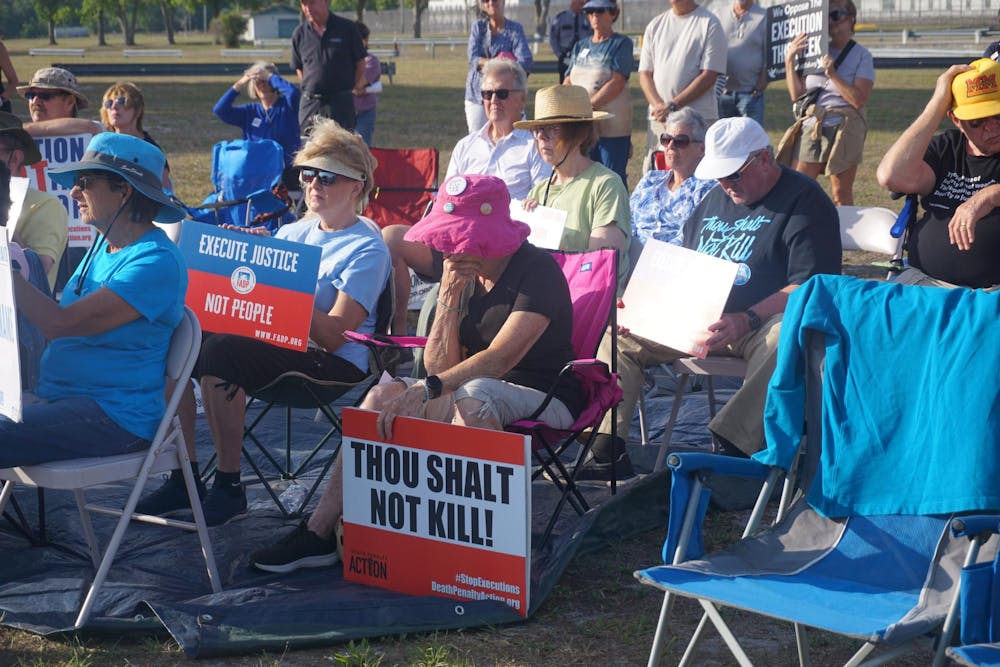
In the hours and minutes leading up to the execution, Paul Nickerson, a member of the Holy Faith Catholic Church in Gainesville, said the scene on the lawn across from the state prison resembled a circus.
For every execution, protesters gather outside the state prison to show their opposition to the death penalty. On the other side of the lawn stand supporters of the practice.
Nickerson heard about the protest by accident, he said, as he was at the state prison getting his fingerprints taken so he could participate in the prison ministry program at the Diocese of St. Augustine.
“I think that this whole thing is a distraction,” he said. “A man died today. And this whole political squabble is really, I think, doing his soul a disservice, personally.”
Nickerson said he is neither for or against the death penalty, but he came to pray Willacy is ultimately forgiven by God.
“I came out, really, to pray for the man’s soul,” Nickerson said.
Paul Braund had different reasons for attending the protest.
“I just hope as a country, we come together and have a unanimous decision that we should stop the death penalty completely,” he said. “The treacherous fact that we kill people for crimes, it’s just crazy.”
He said he has been attending the execution vigils for the last two years with the Our Lady of Lourdes church, which travels by charter bus from Daytona Beach for every execution.
Across the lawn, two people stood in support of the death penalty.
Bill Campbell makes a two-hour road trip from Marion County for almost every execution to support the executions and to counter the opposition protestors.
He said he thinks more states should follow Florida’s lead.
“Florida and Texas are doing the best job in the country,” he said. “I’m just happy they’re leading the way.”
Contact Alexa Ryan at aryan@alligator.org. Follow her on X @AlexaRyan_.

Alexa is a junior journalism and international studies student and The Alligator's Fall 2026 Enterprise editor. She previously served as the criminal justice reporter and the Enterprise politics reporter. In her free time, she enjoys running, traveling and going on random side quests.


