
Lexline Johnson thinks Honks deserves more love.
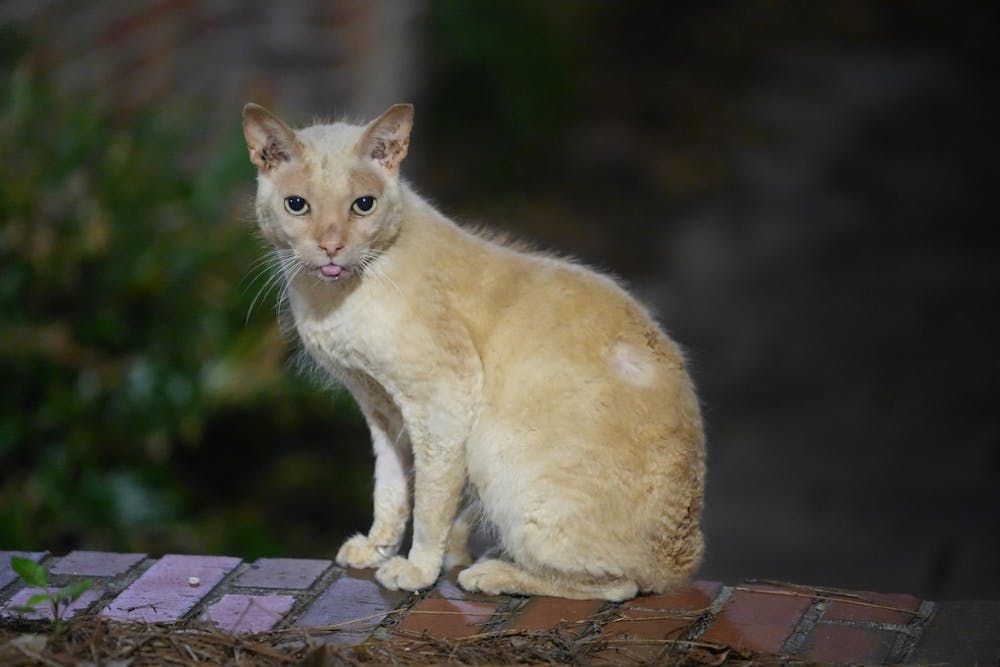
Honks, who lives near Pugh Hall, is one of many felines that call UF’s campus home. The orange cat earned his name in reference to his distinctive meow, which sounds like a honk.
@Campuskittiesfl, a local trap, neuter and release Instagram page, is seeking help for the cat to be fed, cared for and given a full health workup after his caretakers noticed he appeared ill with poor dental health.
Lexline, a 20-year-old UF computer science junior, said she’s determined to help. She started feeding and helping the Pugh Hall cats during her sophomore year, after which she said her love for the cats grew.
Honks might be a difficult cat to trap, Lexline said, but she has succeeded in catching him before. In January, she managed to bring Honks to a nonprofit veterinary clinic to get dental work done.
The cost of helping these cats isn’t cheap, especially because skittish cats like Honks might need anesthesia for a procedure — an extra cost of about $200, according to Lexline. She’s now trying to raise money by asking for donations to her personal Venmo account.
Lexline said popularity impacts the help campus kitties receive. Tenders, the most famous of the UF campus cats, has 7,000 followers on Instagram and almost received an honorary degree when the UF Student Government passed a bill in 2024 to make it possible.
“I feel like some campus cats don't really get as much attention and popularity, and thus not as much help,” Lexline said. “So, I feel like Honks, Houdini and Sphinx and those other less popular campus cats struggle with that more, since there aren't a lot of people willing to help them.”
Ines Aviles-Spadoni, the 57-year-old founder of @campuskittiesfl and a UF research coordinator, said Honks is sick and needs dental and general health care. In Aviles-Spadoni’s first out of two attempts to capture Honks, she noted his patchy fur and unhealthy teeth.
Aviles-Spadoni said she thinks his caretaker must decide whether or not Honks must be put down.
“If he is trapped, I think some hard decisions are going to have to be made, because why let him suffer by living outside if nobody's going to want him?” she said.
Aviles-Spadoni’s goal of @campuskittiesfl is to educate others on TNR programs. She said she doesn’t want the population of homeless cats and kittens to explode, especially because there’s no one to care for them.
Kendall Johnson, a 23-year-old UF alumnus, cared for the Pugh Hall cats when she was on campus by giving them food and water.
Honks might be a skittish cat, Kendall said, but she managed to get close to him while she was caring for the cats. Honks wouldn’t let Kendall pet him, but he did allow her to feed him in an area he felt comfortable in.
“I think once he gets used to people, he'll be a really sweet cat,” she said. "He's got to get that barrier down.”
Similar to Lexline, Kendall also believes social media plays a huge role in how much care and attention the campus cats receive. For those who do wish to help the cats, Kendall recommends giving them wet food and water rather than dry food.
While students and caretakers are able to help the cats on campus, for medical issues like being neutered and vaccinated, the cats are taken to Operation Catnip. The nonprofit vet clinic, founded in 1998, helps community cats around Alachua County.
According to Leah Hawes, the 27-year-old development director at Operation Catnip, the organization has neutered around 20 community cats on campus, with 10 being facilitated through Aviles-Spadoni.
Cats like Honks, who require extra care, either stay at the clinic or at the home of their caretaker. If the cat needs a higher level of treatment, then Operation Catnip will provide the caretaker with recommendations of vets and other resources, Hawes said.
“There's so many reasons that community cats exist, and it's not our place to judge,” she said. “It's our place to help and to educate and to make sure that people know that if you see cats, you're feeding cats, come bring them in.”
Lexline is asking for donations to help Honks receive care. You can donate at: https://venmo.com/u/eepyowl.
Contact Nevaeh at nbakerharris@alligator.org. Follow her on X @nbakerharris.
Nevaeh Baker Harris is a first-year sports and media journalism major and The Alligator's Spring 2026 Student Government reporter. In her free time, she enjoys watching medical dramas, reading horror novels, and listening to 90s rock music.