

The state of Florida executed 70-year-old James Hitchcock at 6:12 p.m. Thursday for the 1976 murder of his 13-year-old stepniece.
His last words were, “Goodbye to Joshua, my friend, and thanks for all you’ve done,” according to witnesses of the execution.
He was the sixth person executed in Florida this year, following a record-breaking 2025, in which the state executed 19 people.
The crime
In late July of 1976, Hitchcock moved to Winter Garden to live with his brother, Richard, and his family. Among the household’s residents was Cynthia Driggers, Richard’s 13-year-old stepdaughter.
A few weeks after his arrival, Hitchcock watched television with the family until 11 p.m. before going into town to drink and smoke marijuana with some friends, according to court documents.
According to Hitchcock’s statement after the arrest, he returned home around 2:30 a.m. and climbed in through a dining room window.
He then went into Driggers’ room and had sexual intercourse with her. When she said she was hurt and was going to tell her mother, Hitchcock prevented her from leaving the bedroom.
Driggers started yelling, so Hitchcock choked her and carried her outside, where he choked her again and beat her until she stopped making noise, according to court documents summarizing Hitchcock’s statement after his arrest.
He then pushed her body into the bushes and returned to the house, where he showered and went to bed.
The family found her body the next day after a daylong search. Hitchcock confessed to the murder after his arrest.
At a press briefing following Hitchcock’s execution, a number of Driggers’ relatives spoke.
Lynn Cobb, Driggers’ younger sister, teared up during her speech, in which she called Driggers beautiful and kind.
“We had dreams of becoming airline stewardesses together, where we were going to travel the world and experience it all together,” she said. “We will continue to remember Cindy by keeping her memory alive and always understanding that life is precious.”
Ginie Meadows, Driggers’ cousin, also spoke against the people protesting Hitchcock’s execution outside the state prison.
“For those of you that just simply do not understand why this process is justified, I am certain that you do not know the agony and emotional turmoil and torture of having someone you loved brutally murdered,” she said. “You have not had to sit in a courtroom and have that murderer smirk at your family.”
She said the fact Driggers is still a part of the family’s conversations 50 years later is proof of how much impact she had on her loved ones.
“It is with absolute pleasure that I know James Earnest Hitchcock no longer exists,” Meadows added.
By the time of his 1977 trial, Hitchcock had taken back his original statement explaining how and why he killed Driggers. He instead told officials his brother had been the one to murder her.
Hitchcock said Driggers let him into the house and consented to having intercourse with him, but Hitchcock’s brother came into the room afterward and dragged the girl outside.
Hitchcock alleged his brother choked her, according to the court documents, and claimed she was dead before he could get him off her.
When his brother told him he hadn’t meant to kill Driggers, Hitchcock agreed to cover for him, the statement said.
“According to Hitchcock, he gave his prior statement only because he was trying to protect Richard,” the court documents said.
During a 2003 evidentiary hearing, several of Hitchcock’s younger sisters testified Richard had been sexually abusive and violent toward them.
Rossi Meacham, a family friend, testified Richard told her he murdered the girl and blamed it on his brother. She said she didn’t tell the police because she was scared of retaliation, according to court documents.
By the time of the evidentiary hearing, however, Richard had died.
The punishment
Despite Hitchcock’s claims of innocence, the jury was unconvinced. Hitchcock was convicted of first-degree murder, and he was sentenced to death in 1977.
The United States Supreme Court overturned the death sentence 10 years later. Hitchcock was granted a second penalty phase, during which he was again sentenced to death.
However, that sentence was also appealed. In 1992, the Supreme Court granted Hitchcock a third penalty phase hearing. Appeals argued the previous penalty phase had unfairly categorized Hitchcock as a pedophile even though the hearing was held for his murder charge, according to court documents.
Hitchcock was again sentenced to death, but the Florida Supreme Court overturned the sentence in 1993, granting him a fourth penalty phase.
During his fourth sentencing, the jury recommended death, to which he was sentenced for the final time.
Hitchcock has filed a number of appeals since, all of which were denied.
Day of the execution
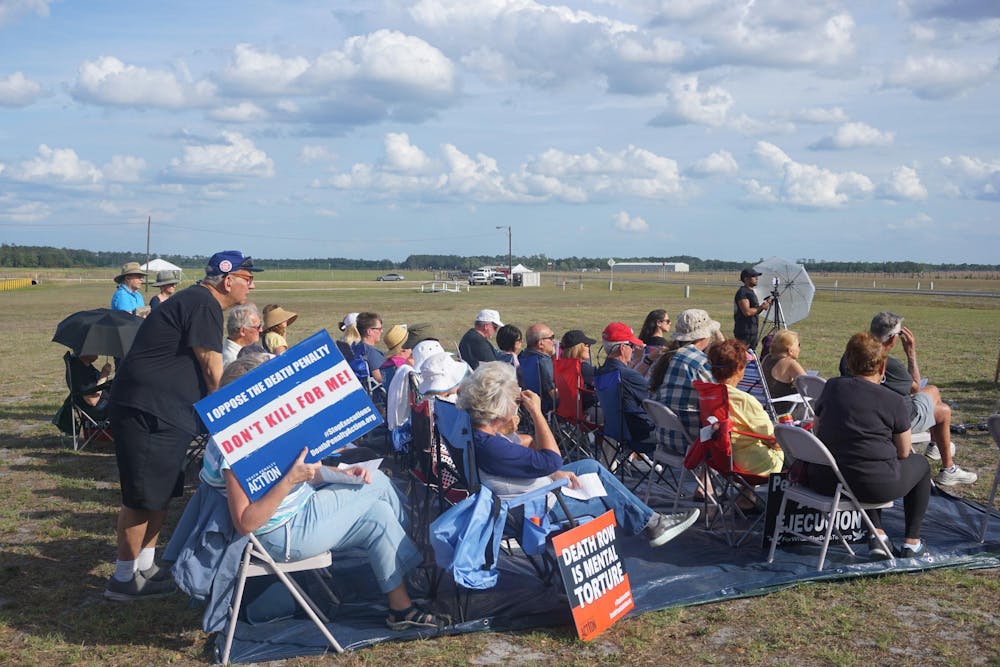
About 50 people gathered outside of Florida State Prison to protest Hitchcock’s execution Thursday.
To Grace Hanna, the executive director of Floridians for Alternatives to the Death Penalty, Hitchcock’s claims of innocence are hard to ignore.
“He’s maintained his innocence, and there are plenty of reasons to believe him,” she said. “Tonight, they are lifting him out of his wheelchair and strapping him to a gurney to kill him for a crime he did not commit.”
For over a year, Barbara Potts has made the over one-hour drive from St. Johns County to the state prison in Raiford to protest the executions. On Thursday, she came to pray for Hitchcock and everyone involved in his execution.
Executing Hitchcock despite his repeated claims of innocence concerns her, Potts said. But she’s opposed to the death penalty in all cases, regardless of whether someone is guilty.
“I don’t understand why we’re doing this,” she said. “It makes no sense. What gives us the right to murder, ever?”
Standing among the protesters was Miriam Welly Elliot, the coordinator of Gainesville Citizens for Alternatives to the Death Penalty. She’s come to the state prison to protest the death penalty since the 1980s.
“The death penalty is a hate crime,” she said. “It's all out of vengeance, and I don't think Jesus taught that.”
She said life in prison without parole keeps the public just as safe.
“Why would we take life away from them?” she said.
Contact Alexa Ryan at aryan@alligator.org. Follow her on X @AlexaRyan_.
Alexa is a second-year journalism and international studies student and The Alligator's Spring 2026 Enterprise Politics Reporter. She previously served as the Fall 2025 Criminal Justice Reporter. In her free time, she enjoys running, traveling and going on random side quests.


