

CORRECTION: This article has been updated to correct the spelling of Nick Ferrara’s name.
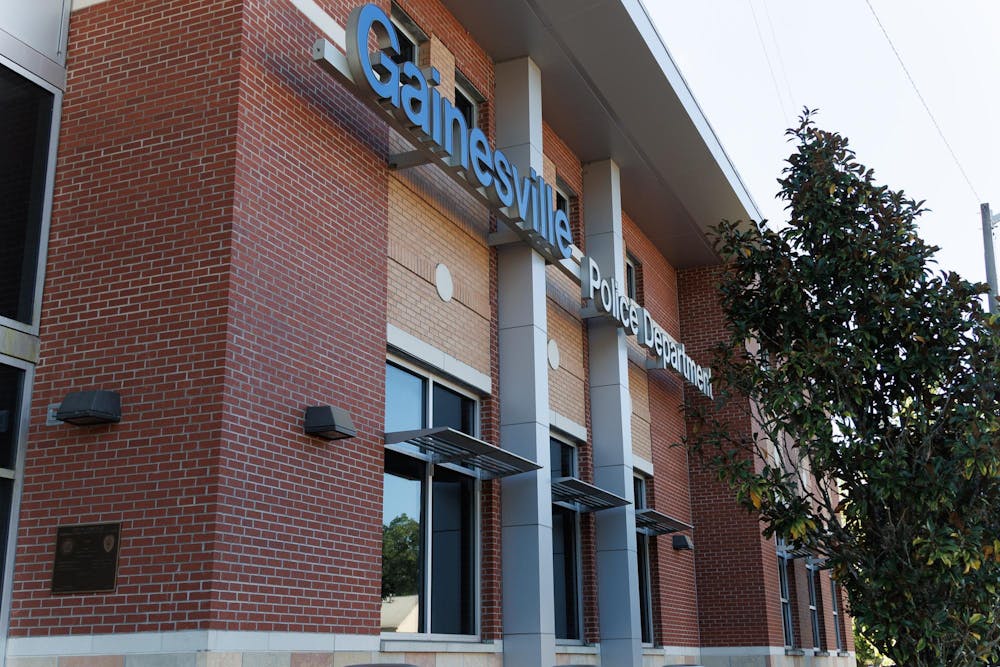
A Gainesville detective said he has entered photographs into facial recognition software more than 30,000 times.
The technology works by comparing a submitted image against large databases of publicly available photographs, including mugshots, driver’s license photos and images scraped from the internet. The software then returns a ranked list of possible matches based on facial similarity.
Of his more than 30,000 searches, Detective Sgt. Nick Ferrara, a nearly 30-year veteran of the Gainesville Police Department, estimates roughly a quarter generated investigative leads: potential matches used to guide investigations.
Those leads, Ferrara said, are only the beginning of an investigation. Detectives never treat facial recognition results as definitive identifications, he said, but instead weigh them alongside other evidence.
“The general public thinks that, as soon as we find a match, boom, we put a warrant out on somebody,” he said. “[That’s] not the case.”
To confirm investigative leads, Ferrara said police will further look into the identified person. They gather information, such as where the person lives and whether they’ve had past run-ins with law enforcement, to convince a jury it's the same person.
Across Florida, police agencies are increasingly relying on facial recognition technology as part of a broader shift toward data-driven policing, which has expanded over the past decade.
Within GPD, investigators use two systems — Faces Analysis Comparison & Examination System NXT and Clearview AI — to compare images against databases of publicly available images.
Faces Analysis Comparison & Examination System NXT, also called FACESNXT, is a state-distributed program. FACESNXT’s database is composed of driver’s license photos and mugshots.
Clearview AI, a private company, has a database of more than 300 million images. In addition to ID photos and mugshots, the database includes images scraped from Facebook, YouTube and other platforms.
At GPD, access to Clearview AI is restricted to roughly 25 user accounts, Ferrara said, with about 17 active users. Access is concentrated among a small number of detectives who conduct the majority of searches, he said.
Even though facial recognition technology has been credited in helping solve missing persons cases and criminal investigations like child sexual exploitation cases, its use remains controversial.
The technology has been linked to wrongful arrests and disputed identifications in cases nationwide.
Ferrara said GPD takes the use of facial recognition technology seriously.
“Nobody wants to lock up the wrong person,” he said. “It looks bad for their department and it looks bad for all law enforcement across the country.”
In Florida, the use of facial recognition technology has drawn attention in cases where the technology was not immediately disclosed in arrest records.
Max Tipping, a public interest attorney and policy director at Community Springs, an organization focused on ending cycles of poverty and mass incarceration, said this lack of transparency limits defendants’ ability to challenge evidence in court.
“The fundamental thing for any system of justice is you have to be able to challenge what it is you’re being accused of,” he said. “You can’t challenge something if you don’t know that it was even used against you.”
GPD doesn’t have a policy specifying when facial recognition technology use must be disclosed in reports. Instead, the decision is left up to officers’ discretion.
Stacy Scott, the lead public defense attorney at the Eighth Judicial Circuit Court, said her team has encountered several cases where facial recognition was reportedly used — mostly in theft cases.
“There's probably plenty of instances where they're using the technology, but they're not disclosing it,” she said. “They don't necessarily have to report on that unless they relied on it.”
In addition to debate over the lack of transparency, facial recognition technology has made some question whether its use is considered a search under the Fourth Amendment, which protects against unreasonable government searches and seizures.
Courts haven’t ruled on if and how the Fourth Amendment applies to facial recognition technology, but past surveillance-related rulings generally focus on whether the information collected could also be obtained through ordinary visual observation.
In Congress, there have been at least two legislative attempts in 2021 and 2023 to limit or ban law enforcement’s use of facial recognition technology, but neither bill was voted on.
Scott said facial recognition technology also raises concerns about racial bias.
Past studies claim facial recognition can produce biased results because it’s trained on data that doesn’t represent everyone equally, which can make it less accurate for people with darker skin tones and other marginalized groups.
Timnit Gebru, the founder of the Distributed AI Research Institute, a group that studies the intersection between technology and equity, helped lead the Gender Shades study. The study found significantly higher error rates for darker-skinned women compared to lighter-skinned men in commercial facial analysis tools.
Clearview has disputed the findings, arguing the study is a measure of how well the technology classifies images based on gender. This gender classification task differs from facial recognition.
However, DAIR research director Alex Hanna said both tasks are similar and relevant to each other's success.
There’s a tendency to overestimate what the technology is able to accomplish, she said.
“They think it's foolproof, they think it can do more than it can do,” Hanna said. “There's definitely a veneer of infallibility.”
GPD spokesperson Art Forgey said the department is open to updating its policies to be more transparent to the public, and it evaluates concerns of racial profiling and bias on a yearly basis.
While the department understands facial recognition technology is controversial, Forgey said it's a valuable investigative tool.
“Everybody has an opinion on it, and we just can't run from it,” he said.
Contact Julianna Bendeck at jbendeck@alligator.org.
Julianna Bendeck is a first-year journalism student and the Summer 2026 criminal justice reporter. She previously worked as a contributing writer and race and equity reporter at The Alligator. Outside the newsroom, she enjoys reading, surfing the web and playing video games.

