
The Florida Gators’ pedigree in the men’s 400-meter hurdles is unquestionably strong. Prior to the 2026 NCAA Championships, five of the 25 national titles in the event this century had been handed out to Gators, while no other program had earned more than three.
When Vance Nilsson arrived in Gainesville in the fall of 2024, it seemed destined that he would represent the next chapter in UF’s esteemed long hurdles history. In his senior season at Gilbert High School in Gilbert, Arizona, Nilsson essentially had a flawless resume.
Nilsson won state titles in 110- and 300-meter hurdles, setting a national high school record of 34.83 seconds in the latter. He won the 400-meter hurdles crown at the U.S. Junior (under-20) Championships and Nike Outdoor Nationals in the same weekend. He finished 11th overall in the U.S. Olympic Trials as an 18-year-old, running the fifth-fastest time in high school history at 49.77 seconds. Finally, in his last hurrah before fully entering the collegiate scene, Nilsson became the sixth American – and the third future Gator – to win the World Junior title in the 400-meter hurdles, with his 49.26-second winning performance coming in under the high school national record.
NCAA success, however, did not come in rapid succession during Nilsson’s freshman year as it had one spring earlier. He ran a full indoor season, placing 15th in the SEC in the 60-meter hurdles and racing on the Gators’ 4x400-meter relay team at the national championships, but he was limited to just two races at his signature distance outdoors. Nilsson qualified for the conference championship final, but was forced to pull out of that race and end his season early.
“I had a hip injury last year,” Nilsson said, “and then I kinda just took the summer off.”
The downtime from training helped Nilsson begin to trend in the right direction, but the same hip issue reappeared early in the season. He raced just twice indoors, only contesting the 4x400-meter relay and avoiding the hurdles altogether.
“That problem came back, and it was just very annoying,” Nilsson said. “I thought I got it taken care of, so I started doing physical therapy more and more.”
Nilsson opened his outdoor season at the Tom Jones Memorial Invitational on April 17. He got around Percy Beard Track in 50.79 seconds, marking a solid season opener and a qualifying time for the NCAA East Regionals. He improved that mark two weeks later at the East Relays, running 50.54.
While contesting those regular-season races, however, Nilsson had an ace up his sleeve that proved to be the difference maker during his postseason push.
“At the beginning of the season, I was using my left leg,” Nilsson said. “I still wanted to race, but I was using my left leg because my hip was bothering me… If I ran with my right leg, it was probably going to reaggravate the injury, and I was really close to feeling very good, so I just wanted to play it safe.”
Deferring back to his dominant lead leg was an immediate game changer, as Nilsson ran 50.24 in the SEC preliminary round, his best time in the NCAA. Nilsson took that improvement to the next level in the final two days later, earning a breakthrough bronze medal in a personal best time of 48.77.
The incredible potential that Nilsson brought to UF was finally unleashed, and the national postseason was set to be his proving ground.
The NCAA East Regional meet is all about surviving and advancing, as an athlete just needs to finish inside the top 12 to earn a spot at the NCAA Championships. Seeded second in the East, Nilsson easily punched his ticket to Eugene, Oregon, equalling his two-week-old personal best in the quarterfinals.
At nationals, Nilsson was positioned well to score, but in order to win, he’d have to beat a pair of far more experienced hurdlers: Texas A&M senior Ja’Qualon Scott and Texas senior Kody Blackwood. Scott and Blackwood entered their final NCAA meet with a combined three first-team All-America honors. They weren’t just the two fastest men in the country by nearly a half-second entering the championships, they were also the top two returners in the field, finishing second and third at last year’s meet.
Nilsson qualified for the final, running 49.39 in his semifinal heat, but that was only the seventh-fastest time, meaning he landed an unsavory lane draw in the final: nine, the farthest to the outside.
“When I got lane nine, I was like, ‘Oh, I don’t know if I like that,’” Nilsson said. “But then looking back to [World Juniors], I got lane two, and I won out of lane two, that makes me think I can win out of whatever lane I get… I knew I wouldn’t have anyone to key off of, so I kind of just had to run for my life.”
Running for his life is exactly what Nilsson did. He rocketed out of the blocks and stayed level with Scott for the lead, with Blackwood trailing just fractions of a second behind. On the seventh of 10 hurdles, Nilsson gained a slight advantage, which then grew to around .3 seconds by the time the trio cleared hurdle eight. As he led them onto the home straight, with the stagger now fully negated, Nilsson was clear of the field.
“The first 300 meters, I knew I was flying,” Nilsson said. “Everything felt like it was coming together. My coach told me you’ve got to come off the curve in first, and that was the plan.”
The penultimate hurdle brought the first true mistake of Nilsson’s race, as he had to stutter his stride and take an extra step prior to clearing it. That allowed Blackwood, who had passed Scott at that point, to make up some ground.
With one hurdle left to decide a national champion, Nilsson clipped the tenth barrier but managed to stay on his feet and charge towards the line. Blackwood wasn’t as fortunate, hitting the final hurdle and tumbling to the track. The last man with a chance to overtake the Gator was out of the race.
“I feel like hurdles nine and 10 are just guts,” Nilsson said. “There’s not really any thoughts going through your head, it’s kinda just fight or flight. It worked out well.”
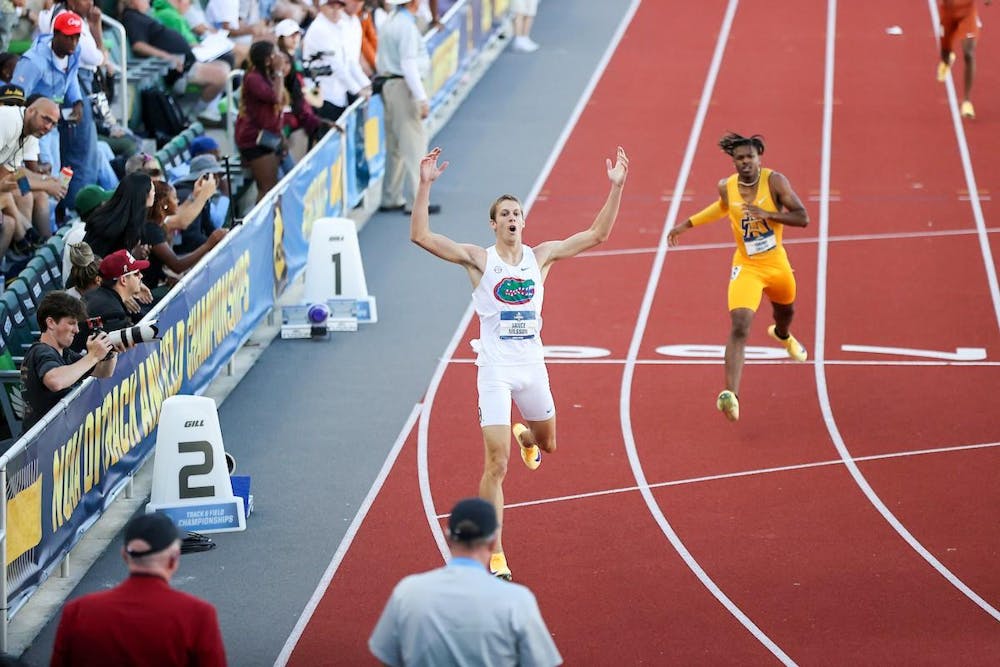
With Blackwood down, it was clear Nilsson was going to win, so attention shifted to the clock. As he crossed the line, Nilsson held his hands over his head, soaking in becoming not only a national champion, but the ninth-fastest man in collegiate history. His 48.06-second run took .71 off his previous lifetime best, slotting Nilsson into a new stratosphere of hurdling. It rocketed him from a tie for 254th in world history into a tie for 81st.
“I would say not much of it is a surprise,” Nilsson said of his transcendent postseason. “I think a lot of other people are shocked, but seeing what I can do in training really helps me see what I can do in competition.”
All this success came for Nilsson as just a sophomore in his first somewhat healthy NCAA season. He’s now set up incredibly well for his last few seasons as a Gator, but Nilsson already has grander destinations in mind.
“The big goal is 2028,” Nilsson said. “I want to make that Olympic team, and I want to win the Olympics. A lot of people may think that sounds unrealistic, but… I think I can do it.”
Contact Paul Hof-Mahoney at phof-mahoney@alligator.org. Follow him on X at @phofmahoney.
Paul is a senior in his fourth semester on the track and field/cross country beat for The Alligator. In his free time, you can increasingly see him jogging around Gainesville or endlessly falling deeper down the rabbit hole that is track Twitter.