

Florida carried out a rare double execution Tuesday, putting two men to death — just under six hours apart — for the first time in 62 years as the state continued its historic pace of executions under Gov. Ron DeSantis.
James Duckett, a former Mascotte police officer, was executed for the 1987 murder of 11-year-old Teresa McAbee.
Duckett was executed at 1:19 p.m. He did not give a final statement.
Dominick Occhicone was executed for the 1986 murder of 62-year-old Martha Artzner. He had also received a life sentence for the murder of her husband, 66-year-old Raymond Artzner.
Occhicone was executed at 6:13 p.m. He apologized to his family and the victims’ family.
“I know it don’t mean much, but I’m sorry,” he said. “I never meant to do what I did.”
The executions marked the 39th and 40th carried out under DeSantis and the 11th and 12th in Florida this year.
Duckett’s crime
During the early hours of May 12, 1987, McAbee’s body was found floating in a lake near south Mascotte, Florida. She had been sexually assaulted, and a pubic hair similar to Duckett’s was recovered, according to a state witness.
McAbee’s mother had reported her missing shortly before midnight.
Duckett was the only officer on duty that night and the following morning. McAbee’s fingerprints and palm prints were found on his patrol car. Duckett testified he spoke with McAbee at a Circle K near where her body was discovered but said he never saw her again after telling her to go home.
Witnesses at the Circle K gave contradictory statements. A passerby claimed to have observed a “small person” inside Duckett’s patrol car. Meanwhile, a Circle K store clerk said she hadn’t seen anyone but Duckett in the car.
Tire impressions where her body was discovered were similar to that of Duckett’s patrol vehicle. Court documents remarked they were unusual for that area. Only eight tires of that tread design were known to have been sold nearby. They had been recently installed on two Mascotte patrol cars.
Prosecutors argued Duckett raped, strangled and drowned McAbee, and a jury convicted him of the crime. It also found the crime to be especially “heinous, atrocious, or cruel.”
McAbee’s mother, Dorothy Tula, spoke at a press conference after the execution.
“I’ve been waiting 40 years to have him dead,” she said.
Shirley Lancaster, McAbee’s aunt, also spoke.
“Maybe she would’ve been a doctor,” she said. “Maybe she would’ve been the next president. We never got the chance to find that out because this bastard took her away from us.”
Duckett’s punishment
Duckett, who has maintained his innocence, was recommended the death penalty in an 8-4 vote. DeSantis first signed his death warrant in February, but the execution was stayed until further DNA testing was done. The test was inconclusive and resulted in the genetic information being destroyed.
Duckett filed a lawsuit challenging how the state handled the DNA testing he alleged could have exonerated him. He also filed another lawsuit arguing the execution method, lethal injection, is cruel and unusual because chemotherapy for cancer has left him with severely compromised veins.
Duckett's appeals before the Florida Supreme Court were denied Tuesday.
Occhicone’s crime
Occhicone was indicted by a Pasco County grand jury on two counts of first-degree murder for the June 10, 1986, shootings of the Artzners.
He had been drinking at a bar in Elfers, Florida, and left at 2:30 a.m. in hopes of convincing his ex-girlfriend, Anita Gerrety — the Artzners’ daughter— to get back together. Occhicone failed and came back later, pounding on their windows.
The police couldn’t be called because Occhicone pulled the wires of the phone box, leading to a verbal confrontation in the garage between him, Gerrety and her father.
Occhicone shot Gerrety’s father in the chest, and he later died at a hospital. Gerrety and her daughter fled, but her mother, Martha, stayed behind. Officials later found her dead as a result of four bullet wounds, three of which were in her chest.
The owner of a bar Occhicone frequented testified he previously said, "Maybe I should just blow them away,” in reference to Gerrety’s parents. Several witnesses said Occhicone was known to drink extensively
A statement on behalf of the Artzners’ family was read at a press conference following Occhicone’s execution.
“The only history that matters here today is the history we lost with our parents, and the events of today do not give us back that lost time together,” the statement read.
Occhicone’s punishments
Occhicone’s death sentence was imposed following a 7-5 jury recommendation. By today’s standards eight out of 12 jurors must agree to impose a death sentence.
Alongside Alabama, Florida is the only other state that does not require a unanimous jury recommendation for the death penalty.
Occhicone filed a joint lawsuit with Duckett arguing a double execution violated their First, Fifth, Eighth and 14th Amendment rights. The lawsuit claimed scheduling their executions on the same day could interfere with due process by limiting their access to the courts during potential last-minute appeals.
Occhicone's appeals before the Florida Supreme Court were denied a week before his execution.
Day of the execution
Tuesday was a long day for death penalty supporter Bill Campbell, who spent the better part of the day outside Florida State Prison playing music from Bluetooth speakers, sometimes at over 100 decibels.
He attended both Duckett’s and Occhicone’s executions. In the time between, he grabbed lunch and spent time at a nearby park before returning to the prison, he said.
“All I can do is make noise,” Campbell said while ringing a cowbell, wearing ear plugs. “They [anti-death penalty protesters] don’t like what I’m doing. I don’t like what they’re doing, but it costs them 50 people to do what I’m doing.”
Campbell has become a familiar presence outside Florida State Prison during executions. While he is often the only counterprotester, Tuesday night’s executions also brought 67-year-old Debbie Taylor, who arrived armed with a microphone from Five Below in support of capital punishment.
Taylor, who was born and raised in Bradford County, said she was surprised by the low turnout of death penalty supporters Tuesday night. She remembered earlier executions when supporters were numerous enough to line the road outside the prison.
“After 10 years, put them on the table and strap them in,” Taylor said. “We’ve been feeding, housing these people for all this time, and it's bullshit.”
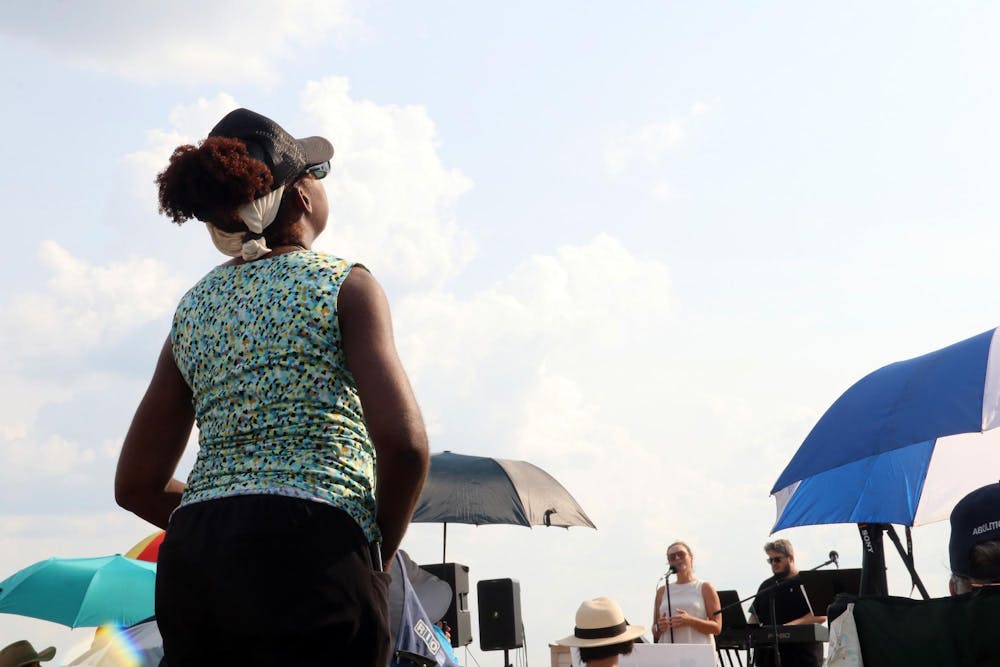
In opposition of the death penalty, roughly 50 people protested outside the prison. The group was largely made up of members of Floridians for Alternatives to the Death Penalty and parishioners from Our Lady of Lourdes Catholic Church.
Unlike some longtime demonstrators outside Florida State Prison, Lenae Ryan had only attended one execution protest before Tuesday. The 28-year-old Gainesville resident said she came with her mother, who has attended nearly every protest since 2025.
Ryan said she wanted to do more than simply support the anti-death penalty movement from a distance. Her opposition to the death penalty comes from both personal beliefs and concerns about its effectiveness as a criminal justice tool, she said.
“It’s just not my belief system to punish people for things they’ve done wrong by taking their life,” Ryan said. “I don’t think the state should have that right.”
Godfrey D’Souza, a 33-year-old aviation professor at Embry-Riddle Aeronautical University, said his views on the death penalty have changed over time. He began attending execution vigils roughly two years ago through his church after previously remaining uninvolved in the debate.
D’Souza said he believes people convicted of serious crimes should face consequences, but execution should not be one of them. He said he believes people can change while incarcerated and should have opportunities to give back to society.
“They have a lot of time to realize what they’ve done, and they’re always willing to change and give back,” he said. “I think there is always change in humans.”
Contact Julianna Bendeck at jbendeck@alligator.org.
Julianna Bendeck is a first-year journalism student and the Summer 2026 criminal justice reporter. She previously worked as a contributing writer and race and equity reporter at The Alligator. Outside the newsroom, she enjoys reading, surfing the web and playing video games.


