
Like most of Gen Z, I was first introduced to Greek mythology through Rick Riordan. My “Percy Jackson” fascination encouraged me to read stories about the Greeks and Trojans in the fantasy series and led me to discover Odysseus in high school.
As I grew older, I read modernist interpretations of minor mythological figures in the books of Madeline Miller, a classics professor-turned-author who wrote “The Song of Achilles” and “Circe.”
That said, I have been waiting in anticipation for “The Odyssey” since the movie adaptation was announced late 2024. It's been 20 years, one could say.
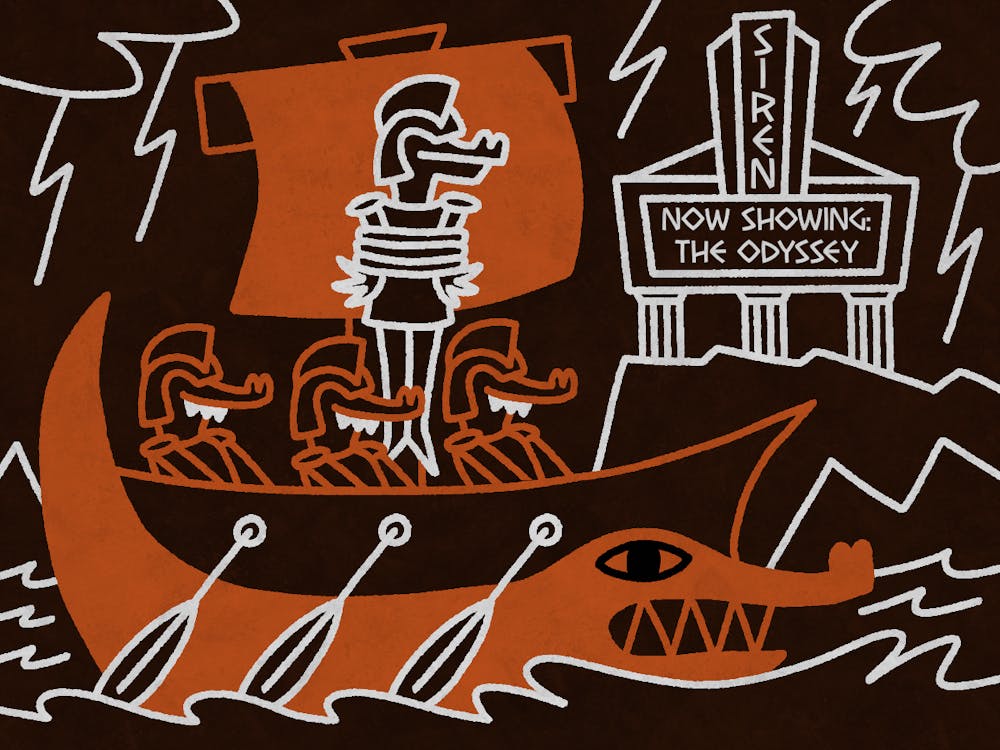
Three years after filmmaker Christopher Nolan won seven Oscars and five Golden Globes — among other awards — for “Oppenheimer,” his version of the over 2,700-year-old Homer epic was released July 17 with a star-studded cast.
From 60 English translations of “The Odyssey,” Nolan credits Emily Wilson’s version as the main source for his screenplay.
The movie starring Matt Damon follows Odysseus, the king of Ithaca and a general in the Trojan War, as he voyages home after 10 years in Troy following the Greeks' victory. Remember the Trojan Horse from your high school English class? That was Odysseus’s plan.
The movie follows the mid-summer successes of Backrooms and Obsession.
I, for one, admire Nolan’s commitment to traditional filmmaking. For instance, the dedicated crew zigzagged 45 minutes uphill to the shooting site: an authentic approach to filmmaking in an industry where artificial intelligence is on the rise.
The three-hour-long epic is intimidating. In the beginning, it’s also confusing, especially without knowledge of the source material, Greek mythology and which actor is which character.
While some actors felt unnecessary in a cast crowded with big names, others proved their talent and reputation fit their character. For example, Anne Hathaway, known for her roles as witty leads, fits perfectly as the queen of Ithaca and Odysseus’s wife, Penelope.
Some scenes are repulsively violent and different from what I expected from Nolan, but neither Greek mythology nor history is pretty. According to Variety, “The Odyssey” ranks among the most expensive R-rated movies with its $250 million budget.
The movie’s commitment to accuracy was one of my favorite parts. It also does an interesting job of shoehorning this story into history by mentioning aspects like the Sea Peoples and the Bronze Age.
However, Nolan missed opportunities to showcase Odysseus’s wit and creativity outside of action sequences. I wish there had been a scene where the lead gathered his men to share his plan and explain his reasoning.
Instead, the film never emphasized the protagonist’s cunning, a key part of his historical character.
I missed some stories from the original epic poem, where we could have seen Hades through the eyes of Damon’s Odysseus. Some sequences — longer in the book — were cut short or not fully developed, and some mechanics of the original blended together.
But for a movie to fully encapsulate this epic work of 12,109 lines and well over 100,000 words without boring audiences is a challenge. This incentivizes writers to cut parts, hopefully encouraging people to read the full story.
There is also the use of modern language, which sometimes took me out of the movie, but I understand it’s meant to make the movie more accessible to those unfamiliar with “The Odyssey.”
In the end, the cuts and changes are OK because you can tell Nolan really cares about the source material.
For instance, Elliot Page’s character Sinon, who isn’t in the original text but in Virgil’s “Aeneid,” plays a major role in the Greeks' victory over the Trojans, showing the extensive research that went into making the movie.
And the film does an excellent job of fully immersing the audience through its sound and practical effects, for which new lighting techniques were developed to replicate the glow of fire.
The movie rendition creates its own retelling of “The Odyssey.”
It is refreshing to see a Hollywood director in 2026 use traditional literary devices underused in modern storytelling.
It also allows Nolan to experiment with the narrative. What is confusing in the beginning becomes coherent at the end. Only then is the full understanding of Odysseus’s range of emotions — from grief to anger — made clear to viewers.
Nolan takes this opportunity to assume the role of a poet as he recounts his tale of the millennia-old epic. He perfectly balances art and prestige with a blockbuster, making a film viewers will truly miss out on if they don't see it in theaters.
Having read “The Odyssey,” I greatly appreciated this film and the lengths the cast and crew went to in bringing this story to life. Following a screening, I hope viewers are inspired to read the text.
Contact Alanna Robbert at arobbert@alligator.org. Follow her on X @alannafitzr.

Alanna Robbert is a fourth-year journalism major and the Summer 2026 Senior News Director and Web Designer. She has served as a Metro General Assignment Reporter and an Enterprise Data Reporter. In her free time, she can be found in the gym or at trivia.