

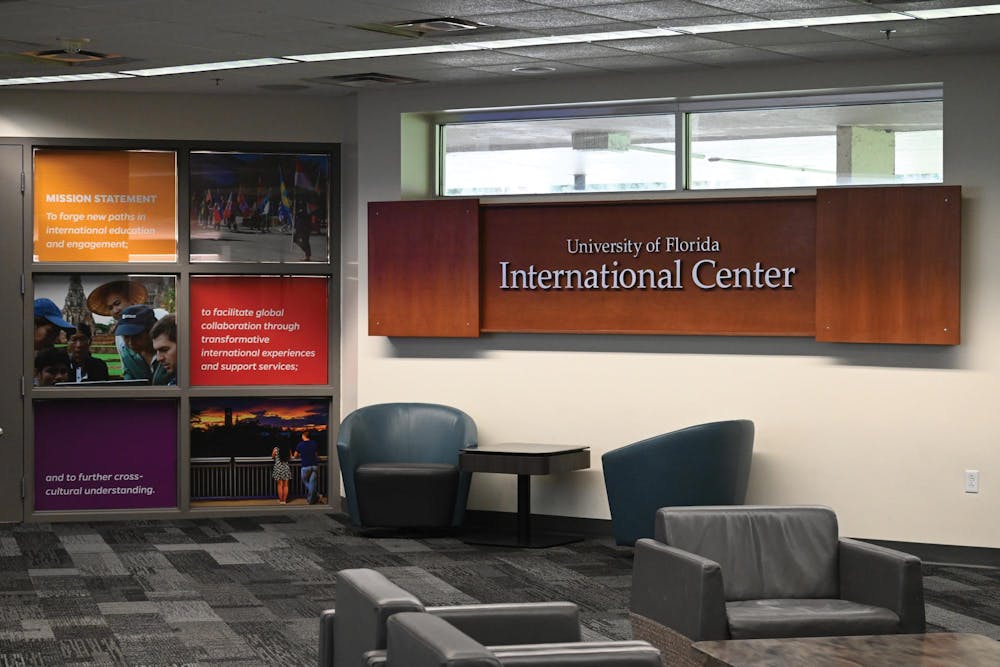
Before Zeinab Tabag could learn her way around UF, she had to learn her way around an American grocery store.
Originally from Sudan, the 22-year-old electrical engineering junior had never been to the United States. She left behind her family, friends and everything familiar from her high school in Tanzania to start over in a new country. Buying groceries — something never too difficult at home — suddenly meant carefully reading every ingredient label because of her dietary restrictions.
For many international students, adjusting to life on campus extends far beyond the classroom. Students must learn how American universities work, how to build friendships from scratch, how to find career opportunities and how to navigate the new resources available to them.
“It was a big decision,” Tabag said. “I took it as an opportunity to be here for four years, finish a degree and be able to see a new part of the world that I might not have the opportunity to see later.”
UF international students compose a small share of the undergraduate population. Nearly 9,000 international students applied to UF last academic year — 930 were admitted, but only 155 accepted their offer.
For Tabag, one of the biggest surprises was how differently American universities operate.
At UF and other schools in the U.S., students choose their own class schedules instead of progressing through a fixed curriculum with the same classmates. The structure made it harder for Tabag to make friends within her major, she said.
Joining student organizations with other international students helped her build community during her first semester, she said.
Minh Pham, a 19-year-old biomedical engineering sophomore, said he had a similar experience after leaving Vietnam to study at UF.
Unlike many domestic students who arrived with friends from high school or nearby hometowns, Pham had to start his social life from scratch.
“You can make good friends,” Pham said, “but I just feel like there’s a disconnection.”
Building relationships took time, he said, especially when so many students carried over established friend groups from high school. However, he said joining student organizations helped him find a sense of community.
Career-building felt like another challenge that set in more quickly for international students than it did for their American peers, Pham said.
Many American students entered university with past job experience, knowledge of the U.S. job market, connections in their field and known research opportunities.
“For most students, they wouldn’t be looking for work in their very first year at university,” Pham said. “But I think that’s something, especially for international students, we need to get ahead on, because we don’t have all these advantages.”
Other international students say language and cultural differences added extra challenges to their adjustment.
For Woojung Son, pursuing his master’s in agricultural and biological engineering at UF also meant navigating language barriers and adjusting to daily life.
The 27-year-old Korean graduate student anticipated graduate school to be academically challenging, but he found one of the biggest cultural differences to be safety, he said.
“There’s no guns in Korea — it’s totally safe,” Son said. “But here, some people have guns.”
His concerns became more personal when his bike was stolen in Gainesville, adding firsthand experience to the safety differences he noticed between the U.S. and Korea.
Son also found speaking English every day more difficult than learning it in the classroom. Academically, the language is much more structured than in conversational use, making it difficult to understand slang terms, he said.
He found UF’s Korean Language Table, an organization where members explore Korean holidays and customs and practice speaking the language together. It helped him meet more people and feel more connected to campus, he said.
To Khayalethu Mlotshwa, a 23-year-old junior architecture student from Estwatini, one of the biggest surprises was how much American social life revolved around technology.
“I came here with no social media,” Mlotshwa said. “I did not think I would need a phone as much as I did.”
Back home, exchanging numbers and meeting up in person was enough to stay connected, he said. At UF, classmates often asked for a Snapchat or Instagram username instead.
Despite the adjustment, Mlostshwa quickly found community through his architecture classes.
“You trauma bond with people,” he said with a laugh. “You are in this studio for three hours … and after that, you stay there still because the homeworks are very long.”
The U.S. welcomed nearly 1.2 million international students during the 2024-2025 academic year, according to the Institute of International Education’s Open Doors report. In that year, international students contributed an estimated $42.9 billion to the U.S. economy and supported more than 355,000 jobs through tuition and living expenses, according to NAFSA.
By the time Eduardo Del Cistia Machado graduated, he had written himself a list.
The Brazilian-Italian alumnus graduated from UF in May with a degree in business information systems. Reading off a list of advice he wrote to himself in his first year, Machado recounted experiences related to community, academia and extracurriculars.
As a freshman, Machado didn’t know a single person in the U.S. The sheer number of student organizations, while beneficial for some, felt overwhelming to him, he said, because his high school offered no extracurricular opportunities. Machado procrastinated getting involved by telling himself he would figure it out later, he said.
When he eventually joined Delta Sigma Pi, a professional business fraternity, he said he found the community he had been searching for.
Machado said he wishes someone had explained how important GPA could be for internships, scholarships and student organizations. Coming from a Brazilian school system that emphasized passing courses rather than maintaining grade point averages, he didn't realize how much those numbers could shape future opportunities.
“I didn’t know GPA was a thing or that it mattered,” Machado said.
But one of his biggest points of advice, he said, is to spend less time ticking off degree requirements and more time saying “yes.”
He passed on fun classes, didn’t go to free campus events and kept putting off experiences he said he took for granted.
By his final two weeks at UF, he found himself visiting some parts of campus — like the bat houses — for the first time.
“I wish I explored more,” he said. “You’re always putting it off, [saying] ‘I’m gonna do it later,’ and suddenly you’re graduating, and you never did it.”
Contact Swasthi Maharaj at smaharaj@alligator.org.
Contact Hailey Kon at hkon@alligator.org.
Swasthi Maharaj is a political science and politics, philosophy, economics and law (PPEL) junior at UF. This is Swasthi's fourth semester at The Alligator, and her third semester on the university desk. She's also reported on the enterprise desk. Swasthi loves coffee, reading, going to concerts, baking and taking long walks.

Hailey Kon is a senior public relations and psychology double major serving as this fall's city and county commission reporter. This is her second semester on staff at The Alligator, having previously worked as The Alligator's student government reporter and a contributing writer for The Gainesville Sun. When she's not on campus, she can be found in the Dutch Bros drive-thru or a Ticketmaster queue trying to buy concert tickets.


