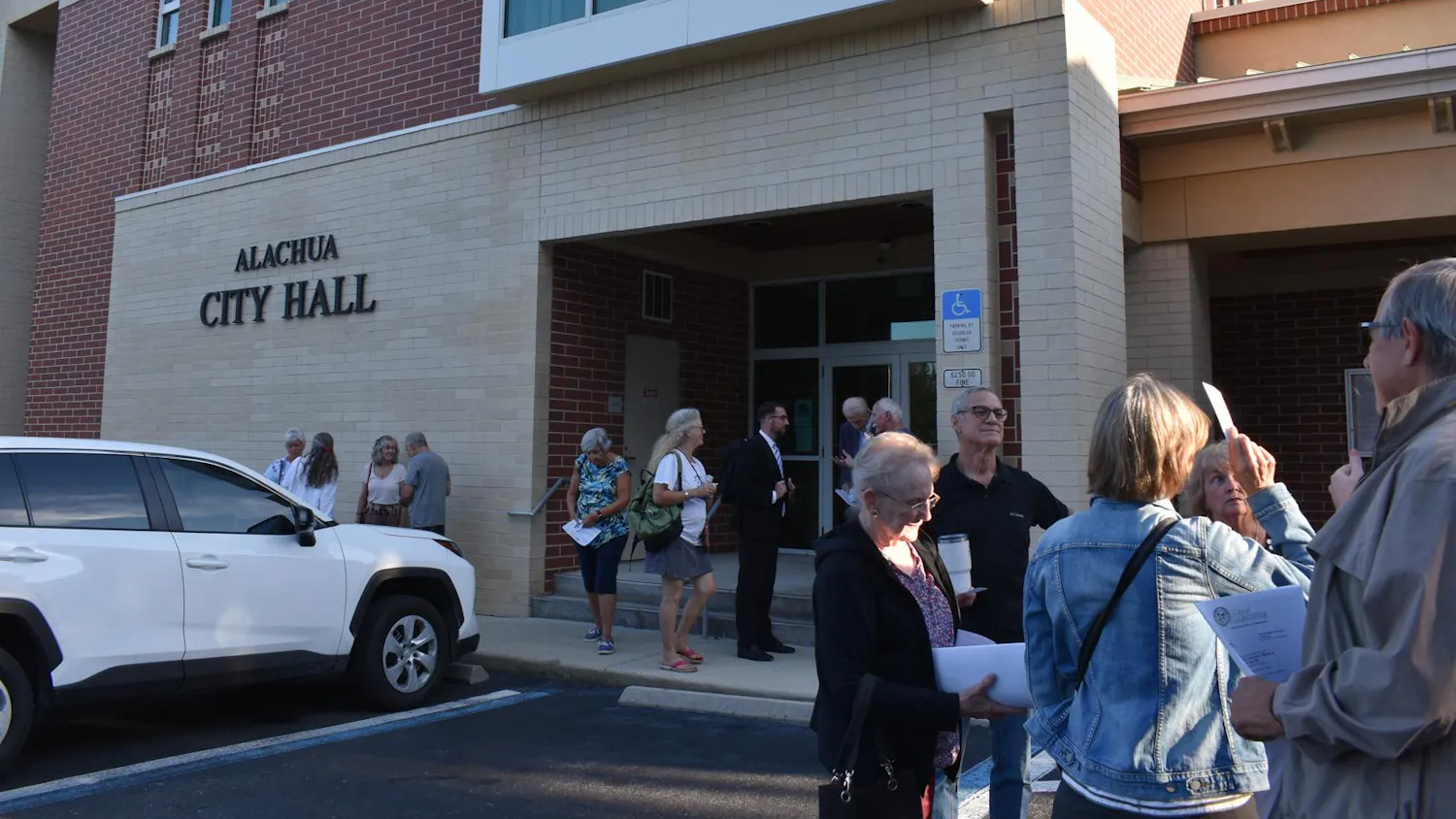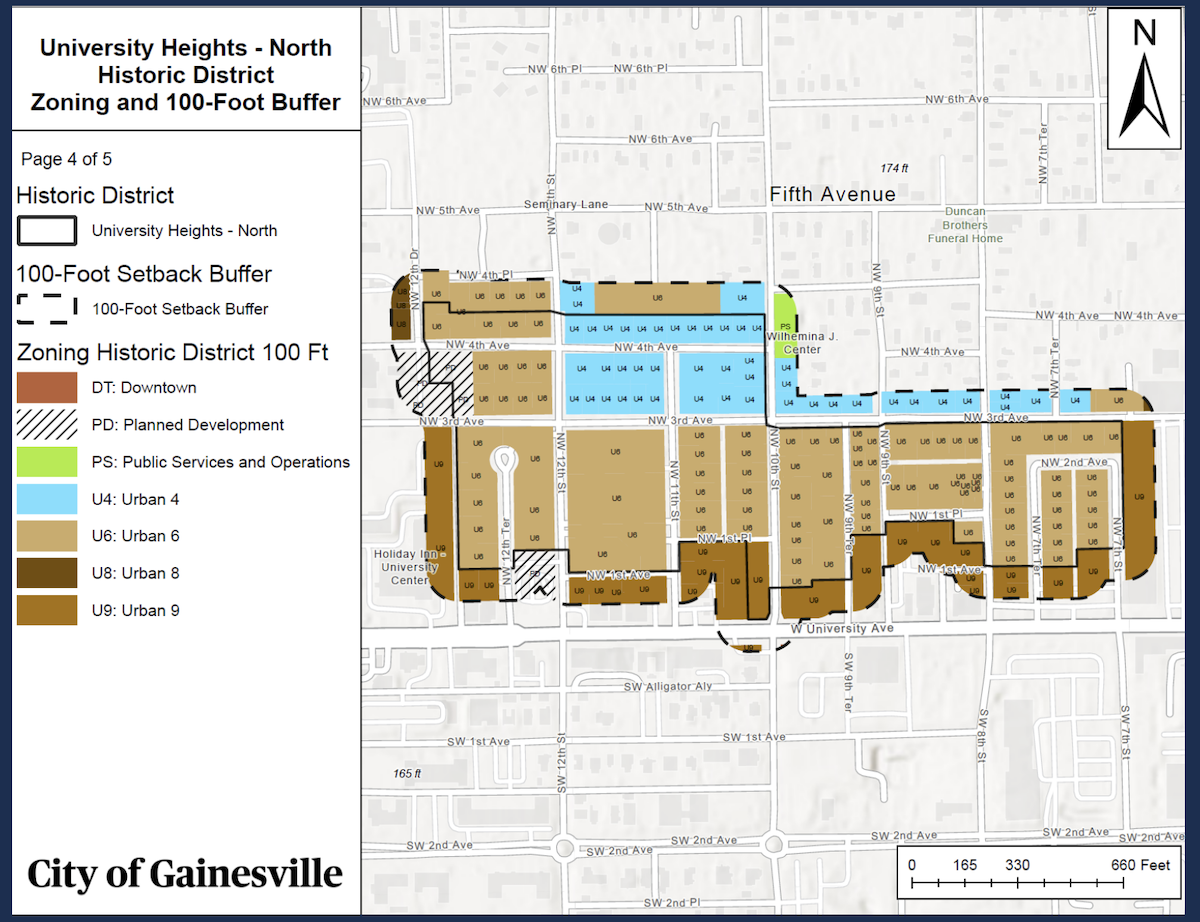

The Gainesville City Commission passed a motion to eliminate 100-foot buffers around the University Heights Historic Districts North, which stretches north of University Avenue from Northwest Sixth Street to 13th Street, and South, which is located near Normal Hall, during an Aug. 27 meeting.
In a 5-1 vote, commissioners proposed city staff draft an amendment to the land development code to remove the two University Heights Historic Districts from buffer requirements. The text is set to be reviewed by the Historic Preservation Board and City Plan Board, and a draft will be returned to the city commission by January 2027.
Commissioner Bryan Eastman introduced the move on August 27th, to open the area up for redevelopment. The buffers, adopted in 2017, currently cap buildings at three or four stories even though their zoning would normally allow up to eight with bonuses, which are extra stories a developer can earn by meeting conditions including affordable housing and other public benefits.
The buffers were meant to prevent sudden tall development from pushing into the historic neighborhoods. But Mayor Harvey Ward said those districts probably don’t want a smoke shop any more than they want a six‑ or eight‑story building.
“So, I think we may need to make some hard decisions here,” Ward said at the Aug. 27 meeting. “Please don’t misunderstand; I think the historic district deserves to be the historic district. I just have issues with the buffer.”
Ryan Barnett is the vice president of Gator Beverage, a liquor store located in the buffer zone of the northern University Heights Historic District. He welcomes turnover as something any business owner faces, he said, but regardless of new zoning rules, Gator Beverage is not planning on going anywhere.
“When it comes to how it would affect Gator Beverage, that I can tell you, we’ll still be here,” Barnett said. “I'm always open to change, and change is a normal part of business.”
According to Barnett, the 37-year-old family business is one of the longest-standing buildings? in the impacted corridor. While removing the buffers would allow Gator Beverage to redevelop and expand, Barnett said the owners don’t plan to make any changes.
“There would be no need for us to redevelop because we have a thriving business that we’ve put sweat and hard work into for a very long time,” Barnett said. “This redevelopment or rezoning doesn't motivate us to proceed with our daily business any differently.”
Ward said the buffers have caused an inability for the area to attract projects like apartment complexes, which lie directly across the street.
“When you're trying to do long-term city planning, you don't want to end up with an entirely different look and use on one side of the street than the other,” he said.
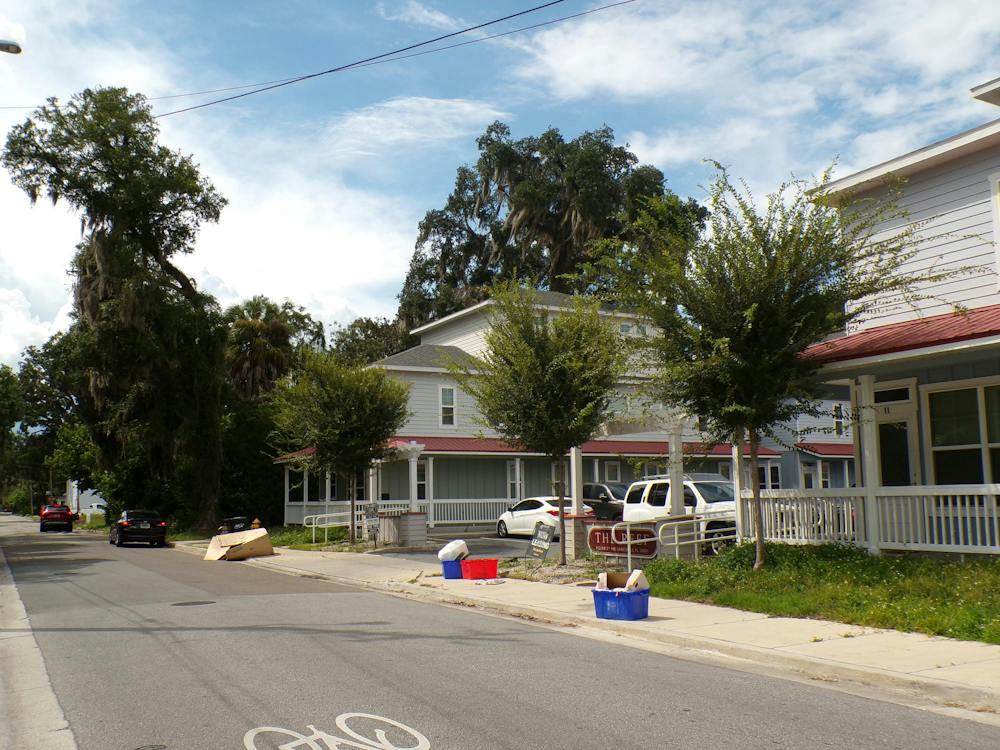
Across University Avenue from the University Heights Historic District North sit the 10-story Sweetwater Gainesville Apartments building and other developments. Meanwhile, the other side remains mostly small one‑ or two‑story shops, Ward added, with no real redevelopment happening.
He said the city is committed to protecting true historic buildings, but many older structures people may feel attached to aren’t actually historic.
“Most of what you see on University Avenue that's been protected by the buffers, it's not historic, so it's just there, and we get attached to things often,” Ward said. “That doesn't make it historic.”
New development would allow for more student housing, retail and restaurant properties, much like on the south side of University Avenue, Ward said.
He said he has no interest in changing historic buffers in other historic districts.
Commissioner Bryan Eastman said the buffers have cost the city hundreds of potential housing units, and, because of inclusionary zoning, hundreds of affordable homes.
“I’m tired of analyzing this stuff all the time,” Eastman said at the Aug. 27 meeting. “Let’s just eliminate the historic buffers in University Heights, North and South.”
Eastman said the area around the university is the center of the city, and people want to live there. Instead of pushing farther west, he said, the city should grow around the university.
Thomas Hawkins, a UF Levin College of Law senior lecturer and director of the UF Environmental and Community Development Clinic, said historic district rules usually override regular zoning, which further limits what development can happen in those areas.
If the restrictions were removed, he said, new developments built next to the historical districts could make it hard for the area to preserve its historic character.
“How can you do this without destroying the viability of the historic district?” Hawkins said. “If it's done deliberately and thoughtfully, there's probably room in here for improved policy.”
Nearly all properties on the north side of University Avenue fall under U9 zoning, which allows six- to eight-story buildings with bonuses.
But he said removing the buffers wouldn’t impact enough properties to fulfill the city’s goal of increasing housing.
“I don't think it's a good argument,” Hawkins said. “It's gonna lead to such a small increase in the amount of housing that could be built in a very small area.”
Any increases would be too minimal to address larger housing issues, he added. He questioned whether height limitations matter when expanding affordability and if higher density creates a better environment.
“Is it gonna make it less expensive? Almost certainly not,” he said. “And is it necessary to provide more [student] housing? Certainly not.”
During public comment, former Commissioner Adrian Hayes-Santos, who served when the buffers were implemented, said he was in favor of the motion. He noted that redevelopment north of University Avenue could also bring significant tax revenue to the city.
According to the Alachua County Tax Collector website, the 10-story Sweetwater building just south of the buffer paid about $405,000 in taxes to the city in 2025.
Christian Haas contributed to this article.
Contact Sara Dhorasoo at sdhorasoo@alligator.org. Follow her on X @saradhrs.

Sara is a journalism senior at UF. She is currently serving as The Alligator's race and equity reporter, and previously served as the first amendment reporter, in Spring 2026. Before transferring to UF, Sara earned her Associate of Arts in Mass Communications/Journalism from Miami Dade College, where she served as staff writer for The Reporter. She grew up in France and aspires to return there and work as a journalist after graduating.