
The state of Florida executed 77-year-old Curtis Wilkie Beasley Sr. at 6:12 p.m. Tuesday by lethal injection. He was convicted of the 1995 murder of Carolyn Monfort.
His last words included, “I am sorry for all the mistakes I made,” according to witnesses of the execution. The rest of the audio was unintelligible, the witnesses added, and they reported Beasley sobbed until the injection set in.
Beasley’s execution is the 16th in Florida this year, the 44th carried out under Gov. Ron DeSantis and the third execution this month. Florida has now executed 141 individuals since the death penalty was reinstated in 1976.
The crime
On Aug. 21, 1995, 46-year-old Beasley beat 62-year-old Monfort to death in her home in Dundee.
Beasley knew Monfort through her daughter’s then-husband, who was friends with him in high school. At the time of the murder, Beasley was temporarily staying at Monfort’s home and doing maintenance work for the apartment complex she managed, according to court documents.
On the day of the murder, Monfort’s daughter, Jane O’Toole, drove to her mother’s house to help move furniture. O’Toole asked Beasley, who was around the house, for help.
While they were moving furniture, Beasley asked O’Toole what he could give Monfort to show his appreciation for housing him. He also asked O’Toole to pay him for the work he previously did for her husband, and she told him he would be paid later, according to court documents.
Later that day, Beasley used a claw hammer to beat Monfort to death.
It is unknown what happened between O’Toole leaving that day and the murder.
She had roughly 16 wounds across her face and head, according to the autopsy report. The medical examiner determined she’d died from blunt force trauma to the head. Monfort also had injuries on the back of her hands, showing signs of self defense.
O’Toole found Monfort in her home three days later.
Following the murder, Beasley stole her car and $800.
He first fled 15 minutes north to Haines City to visit someone he owed money to, whom he paid with one of the $100 bills stolen from Monfort.
He left Monfort’s car 2.5 miles from an Orlando bus station and went to Miami by bus. Later, he traveled to Ozark, Alabama, where he changed his name to William Benson, grew a beard and started working at Herndon Electric.
Polk County sheriffs found him in a motel room a month later and brought him back to Florida.
The punishment
In 1998, Beasley was convicted of first-degree murder, robbery and grand theft auto. He was sentenced to death by a 10-2 jury vote.
His attorneys asked the Supreme Court of Florida to cancel his death sentence Sept. 4. They said it would be cruel and unusual punishment because of his decline in health and inability to walk more than a short distance without a wheelchair.
Beasley’s lawyers also said the 35-day period between his death warrant being signed and his execution date wasn’t enough time to investigate his health and revisit gaps in evidence.
They also added the death sentence hadn’t been approved unanimously. The U.S. Supreme Court found nonunanimous sentencing to be unconstitutional in 2016, but the Florida Supreme Court only applied the decision to those sentenced after 2002.
The court denied all of his attorneys’ appeals. Beasley has maintained his innocence throughout his sentencing.
The day of the execution
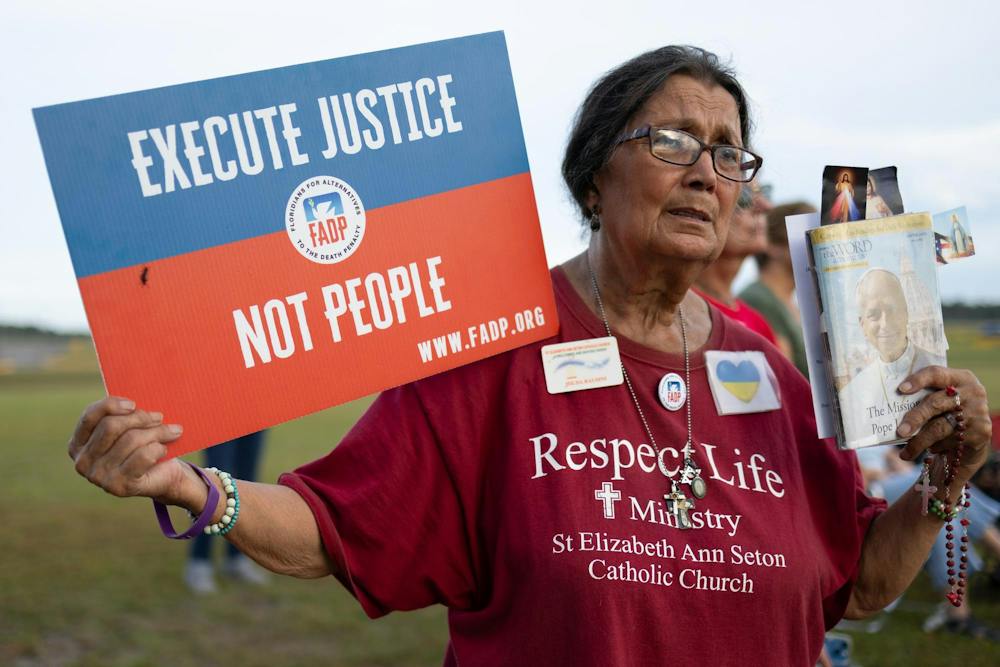
Participants of Our Lady of Lourdes Catholic Church traveled from Daytona Beach to protest outside of the Florida State Prison in Raiford. Floridians for Alternatives to the Death Penalty and Florida residents accompanied them.
The churchgoers drive to North Central Florida every execution to protest. They bring lawn chairs, speakers and a microphone to pray and sing in the hour leading up to the execution.
Sixty-year-old Susann Engel from Nativity Catholic Church in Longwood traveled with Our Lady of Lourdes to attend her first execution protest outside the prison. She said attending executions is sad, but has hope the executions will stop.
“An alternative to this is restorative justice and to find peace in the soul,” she said. “And life in prison without parole, maybe.”
The Rev. Floyd Narcisse, the senior pastor for Bethel AME Church in Deland, led the protesters in a prayer and speech.
“Enough is enough; 16 people is enough,” Narcisse shouted to the group. “Governor DeSantis, enough is enough. We are coming after you.”
Elijah Hutchins, a 17-year-old student at Father Lopez Catholic High School in Daytona Beach, attended the protest with six of his classmates on a voluntary school trip. Being at the prison during the execution felt emotional, he added.
“I just think it’s interesting how people honestly come out here and take the time to do this because it is really important,” he said.
He said he visited the prison to learn people’s perspectives about death row because he wasn’t too familiar with it.
Grace Hanna, the director of Floridians for Alternatives to the Death Penalty, made a speech during the protest. She said the state is trying to desensitize people to state violence.
“This nonstop stream is meant to make us stop fearing,” she said. “So, when I see students, I see people I’ve never met before, that is so encouraging to me because people don’t realize that it’s happening.”
Five minutes before the execution, the church brought a bell that protesters took turns ringing with a hammer. Then everyone held a moment of silence.
No supporters of the death penalty attended the protest. None of the victim’s family members were in attendance.
Contact Teia Williams at twilliams@alligator.org. Follow her on X @teia_williams.
Teia Williams is a journalism senior at UF and the Fall 2026 criminal justice reporter. This is her fourth semester with The Alligator. If she isn't writing an article, you can find her a concert, reading a book or somewhere soaking up the sun.