

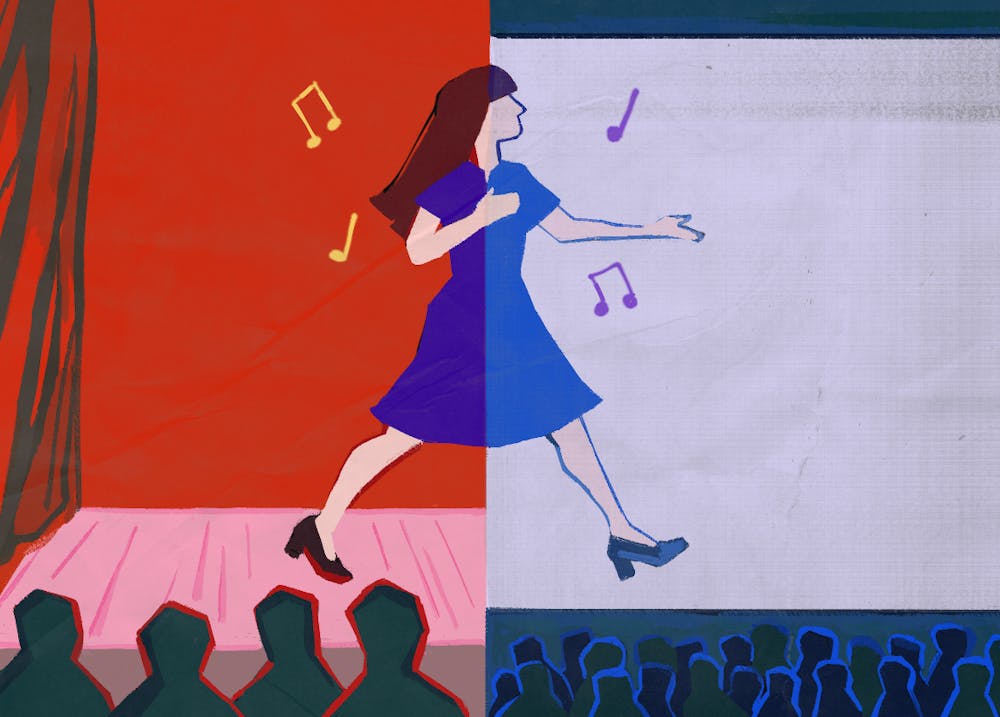
When standing in a seemingly endless line in New York City for a Broadway show full of anticipation, it’s easy to spark a conversation with the people next to you. Anywhere from Ohio, the United Kingdom; people come from over the world just to see a show. I only had a 40-minute train ride from my home in Long Island.
Only some are lucky enough to see Broadway shows in person, and as ticket and travel costs rise, it’s becoming even harder for fans to see their favorite actors on stage.
But the recent increase in blockbuster movie musicals is changing the game. Now, people can see these performances without leaving their living room.
Movie musicals are nothing new. One of the earliest major musicals to be adapted into a movie was “Little Johnny Jones,” a 1929 adaptation of the 1904 Broadway show about an American jockey facing the consequences of being accused of throwing a horse race.
More popular adaptations followed — “West Side Story” in 1961, “The Sound of Music” in 1965 and “Grease” in 1978 — that gained fame on and off the stage
Movie musicals allow a larger audience to access high-quality performances on demand. But these adaptations sometimes don’t reach Broadway’s threshold.
Recent releases like “Dear Evan Hansen” in 2021 and “The Color Purple” in 2023 received mixed results. “The Color Purple” received an 81% Certified Fresh on Rotten Tomatoes, “Dear Evan Hansen” received an underwhelming 28%.
Because stage productions are designed around live performances in musicals, the staging and plot doesn’t always translate smoothly in film adaptations. Camera cuts within these scenes, such as with close-up shots instead of ones that reveal the entire environment like in a stage performance, also change the experience.
While the film “Dear Evan Hansen” performed poorly, the Broadway show found immense success, winning six Tony Awards, including Best Musical. Though movies are making Broadway shows more accessible, on-screen adaptations often worsen its quality.
Even more successful adaptations, like “West Side Story” or “Grease” do not embody the same energy their performances did. Despite their ability to hook movie audiences, these adaptations fail to capture the relationship between performer and audience that plays such a key role in stage shows. In person, the energy of the audience can feed back into the performance, creating an experience unable to be replicated on screen. If you wish to experience the true feeling of Broadway, movie musicals are not the way to go.
Broadway shows were designed for the stage, and movies like “Dear Evan Hansen” are evidence not all shows transition to film well. This inability to meet the same standards as the stage performance can leave the audience with a lackluster feeling.
Luckily, many local theaters, such as the Gainesville Community Playhouse, regularly put on productions, but even these performances have their downfalls.
While local theaters may feature some impressive performances, budgetary constraints for costume and set design make it difficult to put on major visual displays.
These limitations even extend to buying the rights for certain shows, with some being completely off-limits. While these performances draw a crowd, they are constrained.
But live capture videos, which are a high-definition recording of a real stage performance, are a strong option. They allow viewers to see shows as they were intended to be seen — on stage.
Live captures have started to appear more on the big screen. Films such as “Hadestown: The Musical” and “Six: The Musical Live!,” were released this summer. “Six: The Musical Live!” was filmed in front of a live audience at the Vaudeville Theatre in London, allowing viewers to experience the performance as it happened on stage.
Movie adaptations have traditionally reached more people than Broadway, but live captures offer a better way to preserve the experience of the stage production while making theater more accessible.
Many studios also refuse to fully embrace the production of movie musicals. Instances of stealth marketing, where companies deliberately hide musical numbers of movies to attract wider audiences, are increasingly taking place in trailers for movie musicals, such as “Mean Girls” and “The Color Purple.” Believing no one will attend the movie if its true nature is known, studios hide the musical aspects of these movies in their promotional materials. If companies refuse to fully accept the existence of movie musicals, how can audiences?
While the lack of success for certain movie musicals can be attributed to shifts in the media industry rather than adaptability, the use of live captures provides a middle ground.
With the release of more live captures, like the upcoming “Fallen Angels,” anyone can watch these magnificent shows from the comfort of their own home. Poorly received adaptations can leave audiences with a different impression than what the original production intended. Broadway doesn’t have to stay in New York to feel like Broadway.
Contact Kaitlyn Ocuto at kocuto@alligator.org. Follow her on X @KaitlynOcuto
Kaitlyn Ocuto is a sophmore biomedical engineering major in her first semester at The Alligator. In her free time, she enjoys running, hanging out with friends and reading.


