
The competition between brick-and-mortar stores and online sales isn’t new to Americans, but a proposal could put it at the forefront of an unlikely market: gun sales.
A proposed rule change by the Bureau of Alcohol, Tobacco, Firearms and Explosives could allow people to buy guns without stepping foot in a store. In Alachua County, local gun store owners worry the proposal could threaten public safety and the market.
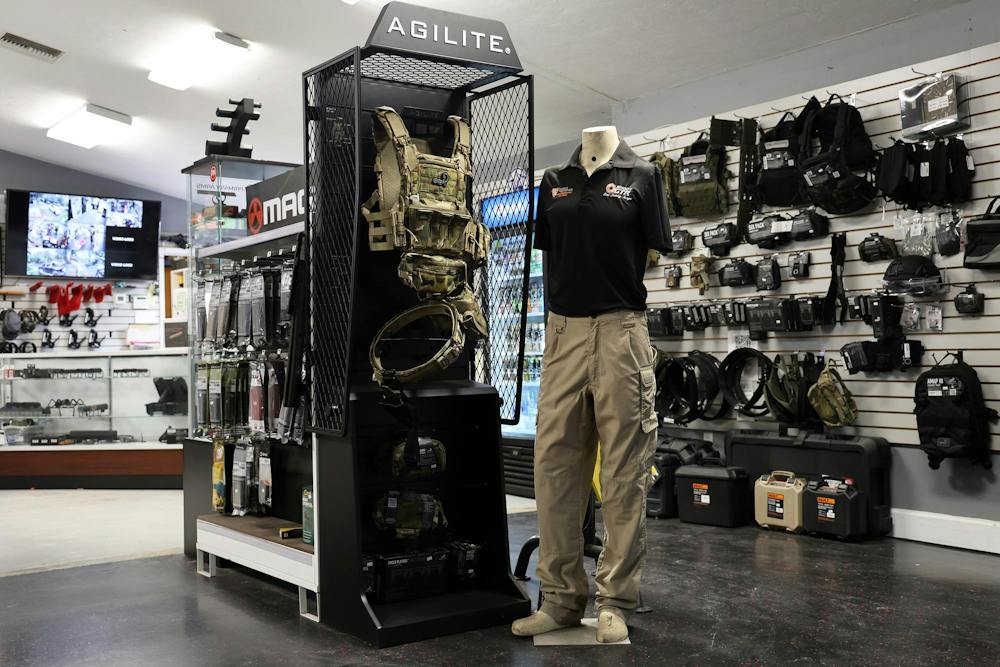
Bennett Latimer, the operations manager at ShootGTR, a Gainesville shooting range and gun store, said the proposal currently fails to address some safety and business concerns.
“With the information we have today, there are too many unanswered questions today for us to form a positive opinion,” Latimer said.
If passed, he said, the proposal could jeopardize both public safety and the profitability of brick-and-mortar stores.
Under the policy, local Federal Firearms Licensees would be less involved in the sales process.
Under current rule, someone can buy a firearm online but must pick it up in a physical store and complete ATF form 4473 in person. Sellers input buyer information into the National Instant Criminal Background Check System, which looks for prior convictions and histories of documented mental health issues or domestic violence. It takes just a few minutes for the system to complete its check before telling the seller whether a buyer's status is approved, delayed or denied.
The new rule would let people complete their background check remotely, allowing guns to be directly shipped to a buyer after their identity is verified.
But it’s hard to judge safety concerns without meeting the buyer face to face, Latimer said.
“There have been a number of instances in my career where just having a conversation with the person, we’ve been able to prevent potential suicide attempts [for] individuals who were not in a good mental state,” Latimer said.
In bypassing the in-person buying process, he said the customer also misses the opportunity to interact with the firearm in a controlled environment and learn more about what could be their first gun.
The policy would also make it harder to identify straw purchases, he said, instances when people buy a firearm for someone else, similar to when someone purchases alcohol for someone under 21.
Latimer also suggested the proposal could drive revenue away from local gun shops, comparing it to haircuts. If everyone decided to start cutting their hair at home instead of visiting a stylist, local barber shops would cease to exist, he said.
An estimated 15.5 million firearms were sold in the U.S. in 2025, and around 7.7 million guns were sold in the first six months of 2026. In 2024, Florida sold an estimated 1.2 million guns, second only to Texas.
The U.S. is home to nearly 78,000 gun dealers, and small businesses representing a significant portion of them. Gainesville is home to 27, and 14 of the city’s FFLs are home-based.
James Pickett, the co-owner of Micanopy’s Harry Beckwith Guns & Range, said a growth in online sales could come at a cost to safety and the livelihoods of local business owners like himself.
Similar to Latimer, Pickett said the face-to-face process of selling a firearm has been valuable in maintaining safety.
If someone buying a gun shows red flags, such as talking awkwardly or acting uncomfortable, he said a shop can refuse to sell it to them. The inability to identify those red flags through a screen creates a “dangerous path,” Pickett said. Mental health risks, especially among young people, can be hard to discern online, he added, and the power of technology can make online over-the-counter sales even more dangerous.
Pickett said the growth of artificial intelligence is prevalent in all industries, and identity theft or scams using AI wouldn’t surprise him. He added he is terrified by the things his 12-year-old daughter can do with technology at a young age, and he can foresee identity theft and improper technology usage in the gun industry.
Straw purchases were also a concern for Pickett, who pointed out warning signs that can be easy to see in person but harder to identify on a screen. Sellers might witness money passing hands or a customer looking at their phone to coordinate a purchase, he said.
The second danger of the proposal, he added, is the threat it poses to small businesses like his.
“In a brick-and-mortar small business situation, it’s definitely going to hurt us a bunch,” Pickett said.
Gun shops without shooting ranges might take the brunt of its effects, he said, because people would lose all incentive to visit them.
About 400 shooting and raining ranges exist around Florida, a fraction of the nearly 3,000 stores that sell guns across the state.
Pickett’s store has a firing range, giving customers the chance to familiarize themselves with firearms before buying one. Without the range, Pickett said online sales could pose an even bigger threat to his livelihood.
The National Shooting Sports Foundation, the U.S. firearms industry trade association, wrote an Aug. 5 letter expressing concerns about the proposal. More than seven in 10 NSSF members polled are in opposition, the association wrote, and over half are “strongly opposed.” Its members consist of manufacturers, distributors, firearm retailers and media publishers.
Tyler Foerst, the chair of the Alachua County Democrats, said gun dealers and industry professionals’ negative reaction to the proposal is telling.
“The fact that the industry’s own trade group is against it should be a red flag to anybody,” Foerst said. “The fact that so many licensed dealers are against it really should bring great pause.”
Foerst, who’s a gun owner himself, said he worries a rule change could redirect business from local shops to bigger companies.
Under the proposal, FFLs would conduct video conferences with prospective buyers with an independent credential service provider to decide whether to issue a gun license. CSPs are systems or organizations designed to verify identities. Under the proposal, identity verification would be done through a software requiring a government ID and a “selfie verification” through a biometric facial scan.
Foerst said he’s concerned about private corporations having access to user data and potentially creating a gun owner database.
“They are effectively handing the keys to the gate to a private company that can now deny you a constitutional right,” Foerst said. “That’s not a human denying it; It’s presumably a software.”
Instead of relying on the discretion of FFLs, he said, it places license issuance in the hands of large companies. The consolidation of the gun industry into a few private companies could further complicate the process if large sellers decide to contract CSPs or create their own verification companies, he said.
The proposal completed its mandatory public comment period Aug. 6. About 4,500 comments were left, with many speaking in opposition to the rule. Now that the commenting period has ended, the ATF will consider the comments and draft a finalized rule in the federal register. Congress would not vote on the rule change, but it could overrule the rule with a joint resolution of disapproval.
It is unclear when or if a finalized draft will be published. If published, it would contain an “effective by” date signifying when the rule would begin.
Contact Logan McBride at lmcbride@alligator.org. Follow him on X @logandmcbride.

Logan is a senior journalism student and the Alligator's Fall 2026 Enterprise Politics reporter. He previously served as a reporter on the Alligator's Metro Desk, covering K-12 Education and the City/County Commissions. In his free time, he enjoys watching sports, movies, or spending time with his cat and girlfriend.