

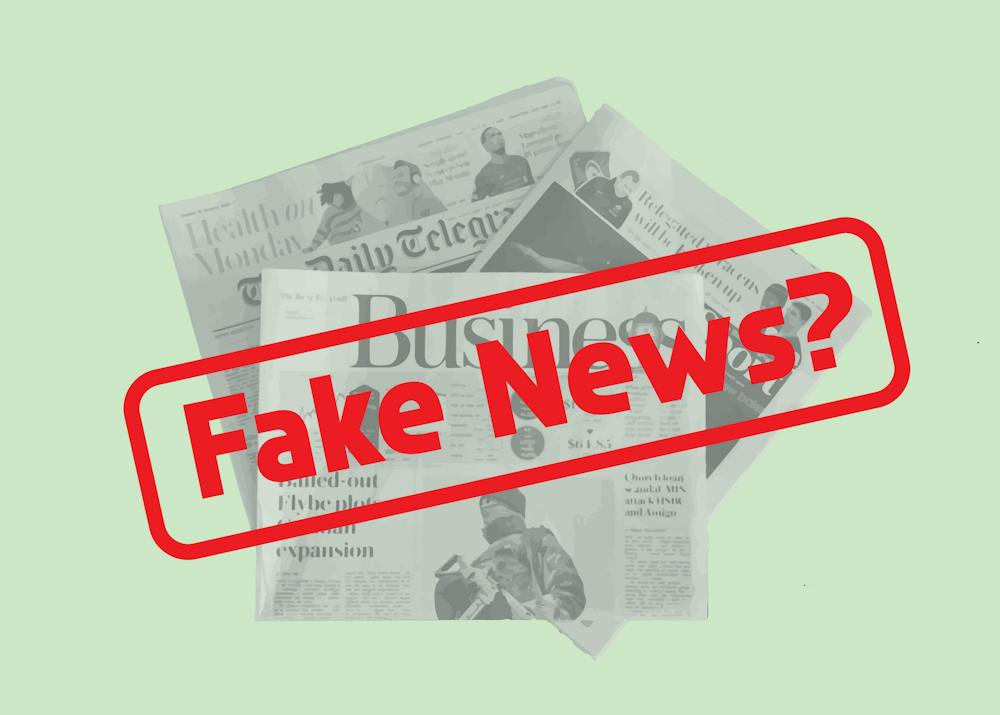
With the rise of social media, news distribution has heavily increased. Instead of waiting to get the newspaper delivered to your doorstep, news is now easily accessible on any digital device. But with the overwhelming amount of news circulating every digital platform, it’s wise to approach stories with skepticism. However, automatically labeling reporting you don’t like as “fake news” is imprudent.
The concept of fake news has been lost.
Fake news has become a label people often put on reporting that contradicts their opinions or beliefs. There is a clear difference between unpopular and inaccurate reporting. Fake news is false or misleading information that derives from either no source, or an unverified source. Negative, unpopular and unfavorable reporting doesn’t fall under the same category, therefore should not be declared fake news.
While labeling verified reporting as fake news doesn’t seem momentous, it has serious consequences.
On Sept. 18, President Donald Trump announced his decision to suspend White House press passes for journalists from Politico, CNN and MS NOW, claiming they wrote fake news about his administration and himself. The reporters’ passes were deactivated and they were officially denied entry a day later. Following this ban, the three outlets filed a lawsuit on Sept. 21, citing the ban was a First Amendment violation.
Trump’s shocking ban didn’t go unnoticed by other news organizations. Following his decision, major television networks decided to suspend all coverage on the president and events he participated in. From Sept. 21 until Sept. 25, absolutely no coverage of Trump was aired by the White House TV pool. In response, the Trump Administration aired its own coverage of the president on Trump TV, the White House’s broadcast channel.
Just because Trump is the president, he doesn’t have the authority to decide what news is fake . This extends to any other public figure too. A journalist’s main job is to be the watchdog of the government, keeping an eye out for any mistakes. A story isn’t automatically unreliable if it reports the president or government in a negative light. By labeling such news as fake, it not only defames the news organization, but also the journalist who took their time to verify their sources and information.
The judge ended up ruling that the ban went against freedom of the press and dual process, therefore temporarily reinstating the outlet’s access to the White House. The President’s reasons for the ban was made public in a Truth Social post, saying “Media Outlets shouldn’t be able to constantly write or report fiction and lies when they’re covering the President of the United States, the Trump Administration, or the United States of America.” Trump’s accusations were not only illogical, but his actions were unconstitutional. Ironically, one of the sources in a Politico article that Trump perceived as false turned out to be Vice President JD Vance.
While the ban on access to the White House is an extreme example of what can happen by calling reporting fake news, it illustrates how much the label can affect credible and valuable journalism. The label can undermine the public’s ability to differentiate between the truth or misinformation.
Sometimes, it’s easy to dismiss reporting that goes against our opinions by calling it fake news, but it’s important to realize these actions have consequences. Trump accused the three news outlets of publishing false information just because he didn’t agree with the reporting. Yes, we are entitled to our own perspectives, but just because someone has a different point of view doesn’t mean they are automatically wrong.
Contact Ella Finkelstein at efinkelstein@alligator.org. Follow her on X @Ellamfink.
Ella Finkelstein is a second year majoring in Journalism and minoring in Innovation. This is her first semester working on the Alligator staff.