

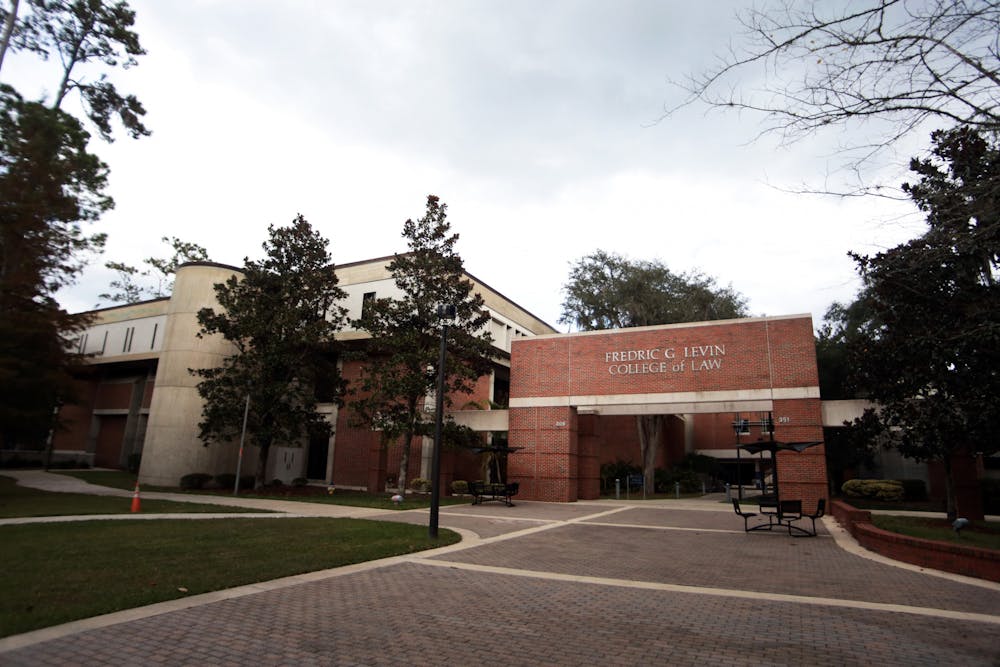
The Florida Supreme Court ruled Jan. 15 Florida law schools no longer need to be accredited by the American Bar Association beginning Oct. 1 of this year.
The ruling means law students won’t need to graduate from an ABA-accredited school to sit for the Florida Bar exam. Instead, schools can be accredited by other U.S. Department of Education-certified entities.
There are 12 ABA-accredited law schools with Florida locations, including UF Levin College of Law. The association has been the only accreditor in Florida since 1992. Out of the nearly 3,000 students who took the Florida Bar for the first time in 2024, all but 10 test-takers attended ABA-accredited schools.
Many view the move away from the ABA as a step toward conservatism, because the association is known for what some perceive as left-wing policies, such as promoting diversity, equity and inclusion. Others see it less as a political decision and more as a step away from the ABA’s monopoly on law school accreditation.
“Good move,” Gov. Ron DeSantis posted on X in response to the Florida Supreme Court decision Jan. 15. “The (highly partisan) ABA should not be a gatekeeper for legal education or the legal profession.”
This decision came nine days after Texas ended its law schools’ reliances on the ABA.
Graduates from Florida law schools that are not accredited by the ABA will only be able to take the Florida General Bar Examination and practice law in Florida. Graduates from ABA-accredited schools, meanwhile, can take the bar exam and practice law in any state in the U.S.
The Florida Supreme Court’s opinion said a court-appointed workgroup study persuaded the Court “that it is not in Floridians’ best interest” for the ABA to be the only association that decides which law school graduates can take the bar exam and practice law in Florida.
Julian Calderon, a 25-year-old UF law student, said the ABA has been perceived as partisan and left wing.
“It’s not surprising that more conservative states are getting rid of them as the sole accreditation,” Calderon said. “Because we would want, at least in theory, the accrediting agency to be neutral and not take sides on controversial issues.”
Calderon also said the move away from the ABA is nothing new. The tradition of using the ABA to vet judicial nominees was ended by former President George W. Bush in 2001, and the Biden and Trump administrations also did not rely on the ABA for judicial nominee vetting.
Lyrissa Lidsky, a professor of institutional law at UF and a former dean of the University of Missouri School of Law, said she thinks many Florida schools will be dually accredited with the ABA and another accreditor.
“A law school like the University of Florida is sending students all over the nation, so we can’t afford to ignore the ABA accreditation,” Lidsky said.
Lidsky is critical of some of the ABA’s many requirements, she said. The association requires a mandatory number of hours for students to take “experiential learning” classes, which can add extra expenses to students’ tuition. These classes give law students experience in performing legal tasks, but they also require schools to spend more on resources, such as staff.
With the ABA accreditation requirement lifted, some schools may move toward dual accreditation, meaning they will be accredited by the ABA and another accrediting body. If a law school has dual accreditation, the ABA’s requirements and another accreditor’s requirements may contradict each other, Lidsky said.
She thinks the idea of dual accreditation is to pressure the ABA to become more flexible in some of its accreditation requirements, she said. Initially, this might raise costs like tuition, but it would hopefully decrease costs for students long term, she added.
Ahmad Alarachi, a 21-year-old UF pre-law senior, said he wasn’t surprised by the Florida Supreme Court’s decision, because it aligns with DeSantis’ conservative policies.
Alarachi said he thinks a lot of people he knows want to leave Florida because of policies similar to this one.
“It isn’t just about what’s going on internally in Florida,” Alarachi said. “It’s also about how Florida is perceived beyond the state.”
Alarachi and some of his peers are concerned about Florida opening the door to other accreditors who may not emphasize topics like diversity in their curricula, he said.
For its part, the ABA has a “diversity plan” with a mission to “promote full and equal participation by all persons in the ABA, the legal profession, and the justice system” through practices like soliciting diverse members as speakers and moderators.
Derek Bambauer, a UF law professor, said the new accreditation law will allow a set of less expensive and more narrowly focused law schools that only teach Florida law and are solely accredited by an alternative accreditor to open. Graduates of these schools would only be able to practice law in Florida.
The ABA is currently the only accreditation body that has the U.S. Department of Education’s approval, Bambauer pointed out.
“The ABA has a monopoly,” he said.
With other accreditors to compete with, Bambauer said the ABA may have to change some of its policies that put strain on law schools and their students.
Overall, he said, this change isn’t as big of a deal for students as it seems at first blush. And UF Levin College of Law will remain an “excellent choice” for students looking to practice law both in and out of state, he added.
“There is less to this change than it appears,” Bambauer said. “It’s not getting rid of ABA accreditation. It’s not putting in place a new accreditation body.”
Contact Cameron Countryman at ccountryman@alligator.org. Follow her on X @cpcountryman.
Cameron Countryman is a second-year journalism major and The Alligator's Spring 2026 Graduate School reporter. In her free time, she enjoys reading, paddle boarding and researching her next travel destination.


