

Among welcome week activities, drop/add and the search for a parking spot, UF students — especially the almost 20,000 newly admitted freshmen — have one burning question on their minds: Which professor will make or break their semester?
Many college students will say the answer lies on professor-rating websites like RateMyProfessor, a tool often used to choose classes and compare instructors who teach the same subject.
Founded in 1999, RateMyProfessor scores instructors on a scale from one to five, ranking from “awful” to “awesome,” respectively. The site also scores class difficulty and how likely reviewers are to take the class again.
However, this is not the only rating website students can use.
Anyone who’s completed a semester at UF knows about the end-of-term GatorEvals survey, but not everyone knows the data collected by those surveys is publicly available.
GatorEvals, UF’s official course and instructor rating system, asks students to provide feedback on their experience in each of their courses at the end of the semester.
On a scale of one to five, surveyed students are asked to rank how much they agree with phrases like “The instructor was enthusiastic about the course” and “The instructor was instrumental to my learning in the course.”
However, the specific written feedback responses are not publicly released.
Integrated directly into Canvas, GatorEvals replaced previous pen-and-paper survey method GatorRater in 2019.
Public GatorEvals results show the average student response over the three most recent academic years to 10 of the questions asked on the survey.
Average ratings for each category can be shown for specific professors, courses, departments, colleges and UF faculty overall.
Spring 2026 results
Most UF professors were well liked by surveyed students during the Spring 2026 semester, consistently scoring above 4.0 in every category, according to the GatorEvals data published July 29.
According to the results, UF faculty as a whole scored the highest in showing enthusiasm for their courses, maintaining clear standards for availability and creating positive learning environments.
Faculty scored lowest in fostering regular interaction between students and instructors, according to the data.
GatorEvals don’t just provide feedback for professors; they’re also a metric the university considers for tenure and post-tenure review and its promotion process, according to UF’s Faculty Excellence and Advancement initiative.
Is the data accurate?
RateMyProfessor and GatorEvals can face similar accuracy issues with small sample sizes.
While they collect information in different ways — GatorEvals is offered to every student taking a course, with professors sometimes offering incentives for completion, while RateMyProfessor’s reviewers must deliberately seek out the website — both can suffer from sampling errors.
On either site, a professor who’s rated highly with a small number of reviews could boast a much higher rating and score than a professor with 100 mixed reviews — not truly accounting for differences in teaching ability.
While RateMyProfessor shows the number of reviews that determine its scores, public GatorEvals results do not, potentially worsening this problem.
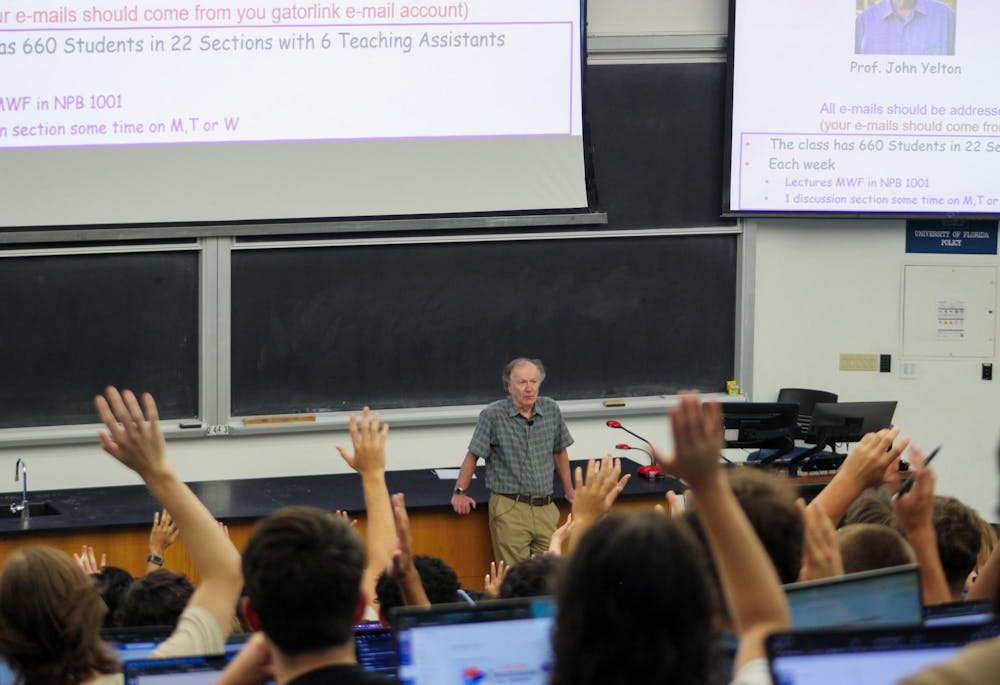
John Yelton, who has taught physics at UF since 1988, said only a quarter to a third of students in his classes, which can have up to 330 students per section, respond to GatorEvals.
Yelton strongly encourages his students to complete their GatorEvals for all their courses each semester, he said, to make professor feedback as representative as possible.
He guessed that in many cases, reviews on sites like RateMyProfessor only account for about 1% of student opinion.
“You’ll get some nice ones, but then you’ll get somebody who says something totally ridiculous and bad,” Yelton said, admitting he’s looked himself up on the site in the past. “If all the students felt like that, I would stop teaching.”
Another major flaw of RateMyProfessor is its lack of verification. With GatorEvals, one survey invitation per class is sent directly to students over email, linked through Canvas and available with a Gatorlink login to the GatorEvals portal, according to the GatorEvals website.
Only students registered in a class can review that class, and they can only do so once.
RateMyProfessor’s system, on the other hand, has no barrier to entry and no safeguards against duplicate reviews. It’s “unable to fully confirm users’ identities, the truthfulness of their contributions or their student or class enrollment status,” according to its website.
“There’s really no way to control who’s leaving a review,” said Christopher McCarty, the director of UF’s Bureau of Economic and Business Research and an expert in survey research. “That’s completely not statistical. RateMyProfessor doesn’t approach me as a respondent — I approach them, and so there’s a problem.”
McCarty, who also teaches anthropology classes at UF, said GatorEvals better capture the big picture of student experiences.
The open-ended comment sections at the end of each survey, while not released publicly, are a valuable source of feedback for instructors, he said.
A class’ base difficulty is often another factor behind less-than-stellar ratings.
While RateMyProfessor and GatorEvals differentiate instructor- and course-specific ratings, students may find it hard to separate feelings of frustration for challenging course content from their views of professors.
“Most of what I see are comments about how easy or hard the class is,” McCarty said of RateMyProfessor reviews. “[UF] wants to evaluate the delivery of instruction. We’re not here to do necessarily easy content.”
How to use rating websites to get the most accurate results
When deciding which class to take, don’t solely rely on websites like RateMyProfessor because a bad score or rating isn’t the whole story.
Jocarys Santana, a 19-year-old health science junior, said it’s better to find a student who’s been in the same shoes. Students who have already taken courses or professors can offer the best advice, she said.
Santana has frequently used RateMyProfessor in the past to look up classes and professors, she said, and the site has especially influenced her decisions during drop/add week. But she makes sure she doesn’t take its reviews at face value.
When deciding who to take for General Chemistry II, Santana said she decided to drop in on professor Stacey-Ann Benjamin’s class.
Although Benjamin’s RateMyProfessor rating was daunting — it currently sits at a 2.2 out of five — Santana realized a lot of the bad reviews were for other classes the professor taught.
Visiting the class showed Santana that Benjamin was actually the perfect teacher for her.
“She made my experience a lot better because of her teaching style,” Santana said. “It was really different from the other chemistry professors.”
So, the key to making sure a professor doesn’t break your semester is finding what works for you. No two students — or professors — are the same, and the learning experience looks different for everyone.
Students can take advantage of the drop/add period, which ends Aug. 26, to experience different professors in person.
Public GatorEvals results for the Fall 2026 semester will become available Feb. 9, 2027.
Contact Chloe Santiago at csantiago@alligator.org. Follow her on X @csant860.
Chloe Santiago is a second-year journalism major specializing in data journalism and coding. She is a first-time staffer at The Alligator. Between classes, interviews and editing she enjoys survival-horror video games and taking care of her extensive houseplant collection.