

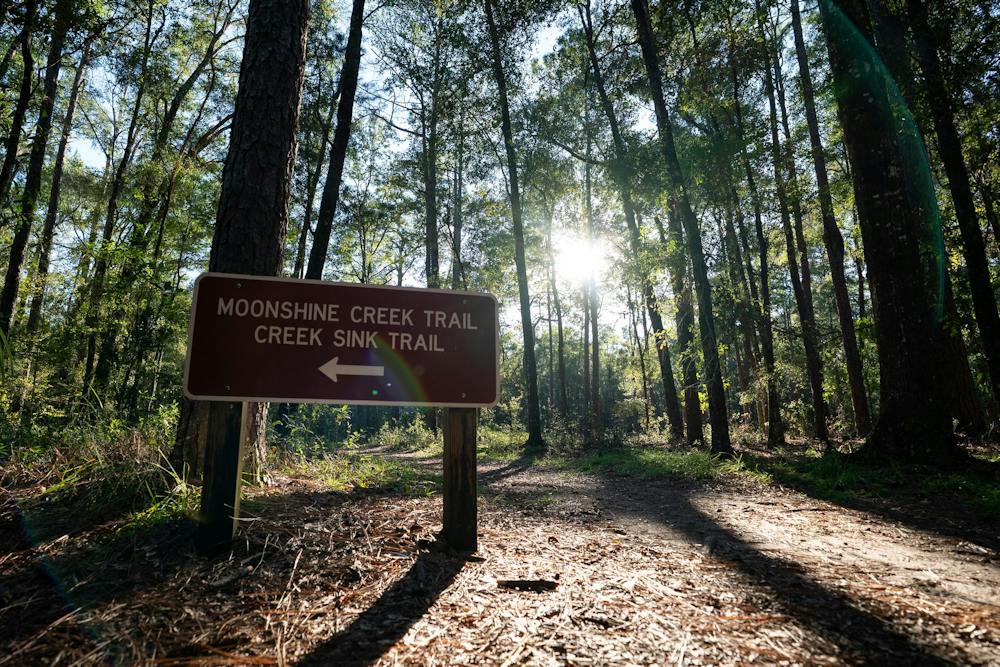
San Felasco Hammock Preserve received national recognition on Friday when it was named Alachua County’s representative forest.
The Old-Growth Forest Network, into which San Felasco was inducted, designates protected forests across the U.S. to preserve and inform people of old-growth locations, according to its website. A forest is classified as old-growth if it has developed over a long period, typically centuries, with little to no human disturbance
When an old-growth forest is inducted into the network, it’s granted formal protections to ensure its trees and ecosystems are safeguarded from commercial logging. San Felasco is the 12th forest in Florida to be recognized by the network, which protects over 300 forests across 41 states.
Less than 1% of old-growth forests remain undisturbed by human activities in the eastern U.S., according to Ciera Wilbur, the network’s southeast regional manager. Recognizing old-growth forests opens the door for people to come together and celebrate them, she added.
“The mental, emotional, spiritual, physical opportunity of getting out and being in nature is incredibly important for us,” Wilbur said.
Old-growth forests trap climate-warming greenhouse gases, mitigate water pollution and serve as a refuge for wildlife and vegetation, according to The Wilderness Society. The Old-Growth Forest Network selected San Felasco to represent Alachua County for its beauty and biodiversity, according to a press release published by the network.
Florida’s forests are “incredibly unique” because of the state’s biodiversity and fire-adapted ecosystems, Wilbur said. She called San Felasco a perfect example of what makes Florida special.
San Felasco’s significance
San Felasco’s status as one of the few remaining old-growth forests makes it an underappreciated “treasure,” said Jack Putz, a UF ecology professor. The forest is the largest upland hardwood forest in North Florida, which also helps to promote wildlife survival, according to the Florida Department of Environmental Protection.
Sinkholes and springs are some of the state park’s prominent features and help house over 20 natural communities of wildlife, vegetation and fungi, according to the FDEP. Sites like sinkholes and springs are examples of karst landscapes, which provide more than 90% of Floridians’ drinking water, according to Florida State Parks.
San Felasco also has a rare canebrake, Putz said, a small ecosystem typically dominated by bamboo and river cane.
Canebrakes used to be common, but about 98% disappeared due to overgrazing, disease and deforestation from European settlement in North America, according to a North Carolina State University news release. Canebrakes help control erosion, remove excess nutrients from groundwater and provide food and shelter to wildlife.
San Felasco State Park covers over 7,000 acres, allowing it to shelter iconic southern species like fox squirrels and bobcats, Putz said. It also has over 25 species of canopy trees, he added, when a typical forest of its kind may only have 10 species at most.
“The diversity is astoundingly high,” he said.
Old-growth forests can serve as benchmarks for researchers to better understand the environment and its history, Putz said.
“When we do ecological restoration, we need to have some reference or target ecosystem to use as our model to evaluate,” he said. “‘How are we doing? What progress are we making?’”
San Felasco’s Native American history
The value of old-growth forests, including San Felasco, was also felt by Native American peoples, said Gifford Waters, the collections manager for historical archaeology at the Florida Museum of Natural History.
Over 50 cultural sites have been uncovered in San Felasco, serving as evidence of about 12,000 years of uninterrupted human activity in the region, according to the FDEP.
“I’ve worked throughout Florida most of my career, and this is the only site that has been totally undisturbed,” Waters said. “Most places in Florida [have] modern trash and construction on the sites.”
One prominent discovery was made in 1956, when UF students found remnants of a 400-year-old Spanish catholic mission in San Felasco, according to the Florida Museum of Natural History.
Mission San Francisco de Potano, the first Catholic teaching in Florida, began in 1606 in the state park’s southern region, Waters said. The Potano people founded the mission at their main village, and it persisted until 1706, he said, though it was abandoned for a small period in 1656.
The mission’s temporary halt was initiated because the chief of the village at San Francisco de Patano helped instigate a rebellion against the Spanish government in St. Augustine, Waters said. Spaniards enforced unfair forced labor practices, he said, and no Franciscan friars were killed during the rebellion.
The village would have been home to a few hundred Potano people during its peak, and they left behind over 7,000 artifacts that have been collected by archeologists and students since 2006, according to the Florida Museum of Natural History. Most of the artifacts are pieces of pottery, tools and animal bones.
Students and researchers have discovered a kitchen area and possible military barracks in San Felasco, Waters said. Students and researchers have found evidence of a “very large special-use building,” he said, which they believe could’ve been a chief’s or council house constructed by Native Americans.
The uncovered Native American structures and sites have remained protected because they are not accessible from any of the state park’s trails, he said.
“We’re hoping to add a lot more, just not to the history of the people in the area, but add a lot more to the environmental history of the hammock as well,” Waters said.
Contact Christian Haas at chaas@alligator.org. Follow him on X @ChristianH58745.
Christian is an environmental reporter with The Alligator, and studies journalism at the University of Florida. He is a fourth-year student who prefers to spend his free time trying new and random things, cooking, reading, watching TV, or hiking.


