

Amna Khalid came to the United States from Pakistan in 2011 with the expectation that American universities represented the freedom to think.
When Florida lawmakers passed legislation restricting how certain concepts could be taught in public universities, she said she was shocked.
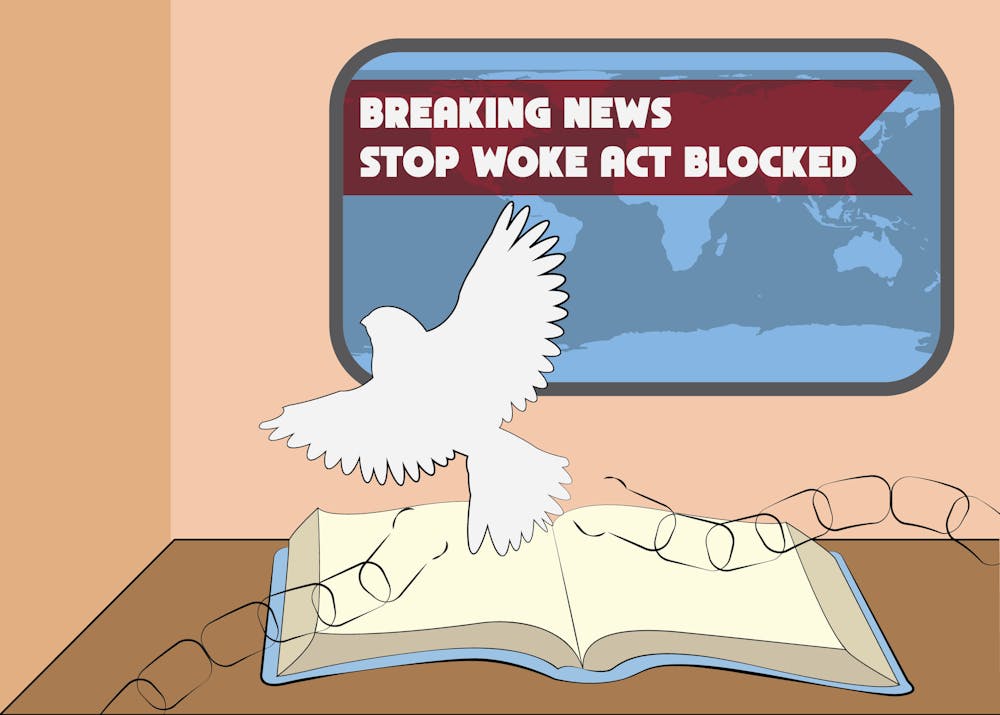
Earlier this month, the U.S. Court of Appeals for the Eleventh Circuit rejected Florida’s attempt to revive the higher education provisions of the Stop WOKE Act. The Court rejected the state’s argument that professors’ classroom instruction constituted government speech, instead deciding the speech is protected under the First Amendment.
The Stop WOKE Act, also known as the Stop Wrongs to Our Kids and Employees Act, was a 2022 Florida state law that prevented schools and businesses from promoting concepts related to race, gender and social privilege while still allowing discussion of them.
The law was blocked by a federal judge shortly after it passed, preventing it from being enforced at UF and other public universities. The state decided to appeal the decision.
“That’s not the kind of thing that should happen in a democracy, particularly not the U.S.,” Khalid said. “That’s the kind of stuff that happens in authoritarian states, and having grown up under military dictatorships, I’m incredibly attuned to where this goes. It starts like this.”
Khalid, a historian and associate professor of history at Carleton College in Minnesota, submitted an amicus curiae brief with her colleague Jeffrey Snyder against the act. She said it threatened the freedom to think and, after seeing similar laws introduced across various states, believed it was important to speak up.
Before submitting the brief, the two conducted research by interviewing various faculty members. Faculty were concerned the act would affect their ability to teach topics in the classroom, Khalid said.
One professor described it as “educational malpractice,” she said, a term that refers to the censorship of topics or limitation of viewpoints within an area of study.
“When the autonomy of higher education is undermined, essentially we’re going to do away with the capacity of the next generation to think independently and to understand and engage with the world as it is, accurately,” Khalid said.
While the law never took effect because of the injunction, faculty leaders at UF said the possibility of its enforcement shaped conversations about academic freedom.
Nearly a century of case law on academic freedom in the classroom at public institutions could have been upended if the state had won the appeal, wrote Meera Sitharam, a co-president of the United Faculty of Florida at UF, in an email statement to The Alligator.
The ruling reaffirmed faculty members are hired to freely exercise their expertise and academic freedom to speak in the classroom and outside of it as an expert in the public interest, Sitharam wrote.
Still, she said other laws may offer broader implications for the campus climate for teaching and learning.
Florida’s Senate Bill 266, which restricts majors and general education courses heavily related to DEI, has removed sociology as a general education class, she said.
“The injury from that is effectively a chilling of speech of faculty in an entire department,” she wrote. “It cuts off a significant portion of the tuition revenue that would be necessary for them to continue.”
Greg Gruebel, a senior attorney at the Foundation for Individual Rights and Expression, wrote in an email statement to The Alligator the law forced professors to ask legal questions before they could do their jobs.
“The chilling effect from Florida’s Stop WOKE Act was real,” Gruebel wrote. “I heard from many professors who were trying to figure out how to follow the law without abandoning the standards of their fields.”
Had the court ruled in favor of the act, Gruebel said, it would have resulted in a quieter classroom where professors avoided topics the state labeled too risky to teach.
Similar laws, like Alabama’s Senate Bill 129, which restricts DEI efforts and bans the promotion of “divisive concepts” in school boards, public universities and state agencies, have put faculty in similarly difficult positions, he added.
“These laws send a clear message that some ideas are dangerous to teach,” he wrote.
Gruebel said the court’s ruling protects what college is supposed to be.
The American Civil Liberties Union of Florida, which represents professors and students challenging the law, argued throughout the case the Stop WOKE Act violated the First Amendment by restricting what could be taught in public university classrooms.
Carrie McNamara, a senior staff attorney at the ACLU, said the court decision affirmed the importance of an open exchange of ideas.
“Teaching our complex history is not discrimination,” McNamara wrote in an email statement to The Alligator. “It is necessary to the education of a free and democratic society.”
Aidan Tran, an 18-year-old UF environmental engineering sophomore, said he believes sharing and understanding different — and often divisive — opinions is important in the classroom.
Tran said in his class, American Civil Discourse in the Political Order, he learned the importance of embracing different opinions because it’s how society functions.
He doesn’t believe professors should remain entirely neutral on issues, he added. Instead, he said students benefit from instructors who are transparent about their own perspectives while making space for differing viewpoints — as long as those viewpoints are not harmful or threatening to others.
Exposure to different ideas and viewpoints is important in higher education, he said, where students are at an age where they should be able to distinguish between what information is true, false or harmful.
“At the end of the day, the university is like a forum for discussion,” Tran said. “If we close off the discussion for professors or students, it just harms the overall value and quality of our education.”
Contact Swasthi Maharaj at smaharaj@alligator.org. Follow her on X @s_maharaj1611.
Swasthi Maharaj is a political science and politics, philosophy, economics and law (PPEL) junior at UF. This is Swasthi's fourth semester at The Alligator, and her third semester on the university desk. She's also reported on the enterprise desk. Swasthi loves coffee, reading, going to concerts, baking and taking long walks.


