

Lilliana Wells drove down University Avenue, hungry. The 44-year-old Gainesville resident wanted to buy a gyro, but it wasn't in her budget.
Then she saw a small group handing out food in front of City Hall.
“I was like, ‘Ooh, food over there,’” Wells said. “I did illegal parking, and I hurried up and came.”
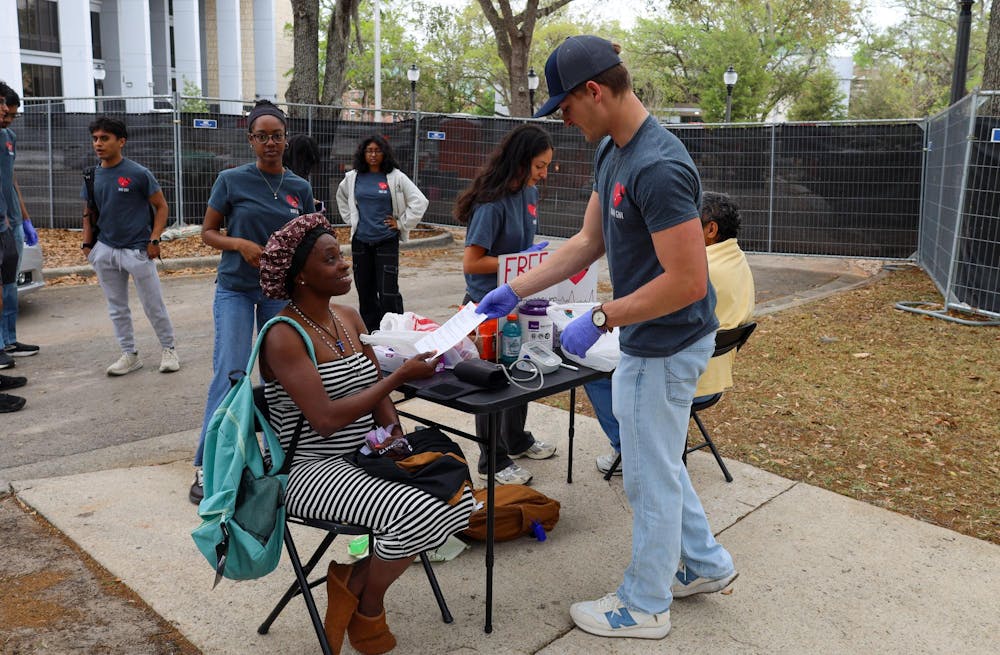
With a rumbling stomach, she walked to the table, where volunteers from nonprofits Project Downtown Gainesville and Hearts for Homeless greeted her with a salad, Gatorade, care packages and a free blood pressure test.
Wells, who lives in her car, said small acts of care — even things as simple as a free screening or a meal — can make a difference.
“They’re doing a great thing out here,” she said.
According to the Alachua County Department of Health, among Alachua County’s estimated 639 homeless people, 95% of those surveyed reported difficulty in accessing health care services in 2024.
Across Gainesville, student volunteers are stepping in to close the gap.
At the center of those efforts is Hearts for Homeless, a UF student organization focused on preventive care. The group offers free blood pressure screenings, hygiene kits and referrals to local clinics at sites like Grace Marketplace. Every Sunday from 1 to 2 p.m., the students table at City Hall with Project Downtown Gainesville to offer free screenings.
Vedaant Mutha, a 19-year-old UF economics and biology sophomore, serves as the club’s medical information director. He’s been involved with the club since his freshman year after discovering it at a student engagement fair.
After attending one event, he was hooked. He said he felt connected to the mission of helping those less fortunate in the community, so he continued to get involved.
“We want to serve the underserved population in Gainesville,” Mutha said.
The screenings are designed to catch early warning signs before they become serious health problems, he said.
“Your blood pressure is one of the best indicators of how your overall body is doing,” he said. “It’s like a preventative care measure.”
High blood pressure is one of the most common risk factors for heart disease, stroke and kidney failure. It is nicknamed the “silent killer” because it often doesn’t cause noticeable symptoms.
Mutha said the screenings are especially important for members of the homeless community, many of whom don't have access to healthy food and health resources such as physical exams and medicines.
Volunteers cannot officially diagnose anything because they are undergraduate students, but they refer people to clinics, gain clinical volunteering hours and share the data with the international organization, Mutha said.
H4H, or Hearts for the Homeless, International is a nonprofit organization dedicated to educating and bringing heart health screenings to homeless communities around the world. There are over 40 chapters in the United States alone, and most are on college campuses.
The data are then published in peer-reviewed journals and shared with policymakers across the country to help make lasting changes in health policy in local communities.
While the food is the draw, the tests are an important bonus, said regular Drew Kennard, a 34-year-old Gainesville resident who is homeless.
“For me, it mainly helps with just having a place to eat after having gotten out of jail,” he said.
Kennard said he thinks it's a useful service for older people in the community who aren’t able to regularly stop by clinics.
He personally finds the services helpful because he has HIV, he said, which pushes him to get his blood pressure tested about every six months.
“That's the only reason I go to the doctor,” Kennard said.
Though the health benefits are crucial to Kennard, he said he also appreciates the community the organization provides. Kennard remembers some of the volunteers, he said, and he considers himself a “Gainesville celebrity.”
“Chelsea, right there, you know, she remembers me,” he said, referring to one of the H4H volunteers. “I remember just their organization, Hearts for the Homeless, and I think that they're a cool organization.”
Nidhi Rao, a 19-year-old UF applied physiology and kinesiology sophomore and the organization's social officer, said interactions with patients are what motivate her to pursue health care.
“I’ve always seen myself as someone who feels more fulfilled by talking to people and getting to know their stories,” she said. “The attitude of a provider can make such a difference in a patient’s life.”
Reagan Bresnahan is a contributing writer for The Alligator.
Reagan is a videographer for the Alligator. She is a freshman majoring in journalism and this is her first year with the paper. In her spare time she loves music, reading, and spending time with friends.


