
“It’s Buddy, oh, Buddy! He’s huggy and a little bit nutty”... and murderous.
Horror movie “Buddy,” directed by Casper Kelly — who’s known for his work on “Too Many Cooks” — released Aug. 28 after a successful festival run, where it screened at events like the Sundance Film Festival. It was highly anticipated by theater-goers, especially following the stream of hit horror movies over the summer, like “Obsession,” “Backrooms” and “Leviticus.”
The creepy “Barney & Friends” spoof faced high standards, after glowing reviews poured in following the world premiere at the Sundance Film Festival. In my opinion, it exceeded viewers’ expectations.
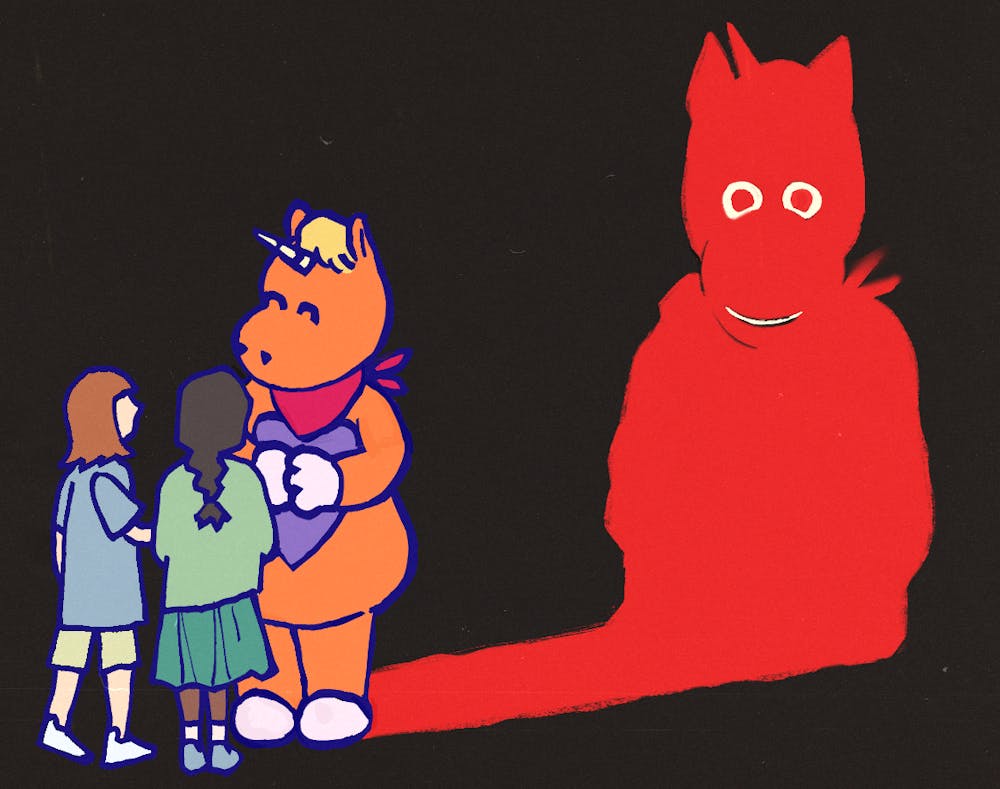
The movie follows a bright orange unicorn named Buddy, voiced by Keegan-Michael Key, who’s most known for comedic acting in projects like “Key & Peele” and “The Super Mario Bros.” Key takes on a silly, overly childish voice that mimics that of Barney the dinosaur. Similar to Barney, Buddy stars in a television show that shares his name.
In the show, Buddy has a gaggle of four children that he speaks with, plays games with and seemingly cares for. But the distant screaming and darkness that opens the film suggests “Buddy” certainly isn’t made for the kids portrayed on screen.
Bright, cheerful singing soon replaces the eerie introduction, offering a stark and subtly unsettling contrast. The opening song — sung by the children about Buddy and how much they love him — is the show's theme, which in turn transitions into the show itself. At first glance, the setup truly feels like watching a children's television show.
With its bright-colored animal main character, name and style, the film doesn’t try to hide “Barney’s” influence. Those familiar elements only add to the growing feeling that something is amiss. The music was too eerie, silent moments felt too tense and adult characters seemed too oblivious.
Audiences watch numerous episodes of “Buddy” throughout the beginning of the film, from its opening theme to the credits. Each episode only adds to the eeriness as things spiral out of control and the children start to ask more questions about who Buddy is.
The movie mainly focuses on Freddy, one of the children in the show. As things take a turn for the worst, Freddy and her friends must find a way to escape Buddy’s horrifying wrath.
The show’s unique format only adds to the discomfort.
The characters all live in the television show — and they’re aware of its structure, too. The roll of the credits signals the end of the day. The camera never pans to a director or off-stage crew. This is their life.
The show also features adult stock characters commonly seen in children’s programming, like a mailman, a nurse and Betty Bunny, another suited character. Items in the show are also personified with voices, movements, eyes and other details that bring them to life through a child’s eye.
The adults seem to ignore the children through it all, playing their roles closely and never straying far. When children warn them of danger, they continue to act as though nothing is wrong.
The movie seems to be a commentary on how abuse, grooming and violence toward vulnerable individuals often gets swept under the rug. Kelly said in an interview on Aug. 26 with Rue Morgue that “when [children's television shows are] trying to present something so perfect, it often feels like there might be something wrong under the hood.”
In the rare moments that the adults address the children in the movie, they tell the children not to anger Buddy — a nod to how adults will turn a blind eye to abuse children experience. They say that it is better to keep quiet and avoid stepping on any toes, especially if the abuser has some sort of power like Buddy does.
In forums like the recent docu-series “Quiet on Set,” former child actors have spoken about experiences of being groomed and abused by directors or others who have power on set while working on children television networks.
In the film, the children are put in a position where they must love and support Buddy, even when he's shown to be violent, or they'll receive punishment. Some of the children even rely on Buddy still, going to him in their distress despite knowing his cruel intentions.
The silent acceptance of the circumstances only gives Buddy more power over the children, bolstering his anger and violence when the children grow more rebellious.
I had the opportunity to watch this film at the Sundance Film Festival. My friends and I were greeted by a freezing 10 degrees when the midnight showing — our last screening of the festival — ended in snowy Park City, Utah in late January. This added so much to the experience when coming out of the film and my overall adoration for the movie. I was almost scared my Uber driver would be the masked unicorn.
I ranked the film my second favorite of the festival, refreshed and captivated by its originality. It managed to be both horrifying and incredibly comedic. The film understands the childhood show-turned horror concept is ridiculous, and it knows not to take itself too seriously.
The film is topped off with a star-studded cast that includes Patton Oswalt, Cristin Milioti and Topher Grace, who perform incredibly alongside Key.
Weaker acting can often make kids hard to watch on screen, but each child delivered a wonderful, convincing performance. Delaney Quinn, who plays Freddy, stood out as a big talent that truly sold the movie and solidified it as iconic.
The film is gory, murderous and hard to watch at times. It’s packed with death and violence, and in some scenes, I couldn’t even look at the screen.
It had all the components of a great horror movie. My only complaint is that the build toward the climax felt too slow and repetitive. There are only so many ways to run from a giant orange unicorn.
I couldn’t recommend “Buddy” any more than I already do. It truly stands out as a new and iconic horror movie, joining the big leagues this year before the summer ends.
Contact Mackenzie Haas at mhaas@alligator.org.

Mackenzie Haas is a Media Production, Management, and Technology junior at UF and the Fall 2026 General Assignment reporter. This is her second semester on The Avenue. Mackenzie can be found at the movies, scrapbooking, thrifting, or sending out too many emails.