

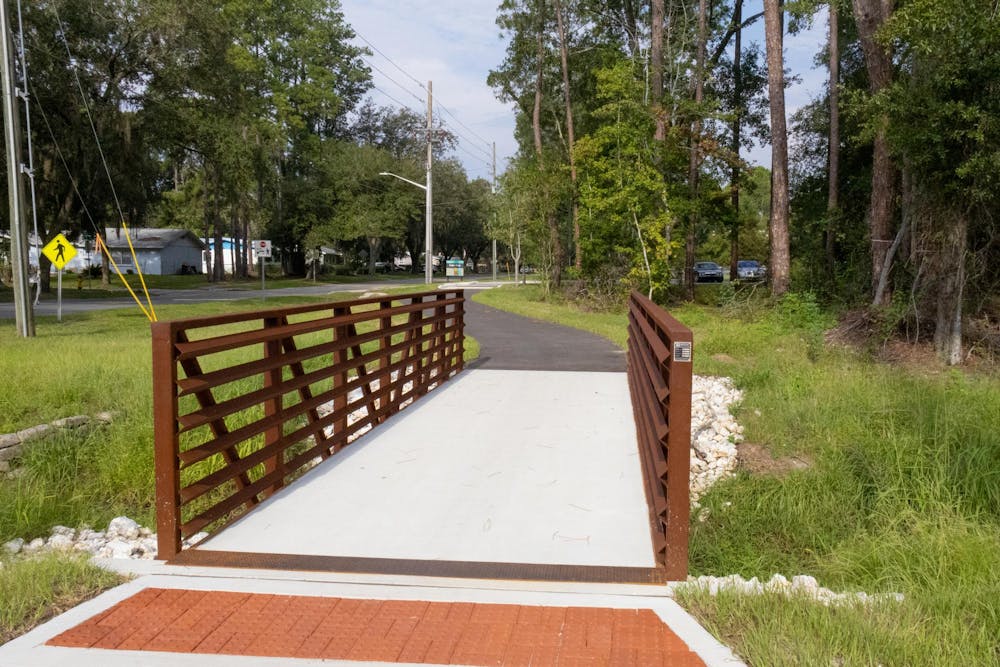
A nearly mile-long multiuse trail in East Gainesville was completed this summer as part of the city’s push to develop infrastructure in the region.
Since the creation of the Gainesville Community Reinvestment Area in the early 2000s, the city has invested millions of dollars into its east side, which is home to several historically Black neighborhoods and has often gone underdeveloped and underfunded.
The multiuse trail is intended to create more opportunities for lower-income residents by connecting homes, jobs and schools.
The $1.5 million project, fully funded through the Wild Spaces and Public Places surtax, promotes walking, jogging, cycling and all forms of wheeling, according to the city.
The nearly 10-foot-wide path connects residential and commercial areas, providing safe access to Unity Park and Flatwoods Conservation Area.
It’s meant to expand transportation options, support local businesses and attract visitors from outside the region, according to the city.
Letiesha Shaw, an admissions supervisor at UF Health Shands Hospital’s patient access center, recently bought a home in East Gainesville, where she’s lived for 15 years.
Although Shaw has noticed more people using the trail and sees value in giving children a sidewalk on 31st Street, she said the project doesn’t address what the community needs most.
“It doesn't lead to anywhere,” Shaw said. “I don't think it's nothing that's going to improve anything, building that little walkway, no.”
She said East Gainesville needs more opportunities for children to participate in sports and stay active. Limited support and costly facilities force families to travel to Newberry and Alachua, Shaw said, where more programs are available.
“We don't have the support and the little areas that they do have,” she said. “Most of them are costing an arm and a leg.”
Shaw was unaware of the trail project until construction began in October 2025.
The trail along Northeast 31st Avenue is part of the proposed Eastside Loop Trail, which would extend south to University Avenue near Fred Cone Park and Hawthorne Road at Southeast Eighth Avenue.
Kathleen Becker, a 47-year-old mother of four, has lived in East Gainesville for 12 years. During that time, Becker said she’s seen housing prices rise as the number of available housing units declines. Data shows median listing prices rose by only about 11% between 2025 and 2026, with home prices down 6%, while the number of homes sold remained steady.
However, Becker doesn’t think neighborhood improvements are behind the housing inflation, she said, blaming rising housing costs on broader economic factors instead of local governance.
Becker’s glad to see the city making improvements to its east side, an area she said has long been ignored.
“I think this part of the city should be treated as desirable as any other,” Becker said. “The people who live here are families. They're good people. It's not some big, scary place.”
Still, while she appreciates the city’s efforts in improving the area, she said there’s only so much it can do to remedy the lasting effects of historical redlining and school segregation. A thoughtful rezoning plan could create equity in the area’s schools, she added.
Recent Alachua County Public Schools rezoning decisions disproportionately affect East Gainesville, according to previous reporting from The Alligator. The district’s draft plan proposed the closure of five schools, three of which — Williams, Rawlings and Duval — are located on the city’s east side. The now-closed Foster Elementary School, located on Northwest Sixth Street, is often considered part of greater East Gainesville.
UF history professor Steven Noll agreed changing these deeply rooted patterns offers a significant challenge.
Gainesville has historically been divided by race and class. Many Black residents were forced to live in East Gainesville — where there were fewer opportunities — as a result of discriminatory housing policies.
East Gainesville has historically received less investment in its infrastructure than other parts of the city because money and political influence tend to draw in development, Noll said.
And that imbalance extended to education, he added. Higher-performing schools on the west side attracted families who could afford to move there, so East Gainesville tended to have a lower average income than the other side of the city, and it has remained that way for decades, Noll said.
“Investment goes where the people who have the most money are,” he said.
Noll said UF historically operated as its own community around 13th Street, rarely getting involved beyond its campus. The lack of investment only exacerbated the imbalance between East and West Gainesville, he said.
In recent years, the university has recognized an opportunity to help East Gainesville, Noll said, particularly through its health programs and facilities such as the UF Health Urgent Care Center and the UF Health Family Medicine located at 410 NE Waldo Road.
But UF hasn’t invested much east of North Main Street, near Eastside High School, he added.
The trail could help, Noll said, but economic development, affordable housing and access to grocery stores remain higher priorities than a shared-use path. East Gainesville remains a food, school and news desert, he added.
“I think those things are much more important than building a trail, although building a trail is a nice opportunity, represents some connectivity,” he said.
The fact that schools in East Gainesville are closing because of declining enrollment while west Gainesville continues to grow shows there is a long way to go in connecting the east side to the rest of the city, Noll said.
The city needs to attract more businesses, particularly grocery stores, to East Gainesville, he added, but businesses will first need to see a path to profitability.
“Gainesville needs to make some sort of attempt to develop businesses on the East side of town,” Noll said. “I mean, people aren't going to go and build a store there if it's not going to be profitable.”
East Gainesville residents might be wary of new investments, he added, because past developments have contributed to gentrification rather than creating beneficial change.
Noll’s solution to avoiding displacement while improving quality of life in East Gainesville is to build affordable, low-cost housing and develop transportation infrastructure so people can more easily live and work there, he said. Investing in schools to get people involved and engaged is also a good start, he added.
Mayor Harvey Ward, who was born and raised in East Gainesville, said he’s deeply passionate about the city’s investment in the area. He’s particularly proud of the new UF Health clinic, a partnership between the city and UF, and the new residential developments being built in East Gainesville.
While the Northeast 31st Avenue trail is not the city’s largest project in East Gainesville, Ward said the city remains committed to expanding its trail network and making transportation options accessible to residents across the community. For residents who can’t afford a car or the cost of gas, he said trails can provide an important alternative to get around the city.
“The way that we go about not leaving folks behind in our community is making sure that there are multiple ways to get from point A to point B,” Ward said. “We have to be very intentional about it being everywhere.”
He said the city will be investing an “enormous amount of public investment,” over $100 million, in East Gainesville for transportation infrastructure, public transit, recreation and healthcare, with the hope of bringing private investment back to the east side of town.
“What we're intentionally doing is trying to make it as attractive as possible for the private sector to invest,” Ward said.
Private companies have stopped investing in East Gainesville over the past 50 years, he added, so the city is trying to attract investors by making it into a dense, thriving set of neighborhoods.
“When we spend public money, private money should follow, and that means that more people will want to live there,” Ward said. “We want all our neighborhoods to be vibrant and to be places where people want to live.”
Although the numbers are not yet showing fewer vacant properties on the east side of town, Ward is hopeful for the future and said he’s glad to see things start to change for the better.
Current and planned investments in East Gainesville include the new trail, renovations to Tom Petty Park, the planned RTS Eastside Transit Hub and the Northeast Eighth Avenue/Waldo Road revitalization project, according to city spokesperson Rossana Passaniti.
The revitalization project includes the construction of a new fire station and renovations to the multipurpose fields, Hunter Pool and Martin Luther King Jr. Multipurpose Center.
Contact Sara Dhorasoo at sdhorasoo@alligator.org.

Sara is a journalism senior at UF. She is currently serving as The Alligator's race and equity reporter, and previously served as the first amendment reporter, in spring 2026. Before transferring to UF, Sara earned her Associate of Arts in Mass Communications/Journalism from Miami Dade College, where she served as staff writer for The Reporter. She grew up in France and aspires to return there and work as a journalist, after graduating.


