
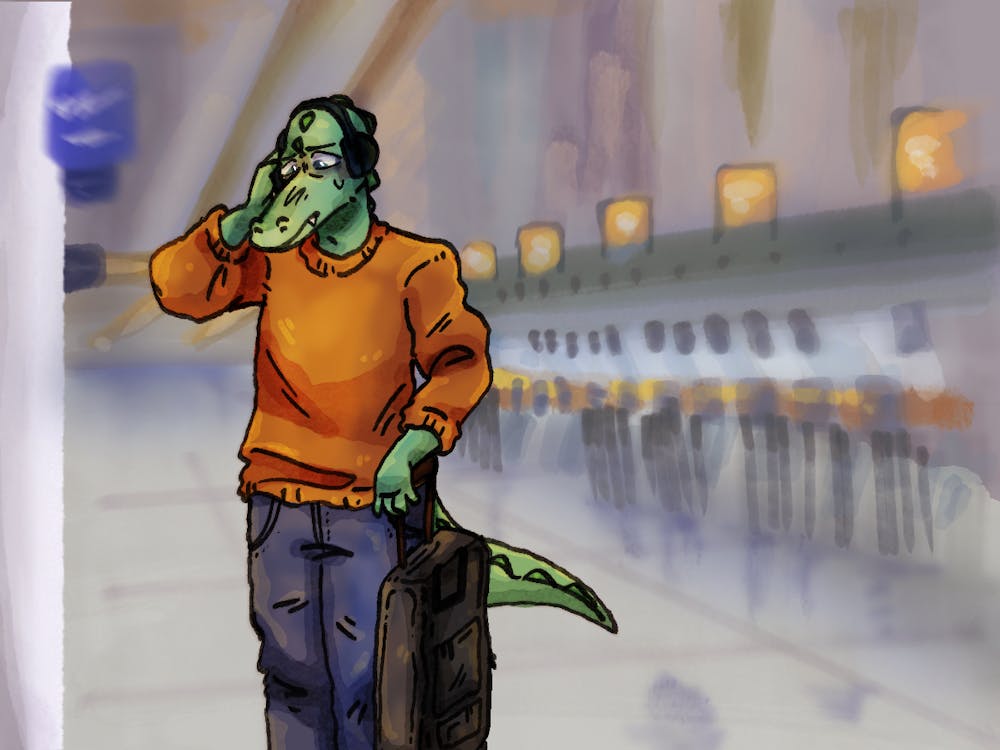
Temporary airspace closures across the Caribbean, triggered by U.S. military strikes on Venezuela Jan. 3, disrupted travel for many UF international students trying to return for the Spring semester beginning Jan. 12.
Although the Federal Aviation Administration, which oversees flights across the country, lifted its restrictions the following day, normal operations were slow to resume. Airlines scrambled to reorganize schedules and accommodate thousands of stranded passengers after widespread cancellations.
With more than 5,200 international students enrolled at UF, including hundreds from South America, Central America and the Caribbean, the wave of disrupted flights immediately affected those trying to return to campus.
Juan Alban, a 22-year-old UF business administration senior, was among those forced to make last-minute changes to his travel plans. Initially, he planned to leave Colombia Jan. 11, the day before classes began.
But his original flight was canceled, forcing him to reschedule to the only other available departure for that day. The flight involved an unusually long layover, though, and he didn’t arrive back in Gainesville until Monday afternoon after 18 hours of travel.
His layover took place at José María Córdova International Airport in Medellín, Colombia.
“The most frustrating part was the waiting,” he said. “There wasn’t even anywhere to eat.”
The Medellín layover, which is ideal for short flight connections, stretched for 11 hours. He said the airport would not allow passengers into the gates because of the long gap between flights, even though most airport shops and restaurants were closed.
“While several airlines adjusted or canceled flights during the weekend of the strike, all decisions regarding service are made directly by the individual airlines,” said Angela Starke, Orlando International Airport’s senior vice president of public affairs and community relations, in a statement.
Matthew Lara Fernandez, a 21-year-old UF political science and theatre senior and dual U.S.-Peruvian citizen, experienced delays throughout his journey back to Gainesville. He flew from Madrid to Lima, Peru — a route that normally crosses Venezuela.
Although his flight wasn’t canceled, Lara Fernandez explained his Air France flight flew to Guyana and then south to Brazil before traveling west to Peru, leading to an extra hour delay on the 11-hour flight.
“Thank God [Peru] wasn’t as affected,” he said as he mentioned most flights to Lima were rerouted rather than canceled, resulting in some inconvenient delays.
Lara Fernandez said he empathized with his UF international student friends who weren’t as lucky, with flights to Colombia and Caribbean islands resulting in cancellations or severe reroutings. Many travelers returning from the holidays were left with no choice but to extend their hotel stays and increase their spending due to being unable to secure departure flights.
Manuel Martínez, a 22-year-old Santa Fe College digital media technology senior, was left stranded in Puerto Rico after his flight was canceled.
“I was going to be missing class days and also probably work,” he said, as Santa Fe began classes Jan. 5. “It concerned me a lot.”
He was supposed to leave Jan. 4 but struggled to find a flight to reschedule. The airport was full, and nearly every terminal was packed, he said, as airlines tried to squeeze as many passengers as possible onto already overbooked flights. In the end, he was able to reschedule his flight for Jan. 7 and return to Gainesville.
Above all, he said he found a positive side to the outcome of the flight disruption.
“After I showed my concerns over making it home in time, I relaxed for a minute, and [my family and I] decided to spend the whole day … just enjoy[ing] the day as it is.”
Contact Ariana Badra at abadra@alligator.org. Follow her on X @arianavbm.
Contact Aaron Zagal Yaji at azagal@alligator.org. Follow him on X @azagalyaji.
Ariana is a first-year journalism major and an El Caimán reporter for the Fall of 2025. In her free time, she enjoys reading, spending time with friends and scouring for new songs to play on repeat to an absurd degree.
Aaron Zagal Yaji is a Public Relations and Economics freshman in his first semester at The Alligator. He covers El Caimán's metro beat. In his free time, he enjoys going to the beach (or reminiscing about it), cooking Peruvian food, and squandering his money on golden shiny things.