

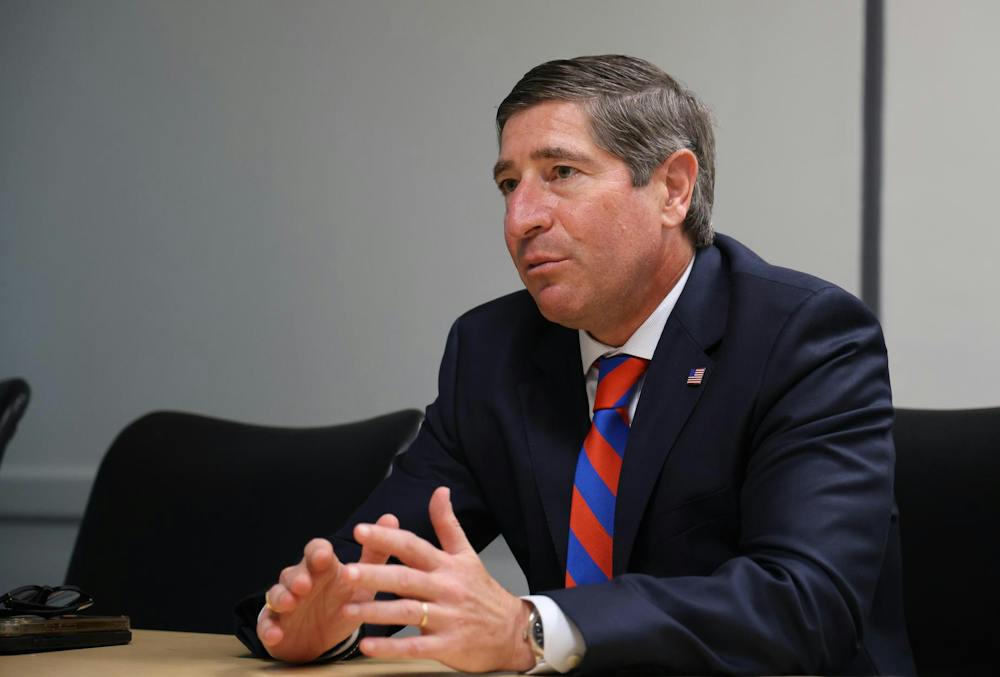
Scott Kupor, the director of the federal Office of Personnel Management, kicked off his college speaking tour at UF on Tuesday with the goal of recruiting college students to the public sector.
The OPM manages and provides guidance over hiring practices across the federal government, and the Senate confirmed Kupor as its director in July 2025 after he was appointed by President Donald Trump.
From the start of his term, which ends in 2029, he’s wasted no time launching an overhaul of the federal hiring process, implementing a more merit-based hiring plan, advocating for increased accountability within the government and the use of artificial intelligence in the hiring process.
On Aug. 27, Kupor sent out a memorandum to all federal offices and agencies outlining the guidelines for using AI within the hiring process.
“Agencies may be compromising efficiency and quality in Federal hiring by failing to adopt the use of Artificial Intelligence,” the first line of the memo said.
In an exclusive interview Tuesday before his campus event, Kupor spoke with The Alligator about the goals and policy initiatives he hopes to implement during his next three years in office.
The following interview has been edited for length and clarity.
Q. What advice would you give to college students hoping for careers within the federal government during a time when there are so many positions being cut?
What’s happening in the federal government is what I would call a reshaping of the workforce, basically. So, there’s definitely areas where we’re having to make some harder decisions to say, “OK, we may have done 20 things in the past, now we can only do 18 things.”
The areas we're focused on, though, are the growth areas for the government. We're particularly interested in people, obviously, who can help us advance the modernization efforts in the government, and we're trying to change the opportunity we see in the federal government.
My best advice for people is: If you think you're interested in building your career, I think the federal government is a wonderful place to do it. We are the single largest employer. We operate at a scale and level of complexity that's very hard to find in other places.
My big appeal to college students is: We don't need people to make a 40-year commitment to the federal government. That's totally fine. Come a couple years, see if you like it. Let us help you build and develop a skill set, and then, if you decide you want to go in the private sector, I'm very confident the skills you'll develop will be very applicable to the private sector.
Q. What should students change about their job hunting approach to better align with the hiring practices you're hoping to implement across the federal government?
The big thing we're focused on is, and we've rolled out, what we called a merit hiring plan, which hopefully should not be controversial to people. The basic changes we're trying to make is we're trying to actually figure out, “How do we assess people's skills and talents for the particular job they're doing?” And, historically, in the federal government, people would actually do a self-attestation. You would say, "Hey, I'm a journalist. I have these particular skills,” and you would rate yourself on some scale, and that's fine. But as you can imagine, that's prone to challenges.
So, where we can, we're trying to roll out what we call assessments, which are kind of — I hate the word tests, but since we're in a school environment, maybe let's use that — things intended to be predictive of your ability to perform at the level of the skills required for a job.
My main advice to people is to make sure we understand who you are, what specific technical or other skills you have, what motivates you, what are the other things — the softer skills — that would make you a good employee. Whether that's teamwork or the ability to work in complex environments, just help us understand it. The interview process, in my mind, is a discovery process. It's a way for us to figure out who you are as an individual. It's an opportunity for the student as well to figure out, “Are these the kinds of people I want to work with or not?”
Q. How much progress has been made on implementing that merit-based system throughout the federal government, and what was behind your push for that?
If you go back to pre-1980, basically the federal government had what was called PACE, which was an assessment — like a test, essentially — for skills. That was abandoned in ‘80, ‘81 because it was found it had a disparate impact on minority applicants relative to majority applicants.
So, the government entered into what's called a consent decree, where basically the government said, “We agree that we're not going to use this.” In the intervening 45 years, what developed is something that, at least from my perspective, is less valuable, which is this idea that I mentioned of self-attestation. So, people would self-assess their skills just through a questionnaire form, and I think that's prone to problems and doesn't reflect true skills.
So, one of the things we did when we first came in was work with the government and rescind that consent decree. We felt it was outdated, and actually the plaintiffs in that case actually worked with us, and agreed this was no longer needed. That allowed us to introduce a new set of assessments that we've worked with industrial psychologists and stuff to make sure they don't have the same bias that maybe those old tests had and that they're very predictive of the skills.
So now we have a test that covers all the jobs we're interviewing for. Simultaneous to that, what we want to do, and we started, is develop what I call technical assessments. So, if you're applying for an engineering job today in the federal government, now you will take a software coding test, for example. Or if you were applying for a PR or a journalist job — again, hopefully, we haven't designed this yet — we’d hopefully have some test which is like, “Do you understand basic journalistic principles?” and things of that sort. So we've built what I would call the generalized skills test. Now we're trying to build the particular technical assessment. That's a very positive step, and the goal is we want everybody who is recruiting for a job to go through some type of formal assessment or structured interview, which would be like a subject matter expert interview.
The goal is to get to 100%. Today, we're about 70% roughly, is what our compliance with that is, which is much better than basically the 25% that we were at a year ago.
Q. Is the switch to these merit-based hiring practices a reflection of the changing rhetoric around DEI?
This is not a DEI issue. To me, this is an issue of what we want.
Look, the goal in my mind of hiring is you want to, as best as you can, match people's skills to the requirements for the job, and we want to avoid inherent bias that always creeps in.
I'll give you an example. I've interviewed millions of people over time. Oftentimes, when you interview people, you find something in common — we went to the same school together — and there's no question whether you intend for it to or not, [but] I think that implicitly biases your assessment of that individual. You feel some sort of camaraderie or something with that individual, and so the whole idea is: How do we eliminate those as much as possible? So, assessments are kind of an actual way to determine someone's physical aptitude for something, and then we do a structured interview. A structured interview is literally [where] we ask the exact same questions to all the candidates.
Now we actually have an opportunity with AI to have an AI agent do those things, record those, so that I, as a hiring manager, am not subject to my own biases [if] you and I hit it off. That's how I think about it. DEI is a totally separate issue, as you know. Obviously, when President [Trump] first came in, the goal was to eliminate DEI as kind of a hiring criteria, but to me, merit hiring is really about, “How do we eliminate any biases but also make sure that we have the right structural fit between the needs of the job and the skills of the applicant?”
Q. How do you plan to balance AI and human oversight in the hiring process?
The basic guidance in its most simple level says AI can be used as a tool to help inform the process; AI itself cannot be a decision maker. And so, this structured interview to me is a great example. So there, we literally have a set of questions, and we want to hear the applicant's answers. It's not a great use of my time or your time for me to get on the phone with you and do that, and you should be able to do it in your pajamas late at night.
What the AI allows us to do is it'll give us a full transcript of that review. I can read all 10 of those transcripts from 10 different applicants and then obviously make some decisions on that basis. So, to me, that's a good example of where the AI is helping improve the efficiency of the process. It's helping actually create a written record. The notes the AI will take will be way better than my notes because they will record verbatim what you said. But the AI is not making a decision. The AI is not telling me, “Hire this individual A over individual B.” It's just actually helping me summarize and see the information in a consumable form in a way that hopefully improves the application process. So, it's stuff like that.
We're not doing this yet today, but certainly you can imagine AI would be good at a resume screen, looking at a whole set of resumes and trying to kind of do some distillation as to “OK, these individuals have this particular background” or “These individuals have that background.” That's not happening at all in any scale today in government. But my expectation would be over the next year or so, that we will be able to develop tools that will help do that. And in my mind, the goal hopefully is to reduce any kind of implicit bias, get informational value from resumes or other stuff, and then help improve the efficiency of the process.
Q. You said in 2025 that all employees should be at will and fireable. Do you think that is a realistic change? Is this something that's just in an ideal world, or do you actually plan to implement that in this new hiring process?
So number one, I can't do it. That would require legislation from Congress. So, there is a whole set of civil service protections, right, that have been set up so I can't do that. Maybe a better way to phrase what I would say is: Look, I think there's two things we should be doing in the employment side of things. One is, I do think that we have not historically done a good job of accountability of individuals. If you talk to any kind of federal managers, what you'll find is they'll say, "Hey, we have people in our organization who just clearly are not holding up their end of the bargain.” But it's very, very difficult because of the civil service protections to fire people, and so as a result, a lot of those tend to go unaddressed. If you look at the ratings of people or stuff like that, that's a serious problem.
So, number one is, I do think we should have more accountability, and part of what we're doing is number one, training managers to do that, and also making sure that from a policy perspective, to the extent that people are not performing well, they need to go on a plan. If they don't actually successfully complete that plan, then at some point they need to be exited from the organization. But that has to be done, obviously, within the context of the existing civil service rules, not at-will employment laws.
On the other end, I do think the other challenge in government is we've not done a great job of differentiating performance on the top end. So, today there's what I would call “grade inflation” where basically everybody gets an A, and as a result, therefore, like differentiation, performance standards, bonuses, promotions and stuff, I think, are not actually handled well. So that's what I would think about. Look, we're never going to get at-will — I shouldn't say we're never, [but] I don't think we will ever get to at-will employment. Certainly, it's not something we can do at the agency level. It would require legislation. But to me, in the absence of that, is, how do you increase the accountability of the organization and hopefully make it as successful as possible?
The Alligator’s interview was cut short after this question when right-wing political commentator and YouTube personality Benny Johnson walked into the room.
“This looks very hardcore,” he said. “This looks like a very mean interview. I don't want to be part of that. This looks very fake news.”
He then added, “I’m just kidding.”
Following the interview, Kupor hosted a “fireside chat” moderated by Johnson in the Reitz Student Union Auditorium to talk about employment opportunities within the federal government and the OPM’s goal to hire more early-career candidates.
The chat drew about 60 people, about 10 of whom asked questions about how they could get jobs within the federal government after graduation.
“We hire between 100,000 and 200,000 people a year, total,” Kupor said. “Our goal is we want a third of those new hires to be from what we call ‘early career.’”
He added this means there will be 30,000 to 50,000 job openings every year.
“If you start early in your career, you actually have the greater flexibility to be able to not only get parity from a pay perspective, but also then to take that experience and actually use that to translate it to a private sector opportunity, ” Kupor said.
People who start their careers in the federal government have a great launchpad for the next era of their careers, he added, and putting in the work in these agencies gives people a valuable perspective about how the world works.
Contact Alexa Ryan at aryan@alligator.org. Follow her on X @AlexaRyan_.

Alexa is a junior journalism and international studies student and The Alligator's Fall 2026 Enterprise editor. She previously served as the criminal justice reporter and the Enterprise politics reporter. In her free time, she enjoys running, traveling and going on random side quests.


