

UPDATE: As of June 12, 2026, Former Florida Rep. Anthony Sabatini, who put forth concerns about Bell’s career trajectory and beliefs, has withdrawn from the race for the Republican primary for Florida's 11th Congressional District.
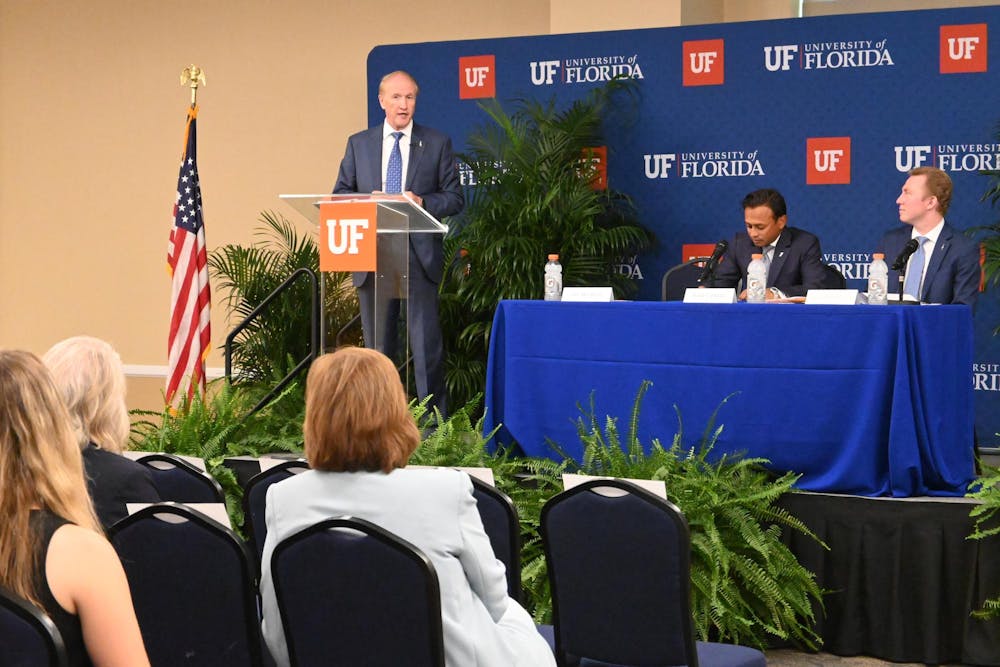
Former University of Alabama President Stuart Bell is one vote away from potentially becoming UF’s next president as scrutiny intensifies over Florida’s university leadership process.
Florida’s university system requires presidents to gain approval from both a university’s Board of Trustees and the state’s Board of Governors. While trustees conduct the search and select a finalist, the Board of Governors holds final authority to confirm the candidate.
After receiving unanimous approval from UF’s Board of Trustees June 10, Bell was scheduled to appear before the Florida Board of Governors June 24 for final confirmation.
However, Board of Governors Chair Alan Levine wrote in a June 17 letter to Chancellor Ray Rodrigues that the board would be delaying the vote indefinitely, citing university governance concerns.
Levine said he’s concerned UF policies may allow too much authority to be afforded to one person, empowering individual trustees or board chairs to make decisions that should be made by the full board.
In a May 20 letter to Rodrigues, he said it would be “egregious” if decisions were removed from full-board, public deliberation.
According to a message posted on UF’s X account, the decision to postpone Bell’s vote is “unfair to Dr. Bell and harmful to the University of Florida and the students, faculty, alumni, and supporters we are entrusted to serve.”
On June 22, the Board of Trustees voted unanimously to make Bell UF’s interim president.
His interim appointment will begin July 1 and run through June 30, 2027. The agreement states trustees “intend and expect” Bell to be confirmed by the Board of Governors, at which point a permanent presidential contract would replace his interim position.
Bell’s interim position is also subject to ratification by the Board of Governors.
This all comes just over a year after the Board of Governors rejected former presidential finalist Santa Ono in a 10-6 vote. Ono, a former president of the University of Michigan, had secured unanimous support from UF trustees before state officials blocked his appointment, forcing the university to restart its search.
Ono’s rejection came largely because of his past support for diversity, equity and inclusion programs, which he was questioned about in a Board of Governors meeting last year. Although Ono closed DEI offices during his presidency at Michigan, the board wasn’t convinced his support of the initiative had wavered.
Bell has also received eerily similar criticism for his work at the University of Alabama.
Former Florida Rep. Anthony Sabatini, took to X and Instagram May 18 to share his position on Bell’s career trajectory and diversity, equity and inclusion beliefs.
“Major red flags here,” he wrote. “The UF Board of Trustees must pump the brakes on this ASAP.”
Bell opened UA’s Division of DEI in 2017. However, he ordered it shut down in 2024 to comply with federal legislation banning support of DEI, replacing it with the Division of Opportunities, Connections and Success.
UF called DEI “discriminatory by design” in its May 22 response to an X post by Linda McMahon, the U.S. Secretary of Education. McMahon’s post expressed the need for UF’s next president to pursue reforms against DEI.
Now, higher education researchers, state officials and even some students say Bell’s confirmation hearing represents more than a decision about the candidate himself.
They say the outcome could shape perceptions of the university’s presidential search process after years of leadership turnover and scrutiny over how UF selects its leaders.
John Sailer, the director of higher education policy at the Manhattan Institute, said a second failed presidential search would point to a deeper flaw in the selection process.
“If the Board of Governors decides to veto the choice, that is a definite indicator that there’s something that the Board of Trustees is doing that’s just not working,” Sailer said.
Should Bell be confirmed, he will be the school’s fourth leader in roughly four years.
Former president Ben Sasse resigned in 2024. Former president Kent Fuchs stepped in as interim president for a year.
After the Board of Governors rejected Ono last year, Donald Landry, who served as the chair of Columbia University’s Department of Medicine for 16 years, was appointed as interim president. He’ll continue to fill the role while Bell awaits confirmation.
For some, the possibility of another presidential rejection by the Board of Governors raises questions about whether UF’s search process is consistently producing candidates who are able to secure support from both boards and the general public.
“That would suggest a deeper issue,” Sailer said.
He said presidential searches work best when multiple stakeholders have opportunities to provide feedback throughout the process, particularly when authority is divided between different governing bodies.
“At the broadest level, what you need is transparency, and you need sufficient feedback from different layers of stakeholders,” he said.
UF declined to comment on questions relating to the presidential search process.
In a May email to Florida Chancellor Ray Rodrigues, Board of Governors chair Alan Levine called for a review of governance practices across the State University System after concerns he said arose while reviewing UF’s presidential search.
The email, sent by Levine to The Alligator, focused largely on fiduciary responsibility and the authority of university boards.
“Ultimately, the governance of each university falls squarely under our purview, and we have an obligation to be able to assure Floridians that our universities are governed based on not only the law, but proven best practice,” Levine wrote.
A systemwide review of governance structures might be necessary, he added.
UF is one of the state’s flagship institutions, enrolling about 61,900 students across undergraduate, graduate and professional programs as of 2024, according to university data. Some of these students are also concerned about UF’s leadership turnovers in recent years.
One UF graduate student studying humanities, whom The Alligator has granted anonymity due to concerns about immigration status and future visa implications, said they believe the repeated searches reflect broader instability in university governance.
“The fact that we have been doing this three or almost four times over the past four years is abysmal,” the student said. “If you have to do something so repetitively, it means something is wrong.”
The student said frequent presidential searches and interim appointments make it difficult to view university leadership as stable.
“When we don’t have a person that can have long-term policies, the student body also suffers,” the student said. “We won’t have the possibility to have a two-year vision because the presidents are going to be here for one year.”
Avery Bollinger, a 23-year-old UF public health doctoral student, said the succession of presidents and interim leaders has left her concerned about the university’s trajectory and the role of politics in leadership selection.
“I’m very concerned for the direction of our university,” she said, “and the direction that it’s been going within the past few years.”
Bollinger arrived at UF during the appointment of former president Sasse and has since seen multiple leadership changes.
“The rejection of Dr. Ono and then now the appointment of Dr. Bell, that all feels like students aren’t being represented,” she said. “We aren’t being heard.”
She said the process seems to align more with politics than students’ desires. Bollinger questioned whether the search process adequately reflects student priorities.
“I don’t really think they know what the students want,” Bollinger said, “And I also don’t think that they care.”
Contact Swasthi Maharaj at smaharaj@alligator.org. Follow her on X @s_maharaj1611.
Swasthi Maharaj is a political science and politics, philosophy, economics and law (PPEL) junior at UF. This is Swasthi's fourth semester at The Alligator, and her third semester on the university desk. She's also reported on the enterprise desk. Swasthi loves coffee, reading, going to concerts, baking and taking long walks.


