

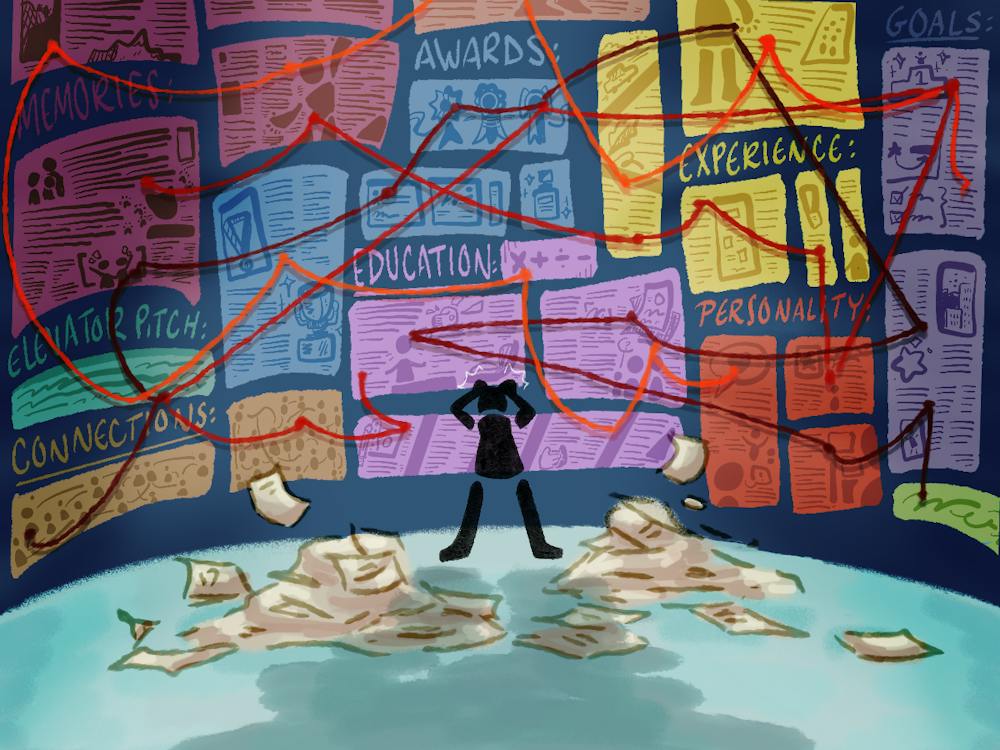
There is a strange pressure to make our lives “make sense.” We like to believe there’s a thread connecting who we were, who we are and who we’ll be. Our varied interests should reveal a common truth. Our choices should point somewhere. Even the things we do for fun somehow indicate the kind of person we are.
Psychologists Dan McAdams and Kate McLean call the evolving story we construct about ourselves our “narrative identity.” By connecting our reconstructed past with an imagined future, these stories can give our lives a sense of unity and purpose. This can be a good thing. Looking back, a narrative helps us understand why certain experiences mattered to us more than others or how we became the people we are now. The problem begins when we take a story meant to explain ourselves and turn it into a requirement for who we are allowed to become.
Once we decide who we are, maintaining that identity can become surprisingly important. Maybe you‘re the academic one. The artistic one. The outgoing one. The future doctor. The one who hates parties. The one who loves them. Eventually, we start asking whether a choice fits that identity before asking what we want.
Research from psychologists Daphna Oyserman and Mesmin Destin helps explain why. Their work on "identity-based motivation" suggests our sense of self influences which behaviors feel natural to us. When something feels inconsistent with who we believe ourselves to be, we can interpret that difficulty as evidence it’s simply "not for people like me.”
But how are we supposed to discover what is “for us” if we only try things that we think resemble the idea of us?
This pressure becomes glaringly obvious in college, where having a coherent narrative is a barrier to entry. Applications ask us to turn years of unrelated experiences into a few hundred words explaining who we are and who we want to become. Professional programs expect us to do the same. As someone considering medical school, I know I’ll eventually have to explain why my various experiences all point to a future in medicine.
There is nothing unreasonable about asking applicants to explain their motivations. The danger appears when we internalize that expectation so deeply that we choose experiences based on how neatly they’ll fit into a future explanation.
I see this in my own life. I’m a pre-med student, but I also write opinion columns for The Alligator. Writing has little to do with the career I’m pursuing, and that’s partially why I value it so much. I don’t write because it strengthens some larger narrative of who I’m supposed to become. I write because I love doing it.
A hobby doesn’t need to reinforce our career. A class doesn’t need to contribute to a larger goal. We can try something and quit because we hate it. We can become interested in something completely unrelated to everything else we like. We can be terrible at something and continue doing it anyway. Not everything has to advance the plot.
Yet the more attached we become to our own narratives, the easier it is to reject contradiction. We protect our identities because consistency is comfortable.
The alternative is admitting that, perhaps, I don’t know myself as completely as I thought. That uncertainty can be uncomfortable, but it also leaves room for change. There should be parts of our identities that our younger selves could never have predicted. Otherwise, we aren’t really discovering ourselves. We’re just following a character outline we wrote years ago.
None of this means we should abandon narratives altogether. There is value in looking at the scattered pieces of our lives and finding a cohesive meaning. We need stories to understand where we have been. We just don’t need to have a predetermined ending we're always pushing toward.
There is a difference between finding meaning in our choices and requiring every choice to have meaning before we make it. Our lives should produce the stories we tell about ourselves, not the other way around. A narrative should be written backward, not lived forward.
Contact Shirin Khizzar at Skhizzar@alligator.org. Follow her on X @Shirinkhizzar.

Shirin Khizzar is a sophmore studying Public Health. This is her first semster working on the Alligator staff. In her free time, she enjoys reading, listening to music, and watching movies.