

Peach, a 6-year-old beagle, was once just called “CTU-9,” the number she was assigned at Ridglan Farms, a now-closed beagle breeding and research facility in Blue Mounds, Wisconsin.
Peach’s former identification is tattooed on her right ear. A tattoo across her stomach reads “WIAE,” which stands for Wisconsin Animal Experiment, a standard practice at animal testing facilities.
Over 2,000 beagles were once held at Ridglan Farms, where they were subjected to animal testing and experimentation. A 2022 study found research beagles exhibited increased fear, attachment and abnormal behaviors compared with nonresearch beagles.
Kim-Anne Dodd, Peach’s owner, planned a Sept. 26 event for Gainesville residents in solidarity with the March to Abolish Animal Testing, a 200-mile, two-week walk from Albany, New York, to the Marshall BioResources facility, a for-profit company that breeds animals intended for research, in North Rose, New York.
Dodd said Peach spent over six years in Ridglan Farms before she was released May 2. A month later, Dodd and her husband adopted her from Big Dog Ranch Rescue in Loxahatchee Groves, Florida.
Dodd’s connection with Peach was instant, she said.
But Dodd said the years Peach spent caged indoors and subject to testing have presented challenges in caring for her.
Peach suffers from PTSD, panic attacks and frequent seizures. She also has dozens of “debilitating” allergies, Dodd said, which limit her from touching grass, disrupt her breathing and cause skin infections and fluid-filled blisters. Peach’s medical complications don’t end with allergies, either.
Peach required extreme dental surgery, mammary gland tumor and melanoma removal in the month after her adoption, Dodd said. She also had yeast infections in her ears, patches of missing fur and paws swollen to double or triple a healthy size.
Dodd and her veterinarian determined the swelling was likely from spending almost seven years on concrete and in wire cages, she said, which may have also caused significant tooth wear and decay. Dodd believes Peach’s other medical complications originated from experiments and testing at Ridglan Farms, she added.
Despite Peach’s lifestyle restrictions, need for constant supervision racked up in more than $6,000 veterinary bills, Dodd said she is bonded to her. She’s even curated Peach’s social media presence.
“I can’t imagine my life without Peach,” said Dodd. “Where she struggles medically, she more than makes up for it with emotional and physical [affection].”
Beagles are commonly used for dog testing because of their small size and docile nature, according to the Beagle Freedom Project.
“They picked the beagles because they’re so precious, and they just take it,” said Missy Crutchfield, a media coordinator for the March to Abolish Animal Testing. “What they’re doing to them is horrific.”
Crutchfield said she met someone who rescued a beagle that spent over a decade undergoing testing at Marshall BioResources before being sold to a veterinary school for more experimentation. The dog was ultimately released because the university did not want to continue paying medical expenses, Crutchfield said.
Universities, including UF, and other animal testing facilities purchase animals from Marshall BioResources to use for testing. UF Animal Care Services purchased 19 cats from Marshall BioResources to be used in a 2024 study.
The protocols followed in the experiments were approved by the UF Institutional Animal Care and Use Committee, according to the article, and all procedures complied with the Guide for the Care and Use of Laboratory Animals.
UF experimented on nearly 800 dogs in fiscal year 2025, according to annual reports filed with the U.S. Department of Agriculture. Of those dogs, about two-thirds were part of experiments that reported no pain, distress or use of pain-relieving drugs. The other third were used in experiments that reportedly created pain or distress and were given anesthetics, analgesics or tranquilizers in expectation or observation of pain, according to the annual report.
UF also selected six beagles to be included, with approval from the animal care committee, in noninvasive sensory testing that applied pressure to the dogs’ skin, gradual increases in temperature and electric nerve stimulation.
The Institutional Animal Care and Use Committee didn’t respond to multiple requests for comment across three days.
Solidarity event
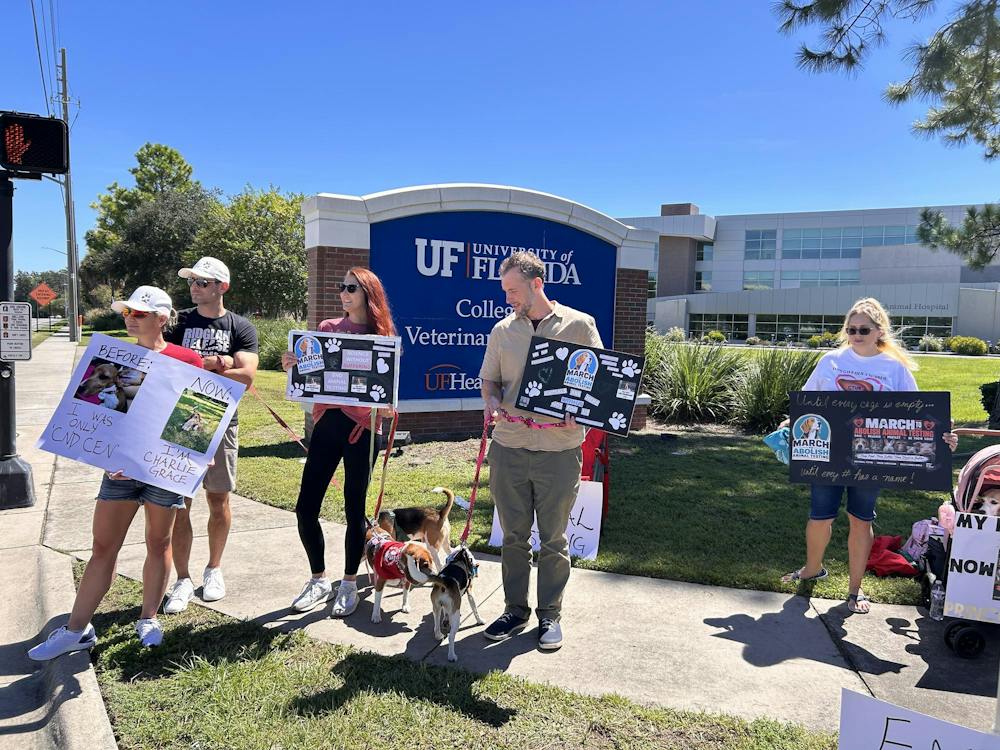
Ten owners of previous test beagles gathered in front of UF’s College of Veterinary Medicine with their pets Sept. 26 to protest testing on animals or breeding them to be experimented on. Drivers honked carhorns as they drove past the crowd and its signs.
“END ANIMAL TESTING,” one sign read. Others showed beagles “before,” when they were still known by their identification numbers, and “now,” with their new names.
As horns beeped, two of the five beagles yipped and shrank away from the road.
Lisa Sapp, a biochemist with a bachelor of science from UF, attended the solidarity event with her beagle from Ridglan Farms.
“As a scientist, I feel like it’s time for us to start looking at alternative methods for making sure that our drugs and our products are safe and effective,” she said.
She added that 92% of drugs that pass animal trials fail in human trials. Testing methods like organ-on-a-chip, computer-generated models and artificial intelligence are promising alternatives, she said.
Organ-on-a-chip testing uses living human cells to simulate organ functions, while computer-generated and AI alternatives attempt to predict how cells and organs will react to drugs or chemicals based on previously collected data.
According to a Harvard article, certain diseases and treatments can only be studied in animals. And alternatives do not sufficiently replace animal testing.
Testing on animals can also be more effective at replicating multi-organ interactions than using human cells from individual organs, according to the Swiss Academy of Sciences.
Ella Magers, who co-founded the March to Abolish Animal Testing, completed the march on Sept. 26 with about 1,000 others.
“We don’t have to choose between compassion and science,” Magers said. “We can have science without suffering.”
Contact Christian Haas at chaas@alligator.org. Follow him on X @ChristianH58745.
Christian is an environmental reporter with The Alligator, and studies journalism at the University of Florida. He is a fourth-year student who prefers to spend his free time trying new and random things, cooking, reading, watching TV, or hiking.


