

For Juan Morin, the start of the holidays is marked by much more than putting up the Christmas tree.
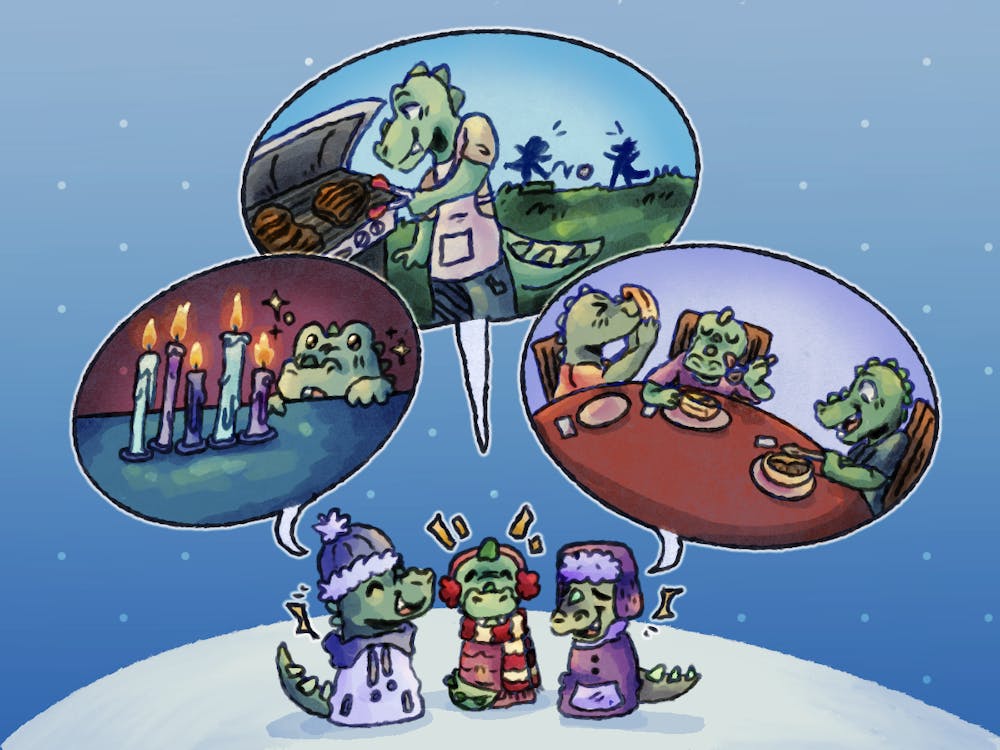
The Colombian-born 20-year-old UF business administration sophomore starts his Christmas celebration on Dec. 7, with the Day of the Little Candles.
Each year, he travels back to Bogotá, where his family lights candles that get placed into paper lanterns and cover all corners of his house and driveway.
“As soon as the city gets dark, everyone goes outside with candles and paper,” Morin said. “We just line them up around the sidewalk, the windows, the steps, the driveway — just basically everywhere until the whole house is glowing.”
Morin’s celebration of the Day of the Little Candles has religious origins, as it begins the celebration of the Immaculate Conception, a Roman Catholic doctrine stating that Virgin Mary was born free from original sin. The day serves as an opportunity to spend time with family, enjoy community and eat good food, Morin said.
“I’ve been doing it my whole life.It’s just a big part of the Colombian tradition,” he said. “It’s just very peaceful and feels like everyone’s connected for a moment.”
Traveling down South America, Uruguayan American Maite Civetta spends Christmas Day with family and asado.
Asado, the Uruguayan take on barbeque, usually takes three hours to prepare, the 20-year-old UF environmental engineering junior said.
While one person, the ‘asador,’ cooks, the rest of the family sets the plates, hangs out and helps out wherever needed.
But cooking isn’t the only activity that brings the group together to celebrate. A full Christmas Day celebration includes hanging out by the pool and horseback riding or playing volleyball or soccer.
Civetta said she’s grateful to spend the holidays with her family and spread the tradition with loved ones in the future.
“My husband better be down to go to Uruguay for Christmas, because that’s where I’m gonna be,” she said.
For Civetta, the tradition is an opportunity to bring together family, including second cousins she wouldn’t otherwise know, she said.
“Uruguay culture is very much family-oriented,” she said.
Others, like Venezuelan American Sara Rodriguez, keep their roots and culture close to their heart through tradition.
To welcome the New Year, the 20-year-old UF political science and economics student eats lentils. The classic Venezuelan tradition is meant to bring prosperity and abundance for the upcoming year, she said.
“It just reminds me of everyone back in Venezuela that also does it at the same time,” Rodriguez said.
She has eaten the lentils, prepared by her mom, alongside her family during their New Year’s Eve celebration for as long as she can remember. It’s a part of her Hispanic identity that she hopes to never lose and one day pass on to her kids, Rodriguez said.
“Even though I'm living in the United States, I never want to forget where I’m from and where my parents are from and their history, which is very important to me,” she said.
Contact Victoria Riccobono at vriccobono@alligator.org. Follow her on X @vickyriccobono.

Victoria is a junior sports journalism student and an El Caimán reporter in her first semester with The Alligator. In her spare time, she enjoys sports photography, reading, spending time with her friends and family, and trying new restaurants.