

This article was updated to accurately reflect the Senate chair's directions to faculty about the new policy.
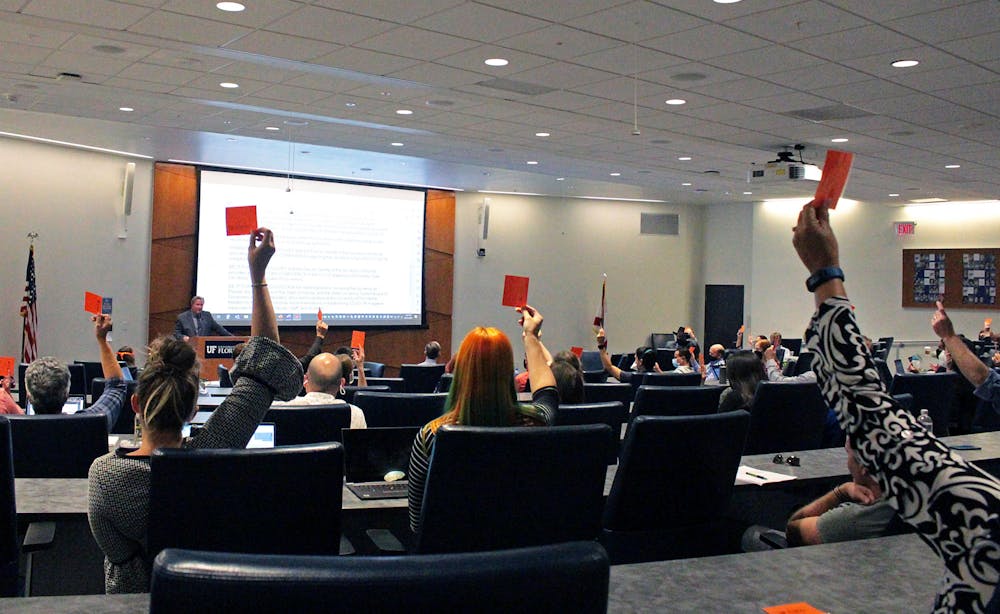
A new institutional neutrality policy sparked confusion at a Faculty Senate meeting today – despite being at the top of the meeting agenda. UF Interim President Donald Landry, a major proponent for the policy, was absent.
In the two previous Faculty Senate meetings, Landry discouraged UF leadership from expressing unnecessary social or political opinions following the assassination of conservative activist Charlie Kirk. Landry told the senators to be scholars rather than advocates, sparking fiery discussions as several senators expressed concern.
Landry was set to present the President’s Report for today’s meeting, but he did not make an appearance. The interim president did not explain his absence but sent his colleagues holiday greetings in a statement read by the Senate chair.
The new institutional neutrality policy restricts UF leadership from speaking on social and political issues, and it applies to communication like emails, social media, videos, messages and websites.
The policy does not explicitly define which UF faculty members fall under “leadership.” If commentary is necessary, it can only be given by the president with the consultation of the Board of Trustees Chair, Morteza “Mori” Hosseini.
UF is the first Florida university to implement an official policy on institutional neutrality, according to the Foundation for Individual Rights and Expression. It joins other major state universities, including the University of Michigan and University of Virginia, in adopting institutional neutrality, based on a list monitored by the foundation.
The interim president sent an email to all UF employees this morning summarizing the new institutional neutrality policy passed unanimously by the UF Board of Trustees meeting Dec. 5. Faculty Senate Chair Luisa Amelia Dempere presented senators with information about the policy in Landry’s absence.
Many senators expressed confusion about the policy’s content, as Landry sent the email this morning despite the proposal passing Dec. 5.
Dempere encouraged senators to discuss the policy with their chairs and committees for clarity about the policy and said feedback to the interim president was welcome.
Some senators disagreed with the policy and voiced their opinions. Judi Shade Monk, a College of Design, Construction and Planning senator, said the policy itself does not feel neutral at all, though she did not provide any further elaboration.
“A lot of people found out about this [policy] today,” said Megan Butala, a College of Engineering senator. “There has not been at all time for discussions, for processing.”
She asked if any UF governance was excluded from the “leadership” category, wondering if staff members or governing groups could be exempt from the policy. Dempere said that, to her understanding, all members of the Faculty Senate or any other governing staff body at UF would be subject to the policy.
During the meeting, Dempere presented a slide with information to adapt Senate practices to adhere to the new policy, which recognized senators as a leadership entity.
The slide, labeled “Proposal to the Senate,” confused several senators, who questioned if the policy would be something they had a voice in, or if it was strictly imposed.
Emily Rine Butler, a College of Liberal Arts and Sciences senator, questioned the extent to which senator feedback would be considered. The word “proposal” conflicted with the word “policy,” she said, making her feel as though the new standard would be mandatory to follow in the Faculty Senate.
When Dempere responded by encouraging senators to discuss the policies with chairs and committees, Butler expressed doubt her feedback would actually lead to change.
Emily Hind, a College of Liberal Arts and Sciences senator, said she did not understand what the term “social issues” referred to in the policy. As stated on UF’s policy website, social issues are defined as “topics that polarize or divide society among political, ideological, moral, or religious beliefs” under institutional neutrality. Dempere affirmed she also was not sure what the term meant, and she said she would eventually get back to Hind with an answer.
Senate members expressed confusion about the extent to which the policy would affect them. Bruce Welt, a College of Agriculture senator, said he understood the new policy as an imposed rule on the Faculty Senate, despite the other senators’ confusion. He said it is equally inappropriate for either the Faculty Senate or the university to make political resolutions.
“Are we going to, as a body, make goofy political resolutions that mean nothing, but piss everyone off?” Welt said. “I think it's a good idea we don’t.”
Other academic changes
The meeting wasn’t all debate. A doctorate-level major in Counseling and Counselor Education was officially closed after the proposal to eliminate the program was approved on Oct. 16 by the Graduate Council. It was brought to the Faculty Senate as an action item following previous discussion, and members voted to proceed with the program’s closure.
The UF/IFAS Environmental Horticulture Department dissolution continues to progress as well, with expectations staff members will be settled in their new departments by Jan. 1. As covered in the Nov. 20 Faculty Senate meeting, no employees will be laid off, as they will be moved to one or four other IFAS departments. Senators voted to proceed with the dissolution.
Tom Kelleher, the Associate Dean for Academic Affairs for UF Graduate School, presented the Faculty Senate with two information items pertaining to changes in academia. He presented a proposal to close the computer science major at the College of Liberal Arts and Sciences at the Master’s degree, citing lack of a student interest and no current enrollments.
He also spoke about a proposal to create a new major in Master of Health Administration to tailor to students who are working professionals. The new program would require 42 credits and professional criteria, and it will include some coursework centered on management and artificial intelligence, he said.
Both items will return at a later date to be voted on by the Faculty Senate.
Contact Leona Masangkay at lmasangkay@alligator.org. Follow them on X @leo_amasangkay.

Leona is a second-year journalism student and the Spring 2025 University Administration reporter. They previously worked as the Santa Fe reporter. In their free time, Leona enjoys going to the gym, watching Marvel movies and traveling the country for music festivals.


