

UF employees are officially discouraged from speaking unnecessarily about social or political issues to protect open discourse for students.
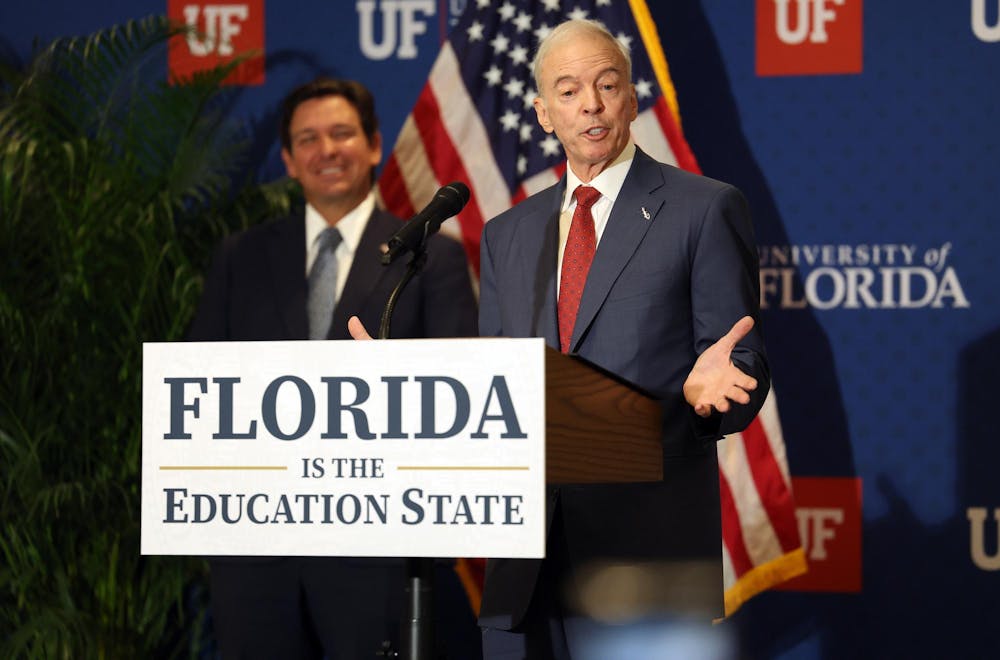
A new policy enforcing institutional neutrality was unanimously passed at a UF Board of Trustees meeting Dec. 5. Interim president Donald Landry summarized the change in an email sent to all university employees today.
Under the new guidance, UF leadership may not discuss any polarizing topics regarding political, ideological, moral or religious beliefs. This policy applies across campus communications, including emails, websites, social media pages, messaging platforms and video systems.
The policy allows only the UF president to comment on social issues and bars UF leadership from speaking on topics unrelated to the university’s mission, governance or operations, according to the email Landry sent to UF faculty and staff.
Since he first spoke at UF Faculty Senate meetings, Landry has advocated for institutional neutrality at UF, which he defined as “leadership holding back on commentary that isn’t essential.”
He spoke about it Oct. 16, after former UF law professor Jeffrey L. Harrison made a controversial online post that spoke about the assassination of conservative political activist Charlie Kirk. The post, made the day of Kirk’s death, stated “I did not want him to die. I reserve that wish for Trump.” UF stripped his emeritus title on Sept. 19 in response.
“Every time leadership comments on something that it doesn’t absolutely have to speak about, it divides the students,” Landry said at the October Faculty Senate meeting.
Landry advised other members of UF leadership against making political or social commentary, saying doing so would divide the student body.
At the Nov. 20 Faculty Senate meeting, Landry revived the discussion about institutional neutrality after speaking with university leadership across all 16 colleges about the topic. He urged faculty members to be scholars rather than advocates to foster open discourse and protect students’ rights to freedom of speech.
Landry’s proposal was met with disagreement among several members of the Faculty Senate, including Carolyn Hollander of the College of Medicine, who said Landry is asking faculty to be silenced. After a lengthy discussion to answer the senator’s questions about the policy, Landry abruptly left the meeting.
During the Board of Trustees meeting Dec. 5, Landry emphasized the importance of truth in academic research and expression, as well as in open discussion. The policy is not meant to infringe on First Amendment freedoms of speech and expression. Rather, it intends to balance free expression and neutrality, Landry said.
“Without the right to teach and the right to learn, we don’t really have a university,” Landry said at the meeting. “Therefore, we have to put on some brakes to academic free expression in the form of time, place and manner restrictions.”
Radical ideology and indoctrination suppress the right to teach and learn, he said. Supporting free speech under reasonable control allows students to engage in open discussion about controversial topics, he added.
Landry said the Florida Board of Governors requires state universities to have debates to encourage civil discourse and protect students’ freedom of expression.
“We have to provide protections for free expression,” Landry said. “But we are not going to be able to engage in that protection if we have leadership speaking on issues that then create those aligned with leadership and those opposed to leadership.”
Students may become discouraged from speaking on social or political issues or choosing topics of research and study, he said. Unnecessary commentary from UF leadership causes divide and chills free speech, Landry added.
Landry said deans and leadership from UF’s 16 colleges unanimously approved enforcing “the voluntary restraint of leadership not to speak” after meeting with them.
Landry said he hopes to see enthusiasm from Faculty Senate members during their upcoming meeting, which will take place today. After he concluded speaking, the board unanimously approved the proposal.
“If speech must come forth, it will come forth from the president in consultation with the chair,” Landry said. “But otherwise, we will remain silent.”
Contact Leona Masangkay at lmasangkay@alligator.org. Follow them on X @leo_amasangkay.

Leona is a second-year journalism student and the Spring 2025 University Administration reporter. They previously worked as the Santa Fe reporter. In their free time, Leona enjoys going to the gym, watching Marvel movies and traveling the country for music festivals.