

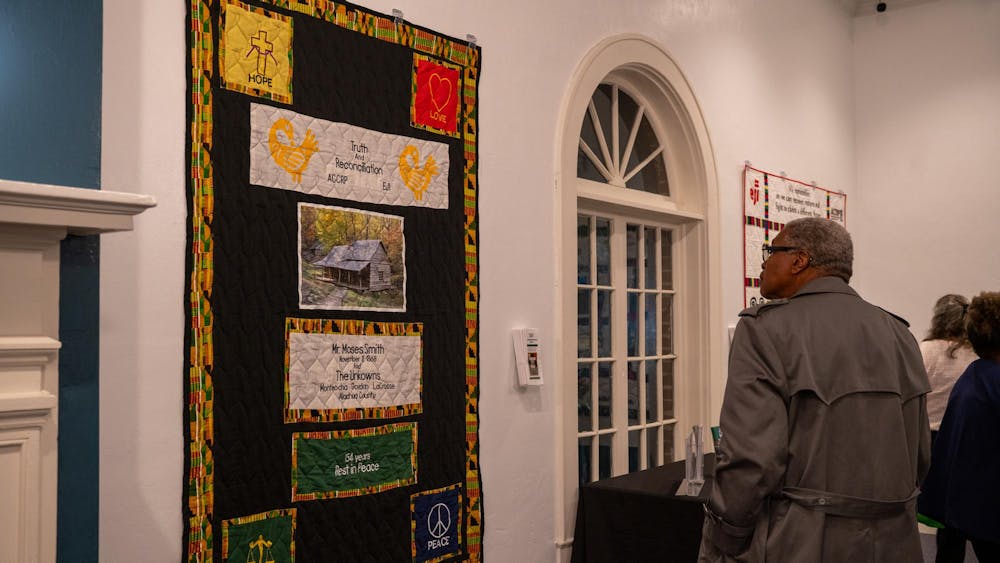
Inside the Matheson History Museum, eight quilts hang on the walls, their patterns subtle but deliberate. The quilts tell the stories of the 47 people lynched across Alachua County, their legacies memorialized by community members reckoning with the county’s history of racial violence.
The exhibition, which opened Wednesday, gives visitors the opportunity to connect with victims through local art.
The quilts are part of the Alachua County Community Remembrance Project, an ongoing lynching rememberance effort rooted in the county’s dedication to truth and reconciliation efforts.
The project, which formally began in 2020, grew out of discussions by the Alachua County Commission following the discovery of previously unknown lynching victims.
The quilting initiative itself began five years ago under the leadership of Dawn Beachy. A quilter for more than 50 years, she said there is a long history of memorial and political quilts, as well as similar projects across the country. What began as a single quilt eventually expanded to eight, a decision meant to ensure each victim was individually represented.
“We have to tell the truth about what happened,” Beachy said.
Jackie Davis, a liaison between the Equal Justice Initiative and the ACCRP, said the 2015 mass shooting at Mother Emanuel AME Church in Charleston, South Carolina, prompted her involvement in anti-racism work. The attack, perpetrated by a white supremacist, resulted in the deaths of nine Black churchgoers.
She said the legacy of Jim Crow continues to shape life in Alachua County, where racial and economic disparities persist.
“I have a debt to use my privilege to fight inequality,” Davis said. “This felt like an opportunity to recognize, and make amends on some small level, for what my white ancestors have done.”
Davis created a quilt square honoring Alfred Daniels, a Black man lynched in November 1896 after a deputy sheriff allowed a white mob to hang him and shoot his body. She used African fabrics and decorated the square with a Ghanaian symbol representing God’s omnipotence.
Jiana Williams, the first Black woman to serve as Micanopy’s mayor, also contributed to the quilts. She said it wasn’t until working with the ACCRP that she learned there had been lynchings less than a mile away from her home.
Williams said making the quilts was initially nerve-wracking because of their significance, but connecting with her neighbors and seeing the finished work made her feel more confident.
Speaking at the exhibition’s opening, Williams said the process brought a “myriad of emotions.” While she felt anger and sadness over the lynchings, she also found beauty in the community’s efforts to memorialize the victims.
“It’s like the seven stages of grief,” Williams said. “How can you forget about this history when it's right here in your face — people who are related to these gentlemen are still alive.”
The history Williams spoke of was close to home for others: One contributor, a grandniece of
Lee Walker, a man lynched in 1893, donated antique stars sewn onto one of the quilts. The squares honoring Walker were created by her great-aunt decades earlier.
For many visitors, the exhibition serves as both a memorial and a reminder that racial violence is not confined to the past.
Theresa Adams, a retiree and mother of two, said seeing all of the quilts together was heartwarming. The exhibition reminded her of her childhood, particularly learning about Emmett Till, a 14-year-old boy lynched in Mississippi. She also reflected on her own family’s history — her cousin had narrowly escaped a lynching.
“There’s still [lynchings] going on. They may be called different names, but they’re still doing it,” Adams said. “We can’t forget. We can’t stop fighting because we can’t let them win.”
Contact Julianna Bendeck at jbendeck@alligator.org.
Julianna Bendeck is a first-year journalism student and the Summer 2026 criminal justice reporter. She previously worked as a contributing writer and race and equity reporter at The Alligator. Outside the newsroom, she enjoys reading, surfing the web and playing video games.
