

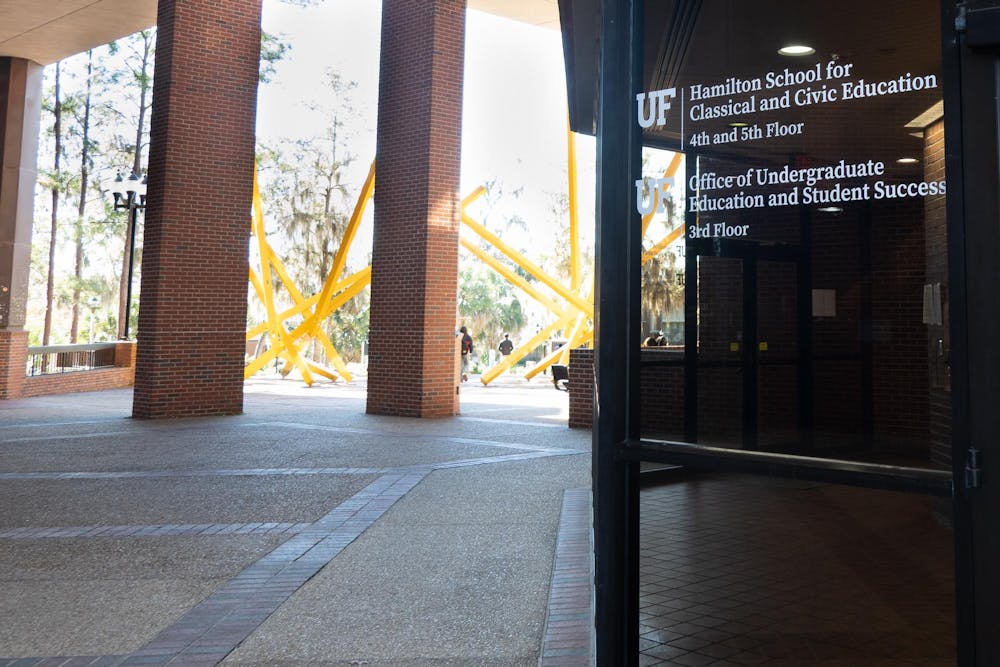
On the fourth floor of the Computer Science and Engineering building is the Hamilton School, a circle of classrooms, offices and old lab spaces reminiscent of a typical college campus building. The Hamilton School, rather than focusing on many of the school’s popular liberal arts pursuits, prioritizes the study of classic literature, timeless political ideologies and the foundations of philosophy.
The Hamilton School aims to emulate a model of education seen in “elite” institutions like Oxford, Harvard and Cambridge. The school hires top-of-the-line professors, like Wall Street Journal columnist and former Yale professor Walter Russell Mead and Jeffrey Collins, the 2021 winner of the Morris Forkosch Prize. The school combines these world-renowned professors with a teaching style that prioritizes discussion and the creation of thought.
As a student at the Hamilton School, I am blessed with the opportunity to work under some of the brightest minds in political, philosophical, economic and legal theory. For UF students who wish to become experts in those topics or — as Walter Mead put it at the beginning of my first class with him — to win arguments with their parents, this is a great place on campus to do so.
But I’ve noticed an unfortunate trend as my time spent at the Hamilton School increases: The school’s funding mechanisms, professors and a majority of students beget and prioritize conservative American thought. I realize this claim may seem like I’m “jumping the shark” per se; however, I believe it to be instrumental to understanding why and how the newest college at UF conducts itself.
Here are what I would call the “blind spots” of the Hamilton School.
First, the Hamilton School’s conception was not initiated by the university or the students; it was conceived and primarily funded by former UF president and Republican U.S. Senator Ben Sasse, Republican megadonor Ken Griffin, Florida Gov. Ron DeSantis and the Florida GOP. With UF’s recent pledge to political neutrality, how can the Hamilton School rely on funding from politically biased avenues?
Conservatism isn’t inherently a political term. It only defines a desire to preserve tradition and reject certain progressions in thought. Yet it’s become the primary philosophy of the GOP and the American political right. Until the Hamilton School rids itself of its politically backed funding, we can’t be certain our education is legitimized by anything beyond conservative politics.
Second, these dissonances become even louder considering classes such as “Special Topics PPEL (Conservatism)” are paired alongside “The Crisis of Liberalism (Quest 1).” As a supporter of open thought and persistent education, I have no issues with these classes being taught. My issue comes in when two opposing ideologies are pitted against each other dialectically by a college that tells us to form our own thoughts, and these are the only two classes discussing such topics.
How can conservatism merit a “special topic” status, but liberalism, an ideology commonly found on our campus, only merits being talked about as in a “crisis state”? If the Hamilton School is actually keen on replicating the traditional Oxford model, it must treat all ideologies as opposite but equal.
Third, and finally, there is a disconcerting lack of diversity within the college’s faculty. Virtually all of the scholars who teach at the Hamilton School, except for two, are of either American or European descent. Throughout the time I have spent taking courses, I’ve noticed analysis essentially forgets to consider the narratives of systemically excluded people. “Classical” education will certainly include philosophy and literature from the political elites and higher classes. But the truth is, I wasn’t assigned to read a single non-white scholar in any of my introductory courses last semester.
As the professors posit methods on how to read and analyze history and thought, you should consider supplementing their readings with alternate perspectives. A history that fails to remind itself of the suppression of others may allow for the same arguments to be reused today. This is a fate that the politically active reader may not just fear; it’s a fate they may recognize in their day-to-day lives.
I highly recommend taking courses at the Hamilton School. However, if you are interested in exploring one of the coolest academic opportunities on campus, be conscious of the structural and systemic blind spots it presents, and don’t fall victim.
Contact Sasha Morel at smorel@alligator.org. Follow him on X @BySashaMorel.
Sasha Morel is a sophomore at the University of Florida studying Politics, Philosophy, Economics, and Law, as well as Anthropology. His returning column focuses on policy analysis surrounding domestic, global, and local politics, with a focus on targeting root causes of common issues and highlighting unrepresented perspectives. Outside of the Alligator, Sasha is a nationally recognized debate coach for high schoolers across the US.


