

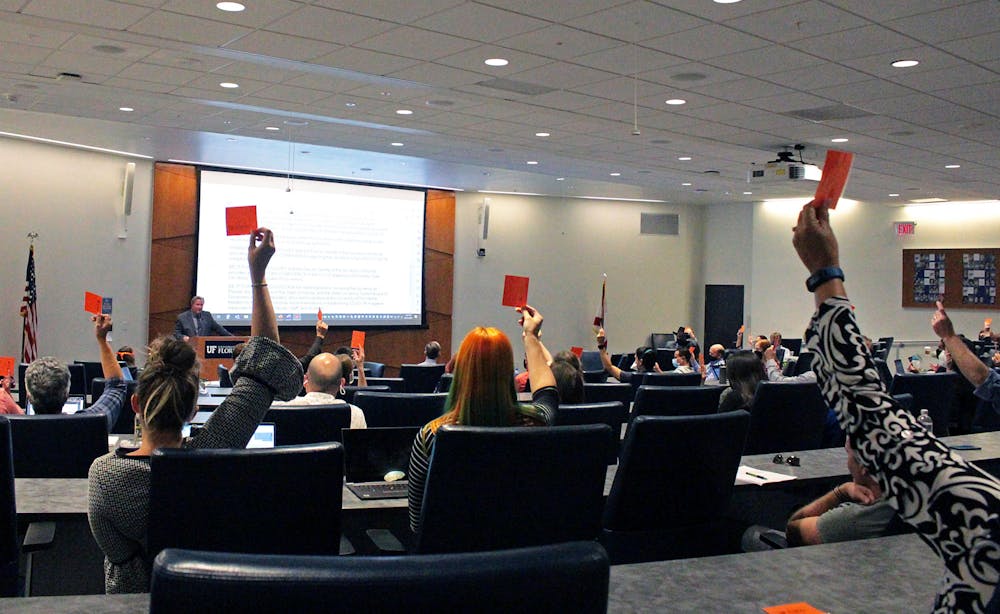
Over 60 faculty members gathered in the Reitz Union Senate Chamber Thursday morning, where the United Faculty of Florida UF chapter met with UF’s Board of Trustees for a contract negotiation impasse hearing.
The hearing was one of many bargaining meetings between the union and the board since July 2024, when UFF-UF’s collective bargaining agreement with the university expired. Attendees gathered both in person and virtually in a disjointed, over six-hour-long meeting that saw a myriad of delays due to technology issues and debates over allowed and non-allowed materials.
Despite previously having agreed on 26 out of the 35 articles in the CBA, nine articles of contention are left. The contested articles involve faculty input in post-tenure review criteria, the assignment of neutral arbitrators during grievance hearings and the preservation of release time for union officer duties. The meeting focused on Articles 28, 18 and 4.
An impasse hearing occurs after an employer and union bargaining delegates fail to compromise on the terms of a CBA – a modified employment contract proposed by a workers union that grants employees certain rights.
In a UF impasse meeting, both parties present arguments over contended points in the CBA to a neutral magistrate, who then offers a legal opinion.
On Thursday, the UFF-UF argued for the review of post-tenure review criteria, neutral arbitration and for the right of UFF chapter officials to solicit time off for union duties. The board contests these articles in the CBA.
Post-tenure review, introduced in Florida in 2024 by Gov. Ron DeSantis, is the process by which Florida public universities review tenured faculty’s performance. Every five years, faculty are to be assessed based on their accomplishments, productivity, professional conduct and student feedback, among other factors like attendance.
The purported purpose of post-tenure review is to ensure that professors are maintaining high standards of work. UFF-UF, however, believes evaluation criteria under the new terms of PTR are ill-suited to accurately assessing the performance of tenured faculty.
For example, the union argues the terms of post-tenure review are too broad to properly assess the performance of unique departments across campus in any meaningful way.
In a statement, UFF-UF said it “holds that faculty should take the lead in determining their evaluation criteria because we know our disciplines best.”
Many faculty members attended the hearing in support of the unions’ stances.
Dr. Jorg Peters, a UF professor of computer science and information and UFF-UF member, said he thinks the new deal is inefficient because it reduces progress to quantitative measures and doesn’t consider other qualitative means of success.
“The rules themselves are not thought through,” Peters said. “They're being decided by not where the expertise is, but at a level that looks at numbers.”
UFF-UF First Vice President Sean Trainor, a UF business professor, said, “This is a moment where we can make our case on some of the most important issues facing faculty to the university community writ large.”
The ruling of the special magistrate is nonbinding, allowing the university to legally change or not change anything. Whether or not the university would act upon this bargain in spite of ruling is unknown.
“We know that this process is rigged. We know that it's stacked against us. We know that it's unfair,” Trainor said. “The purpose here today is to demonstrate to our colleagues the issues at stake so that the struggle can continue going forward.”
The meeting concluded with the special magistrate announcing he’d declare a ruling within 60 days. As of now, parties are expected to have a post-hearing brief in 30 days.
UFF-UF Chapter President Dr. Meera Sitharam stated after the hearing, “The university's interpretation of the law is a vast and arbitrary overreach beyond the law.”
UF declined to make an official statement until the special magistrate declared a ruling.
Contact Aaron Zagal Yaji at azagal@alligator.org. Follow him on X @azagalyaji
Aaron Zagal Yaji is a Public Relations and Economics freshman in his first semester at The Alligator. He covers El Caimán's metro beat. In his free time, he enjoys going to the beach (or reminiscing about it), cooking Peruvian food, and squandering his money on golden shiny things.