

When Colleen Cole Beucher started attending the University of Michigan in 2019, she had 13 years of voice study under her belt.
Not once in those 13 years was she assigned a piece of music by a Black composer.
“I came to understand that we have a big problem, in that we have a lot of American singers studying voice at the higher education level who aren't coming into contact with this repertoire,” Beucher said.
Discouraged by the lack of education in Black art song — songs made from poetry but written for operatic voice — she took a course at U-M on African American and African diaspora song. Now an assistant professor of voice at UF, Beucher created the Resonance Festival to celebrate the rich legacy of Black composers.
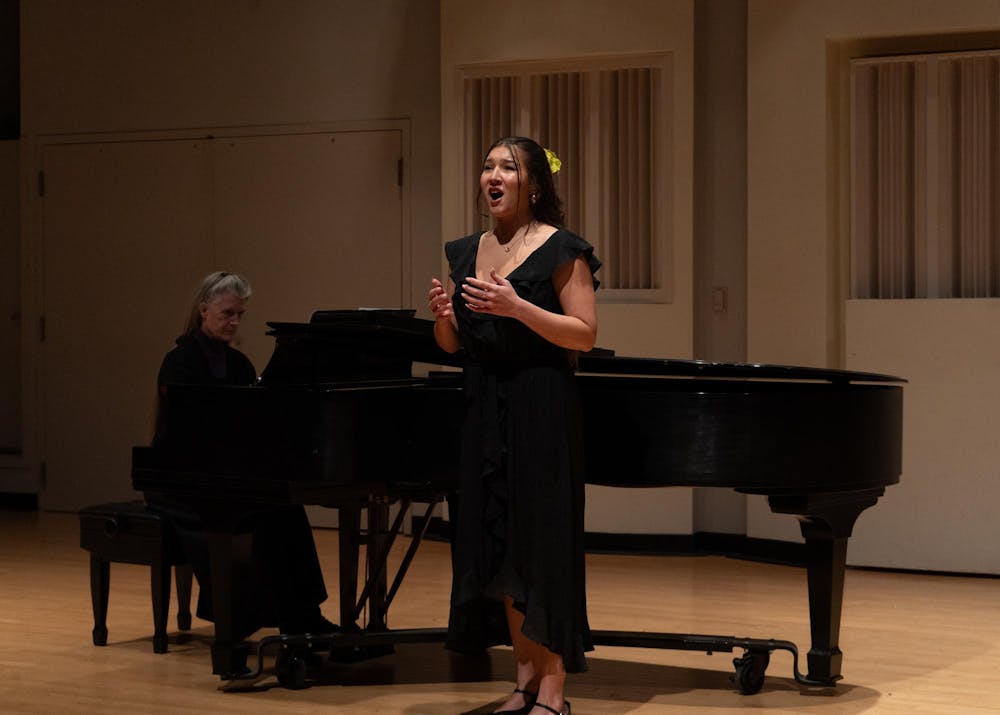
Held Jan. 25 through Jan. 28, the four-day festival honored African American art song and spiritual music through master classes, lectures and student and faculty recitals.
The UF School of Music collaborated with UF’s Center for Arts, Migration and Entrepreneurship and other organizations to highlight the artistry of Black composers ahead of Black History Month.
Beucher, only in her second year with UF, is determined to provide students with the opportunity to engage with music from a perspective different from their own.
“I feel very passionate about the fact that we can learn empathy through art, whether that is poetry, music, performance,” she said. “I think we can all use a little bit more empathy in today's world.”
Much like Beucher, her student Marbella Deininger didn’t have much exposure to the repertoire the Resonance Festival celebrates. The master class held Tuesday was her first time singing an art song by an African American composer.
“Considering that I'm 22 years old and a senior in college, and I've been singing classical music since I was in sixth grade, it's crazy to even think about how there's been so minimal exposure to that,” Deininger said of African diaspora music.
Deininger, a UF vocal performance and business administration student, was one of several students who Beucher invited to perform at the event.
At the masterclass, Deininger sang “Love Let the Wind Cry … How I Adore Thee” by Undine Smith Moore, who is often hailed as the “Dean of Black Women Composers.”
Though a technically challenging song for the mezzo-soprano singer, Deininger said she was privileged to receive on-the-spot feedback from critically acclaimed operatic performer and professor Louise Toppin.
Toppin, who led the festival’s master classes, taught the African American art song course Beucher took at U-M, one of the few universities that offer such a course, she said. Like Beucher influenced Deininger, Toppin inspired Beucher to further explore this subject in academia.
Toppin travels the world teaching the principles of good singing regardless of the repertoire, she said. Though African American music deserves to be celebrated, the works she teaches should not solely be included in the historical canon of song because they are Black music, but because they are good music, she added.
She and Beucher hope the festival returns in 2028 and expands the faculties, universities and cultures involved in the showcase. Toppin said the Resonance Festival ought to distinguish the UF School of Music from other colleges and emphasized how important its mission is in preserving the complete history of American music.
“We're telling the history of American people, and if we neglect a whole body of work that's existed since the 1500s … you're leaving out half of the narratives in our shared American story,” she said.
Contact Isabel Kraby at ikraby@alligator.org. Follow her on X @isabelgkraby.

Isabel Kraby is a journalism senior at UF and the Summer 2026 editor of The Avenue desk. She has served as both a general assignment reporter and the music and performance reporter for The Avenue. Izzy loves going to concerts, crocheting and practicing guitar in her spare time.


