

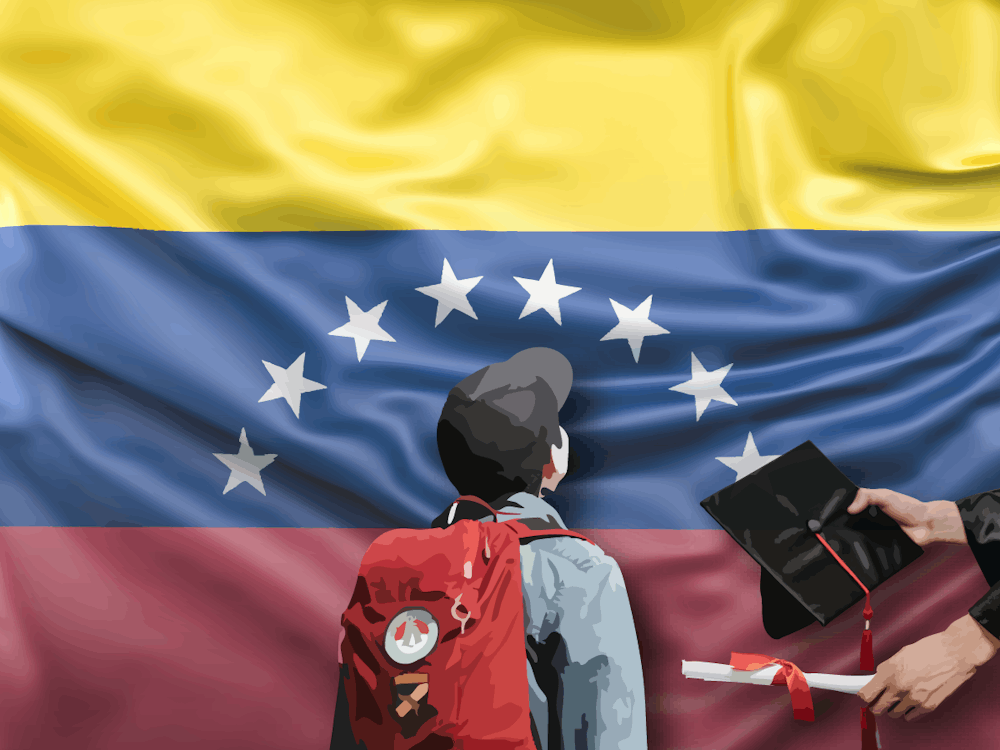
A hope that once seemed impossible has now surfaced among Venezuelan students at UF: returning to their home country without fear of an authoritarian regime. That hope came after the U.S. forcefully removed the country’s president, Nicolás Maduro.
The capture of Maduro, whose regime oversaw Venezuela’s collapse, prompted mixed emotions on campus. There were 107 Venezuelan international students enrolled at UF as of 2025. The university is also home to many more students whose families came from Venezuela years or decades ago and still retain ties with their home country.
Some of these students now say they’re experiencing a renewed optimism they might return to Venezuela, either temporarily or permanently. Others remain skeptical, voicing concerns over present and future U.S. involvement.
Renewed optimism
For years, Diego Oliver, a 19-year-old UF biomedical engineering freshman, had a clear plan: He would graduate and build his life in the U.S. Now, that plan has started to change.
Maduro’s capture took Oliver by surprise in the early hours of Jan. 3. It marked a moment of reflection on what the future holds, he said.
“I’ve thought about it,” Oliver said. “I would finish my university studies here, but in the future I would like to work and live, even if only for a short time, in Venezuela.”
Oliver moved to the U.S. in June 2016 with his brother and his mother, he said, while his father remained in Venezuela for work. What was initially a temporary move became permanent by December of that year, as his parents believed life would be safer and the family would have better opportunities in the U.S.
Still, leaving the country was a difficult decision for Oliver’s family.
“My parents would have loved to remain in Venezuela if the situation in Venezuela had been better,” he said.
In his desire to return, Oliver said he hopes he might be “able to experience what I couldn't fully experience during my childhood.” While Oliver did briefly return to the country to visit his grandparents during the COVID-19 pandemic, the distance has been difficult for him.
“I’ve been away from my country for so long,” he said. “I miss my family, and for me, being able to return someday is what matters most.”
Other students echoed Oliver’s optimism following Maduro’s removal. David Gomes, a 19-year-old UF biochemistry freshman, said his family began to celebrate as soon as they heard the news.
“In my family group chats, everyone was celebrating,” he said. “They finally captured him.”
For Gomes and his family, the news opened the idea of a possible return to Venezuela, especially for his mother, who he said always wanted to return to her home country.
Gomes knows the future is still uncertain for the country. Venezuela needs to reach a certain level of political security and public safety before he can “even consider” returning, he said. But he remains optimistic.
“It’s not like we’re going back tomorrow, but it’s one more step,” he said.
In the meantime, Gomes plans to continue a medical career in the U.S. If Venezuela improves its political and economic status in the future, he said he would learn medical practices there, gaining unique experience in his country of origin.
Lingering doubts
Other Venezuelans have expressed more skepticism about what Maduro’s removal means for their future.
Andres Eloy, a 19-year-old UF chemical engineering sophomore from Venezuela, said he was more worried than excited when he heard about Maduro’s capture.
Immediately, he worried family members living in Caracas would be in danger due to military strikes carried out in coordination with Maduro’s capture.
In the aftermath, Eloy said he doesn’t feel as much happiness as other Venezuelans. He believes U.S. intervention will not bring prosperity to Venezuela, politically or economically.
“I am more worried that the mismanagement of our natural resources will keep the Venezuelan population in poverty in the long term,” he said.
In a press conference following the strikes, President Donald Trump announced the U.S. would “run” Venezuela to control its oil reserves, the largest in the world.
Eloy said he worries a regime change will benefit wealthy politicians and foreign interests more than ordinary Venezuelans, with the poorest no better than before and many immigrants still stranded abroad.
He also worries about family separation and basic living conditions, including access to education and daily essentials. The country is still poor and “in turmoil,” he said, making it difficult even to find food.
“We are not considering returning,” he said. “The situation remains difficult.”
Contact Dulce Rodriguez-Escamilla at drodriguez@alligator.org.
Dulce Rodriguez is a sophomore Journalism Major with a Public Relations minor in her first semester at The Alligator, working as El Caimán's general assignment reporter. She loves to dance and bake in her free time, and she also enjoys watching murder mysteries and documentaries.


