

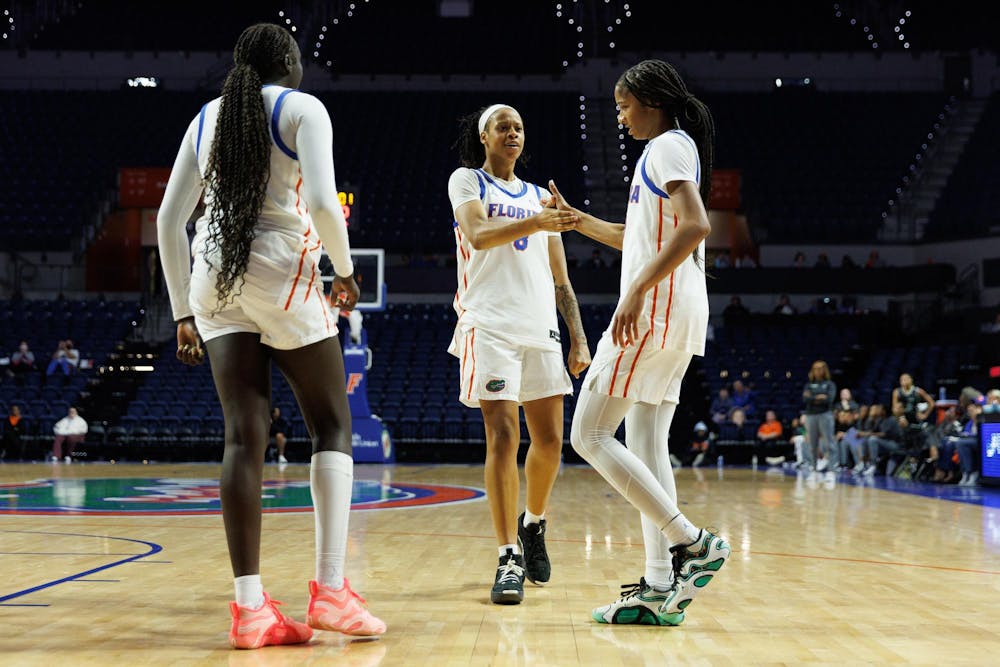
Through the opening stretch of Southeastern Conference games, Florida women’s basketball is still searching for its first conference victory. The Gators are one of three teams that remain winless heading into the third week of SEC play.
The Gators (12-7, 0-4 SEC) have yet to find their stride, but the team’s flashes of strong performances suggest that a breakthrough could be looming.
One of the most pressing issues that Florida faces is its slow starts. In three of Florida’s last four conference games, it was outscored by eight or more points in the first quarter. This forced the team to fight an uphill battle to overcome its deficit. This sluggish beginning to a high-intensity match-up creates a hole the Gators just can’t climb out of.
And this adds up in the margins. The extra rebounds, the additional free throws and the points that pile up before the Gators fully settle into the game knock the team off rhythm.
Against Auburn (12-6, 1-3 SEC) on Sunday, Florida made 3 of 13 shots while giving up seven turnovers to open the game. The Tigers had doubled the Gators’ score by the beginning of the second quarter, 19-8.
Additionally, turnovers have eaten away at Florida’s early play. It's averaging 18 miscues per conference game, and opponents have converted those into nearly 19 points per contest. Protecting the ball, especially in the first quarter, could prevent opponents from running up the score.
Yet the story of Florida’s games rarely ends with the opening ten minutes.
The first quarter ends, and head coach Kelly Rae Finley has words for her team. Whatever she said in those huddles seems to work, because in the second and third quarters, the Gators find a foothold.
In three of its four SEC games, Florida has posted its most efficient shooting in the second or third quarter, consistently playing its best basketball in the middle stretches. Against No. 23 Tennessee (12–3, 4-0 SEC) on Jan. 1, the Gators trailed by 10 entering the second quarter but cut the deficit to three by the end of the third (55–52).
Rebounding has been another turning point. Florida is being out-rebounded by 12 boards per game in conference play, a gap that has repeatedly given opponents second and third chances. Winning the battles on the board is key to preventing easy put-backs and could give the Gators space to show out in their strong middle quarters.
Notably, Florida has not struggled at the free-throw line as much as it has struggled to reach it. Florida shoots a solid 74.2% from the free-throw line in SEC play, but it only averages 11.5 made free throws per game, which is far fewer than opponents, who are hitting 17.5 per contest.
Finding a way to convert those fouls into points could help erase first-quarter deficits that proved to be costly. But who might draw those fouls?
Referred to as the “Big Three” by the Gators, sophomore guard Liv McGill, junior guard Laila Reynolds and sophomore forward Me’Arah O’Neal have all mastered crafty ways to score in the paint. Post moves, fast breaks and driving layups all present opportunities to draw contact and earn free throws.
But so far, none of them have dominated from the line. Graduate guard Alexia Dizeko leads the team in free-throw percentage at 84.6%, but she has only attempted 13 shots from the stripe.
When factoring in both efficiency and volume, McGill remains Florida’s most reliable free-throw contributor. She has made 71 of 92 attempts, providing consistent production while drawing enough fouls to impact games.
Florida has a chance to get Dizeko more involved in offensive production, or it can continue to rely on McGill to carry the bulk of free-throw opportunities while the “Big Three” work to draw more contact in the paint.
The team's perimeter shooting has also been inconsistent in SEC play, making it hard to stretch the floor. The Gators are hitting just 25.6% from 3-point range, and spacing issues often allow defenses to collapse on driving lanes. Improving outside shooting and floor spacing would open up more opportunities for McGill, Reynolds and O’Neal to attack the rim and draw contact early.
Role players have shown flashes that could tip close games in Florida’s favor. Against Texas A&M on Jan. 8, Reynolds had an impressive showing where she tied her career high for points with 21.
Players who crash the boards, hit open perimeter shots or provide defensive stops give the team depth it can rely on when starters are being contained. Tapping into those contributions consistently could be the difference in tight SEC matchups.
A game where Florida did it right was against No. 2 South Carolina (17-1, 4-0 SEC) on Jan. 4. Florida started the first quarter with energy and stayed competitive through much of the first half, trading baskets and keeping the score close. By the end of the opening 10 minutes, the score was 21-19 in favor of South Carolina.
Despite the strong start, shooting struggles from beyond the arc and turnovers in key moments allowed South Carolina to slowly build a lead. The Gamecocks held on long enough for an eleven-point win.
If Florida can combine better first-quarter execution, improved shooting from the perimeter, stronger ball security and continued mid-game efficiency, the Gators have the tools to turn competitive games into victories. Now it’s about putting these ingredients together for a full 40-minute effort and finally securing that elusive first SEC win.
No rule says a team can’t get better during conference play, and the Gators have 12 more chances to improve before the SEC tournament. Florida’s next match-up is against No. 7 Kentucky (16-2, 3-1 SEC) at the Rupp Arena in Lexington at 7 p.m. Thursday.
Contact Isis Snow at isnow@alligator.org. Follow her on X @isis_snoww.

Isis is a senior sports journalism student who is in her fourth semester at The Alligator. She previously has written for the Avenue desk and has covered the Florida volleyball beat. She also has experience in live broadcast reporting with WUFT. Despite hailing from Las Vegas, Nevada, she is a life-long Michigan and Detroit Lions fan. To make up for the emotional toll of being a fan of those teams, you will often find her in the gym weight lifting and playing basketball.


