

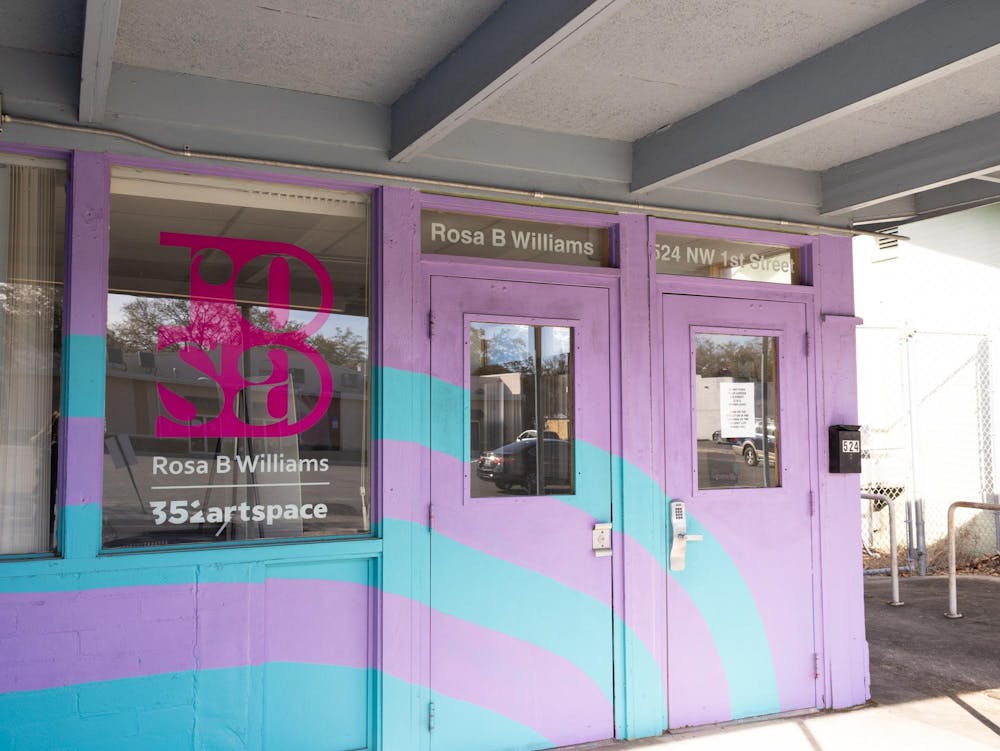
Gainesville civil rights activist Rosa B. Williams, known affectionately as “Miss Rosa,” died Feb. 12 at age 92. She was a local pioneer for the Black community, and those who knew her remember her as a catalyst for change who touched countless lives in Gainesville.
Born in 1933, Williams’ civil rights activism was not a choice, but a necessity.
“Black women have had to be fierce women from day one,” said Vivian Filer, the 88-year-old founder and chair of the Cotton Club Museum and Cultural Center.
Filer recalled her experience working with Williams in the 1960s during the Civil Rights Movement. Williams spoke up to the Alachua County government any chance she could about the inequalities the Black community faced, Filer said, even when it was difficult.
“Miss Rosa was a spokesperson who had the ear to a lot of people who were elected officials, and she wasn't afraid to speak up,” Filer said.
Williams fought for desegregation, voting rights and equal opportunities in Alachua County, Filer said, and she was an advocate for young people.
In the 1950s, Williams was the first Black person in Gainesville to obtain a library card. Williams recalled in an interview from 1992 that she had to go through multiple background checks and provide references to even be considered.
During her lifetime, Williams joined countless community boards and foundations. She was the chair of the Gainesville Black on Black Crime Task Force, Concerned Citizens for Juvenile Justice and the United Gainesville Community Development Corporation.
The Black on Black Crime Task Force, established in 1988, is still active. The force meets monthly to discuss educational and crime-reduction youth outreach programs, programs for preparing inmates after release and updates from GPD on crime trends.
Williams also served on boards for Shands Hospital, the Gainesville/Alachua County Regional Airport Authority and the Gainesville Housing Authority. She was the first vice president of Gainesville’s chapter of the NAACP.
Williams worked with local agencies to improve the lives of her peers, Filer said, and she cared deeply about keeping people safe and encouraging change by building community.
“I share the sentiment of all of the rest of us that her work is a legacy that we will all benefit from,” Filer said.
Williams went on to co-found Gainesville’s flagship program for at-risk youth, the Reichert House Youth Academy, in 1987. Though it closed in 2023 due to a lack of funding, the program served 2,200 students while active.
The program was managed by the Gainesville Police Department and provided educational tutoring, mentorship, behavioral support, life skills training and meals for at-risk Black young men.
James Nixon, a 32-year-old Bunnell, Florida, resident, went to the Reichert House for help from 2006 to 2007.
“They gave me that structure that I needed to survive in life and not become a statistic as a young Black male in this world,” Nixon said. “That program is kind of the reason why I succeeded in life to this day.”
Nixon recalled his fond memories of Williams. Her guidance helped him change his perspective on life, he said.
“She taught me that being good wasn't a bad thing,” Nixon said. “Being a person that helped others was a way of life … versus being that troublemaker child that was constantly in and out of jail and court systems.”
Nixon said he’ll always remember her generosity. Williams never let anyone leave the Reichert House without eating a hot meal, he added.
“She will give you the clothes off her back,” Nixon said. “She will give you her last dollar.”
Nixon wishes there were more people like Williams in the world, and he said he’s just one of the many people from Gainesville who will miss her dearly.
“If I could personally make Miss Rosa known worldwide, I would,” he said. “That lady had the greatest soul ever, and she loved everybody, just like you were her own kids.”
Williams’ niece, Terri Bailey, a 59-year-old Gainesville resident, also shared fond memories of her aunt. She said Williams introduced important values in her from a young age.
When Bailey was about 5 or 6 years old, she recalled, her aunt brought her to her first NAACP meeting. Bailey said she was instructed to “take notes,” but at the end of the meeting the adults were surprised when she actually had.
“She instilled in us a sense of giving without expectation of return,” Bailey said, "and that we have to unify and be together in order to affect change.”
Many people who knew Williams emphasized how her outlook on life is something current society is lacking. Williams was a prime example of how change can be enacted through true passion and care, Bailey said.
“Right now we live in such an individualistic society, and my auntie embodied community, doing for others, looking out for others, knowing your neighbors,” Bailey said.
Contact Kaitlyn McCormack at kmccormack@alligator.org. Follow her on X @kaitmccormack20.
Kaitlyn McCormack is a senior journalism student serving as the County Commission Reporter for The Alligator's Spring 2026 metro desk. In her free time she enjoys journaling and drinking too much coffee


