

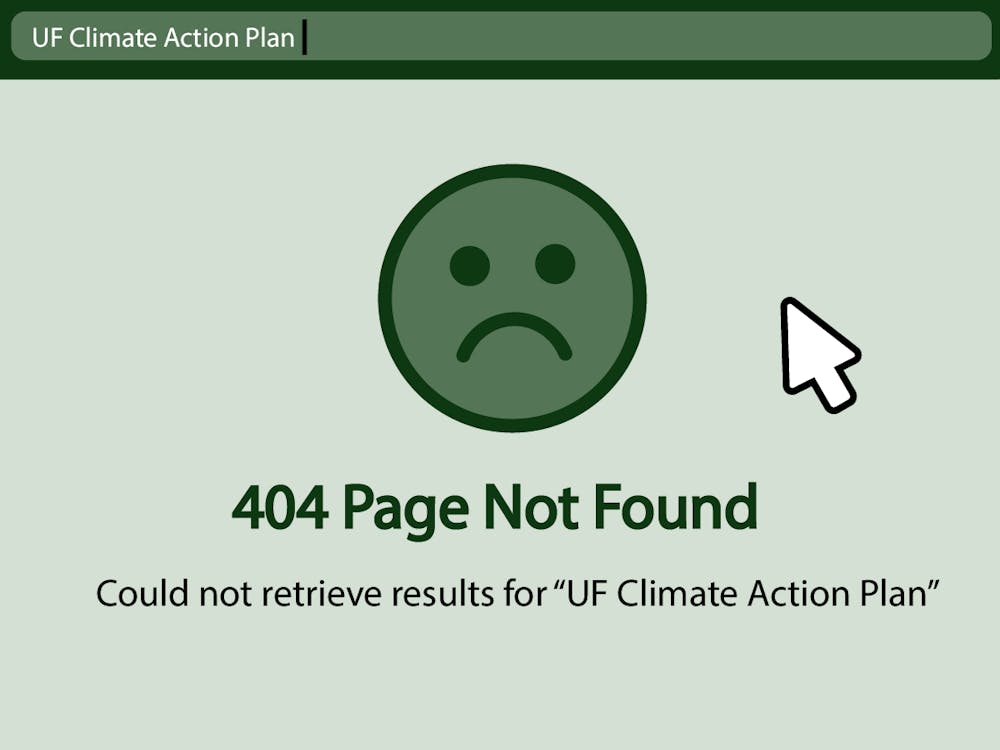
UF’s Climate Action Plan 2.0 is on an indefinite pause. Following the Office of Sustainability’s closure in August 2025, it’s unclear who — if anyone — will pick it back up.
UF initially started working toward climate action in 2006 under former UF President Bernie Machen. A group of staff and faculty, called the Energy and Climate Change Task Force, published the first Climate Action Plan in 2009. The CAP focused on infrastructure energy efficiency, as well as monitoring and reducing greenhouse gases.
UF met the requirements of the first CAP in reducing emissions by 18% in 2020, according to previous reporting by The Alligator. CAP 2.0, a draft that started in 2021, continued UF’s original goal to be carbon neutral for all tracked campus greenhouse gas emissions starting in 2025.
But since its drafting, climate action plans have stalled.
UF halted its adoption of the CAP 2.0 in 2023 before former UF President Ben Sasse transitioned into leadership to allow him to evaluate institutional priorities, spokesperson Cynthia Roldán said in an email statement to The Alligator. Last year, the university closed its Office of Sustainability, the entity responsible for implementing the plan, after 20 years of service.
Roldán said while the plan has still not received approval, UF still works on its commitment to sustainability.
The previous link to the new plan on the university’s website is no longer available — nor is the link to the 2009 original.
Cory Rinesmith, a 22-year-old UF political science senior with a minor in sustainability, said privatizing this information “clouds” the university’s image. A climate action plan can create public engagement and educate others about the importance of climate change, she said.
“I think the most important thing about sustainability is getting everyone on board with it,” Rinesmith said. “For a prestigious institution to come out with information about climate change and the environment is very important.”
Rinesmith also said without a climate action plan, students are becoming discouraged from finding jobs within the sustainability field — questioning why they should pursue sustainability studies when their university doesn’t treat the topic as a priority.
UF did not receive a nod on this year’s review of Green Colleges from The Princeton Review, an honor it received last year and still has pinned on its social media as of Feb. 6. Several other state universities, including Florida State University and the University of Central Florida, all earned recognition from the review, which previously praised UF for employing a sustainability officer and offering a public greenhouse gas inventory plan.
Many students haven’t given up on encouraging sustainability. The UF Student Senate proposed its own Green New Deal resolution in 2024, becoming the first student government at a public university to do so. The resolution endorsed UF’s adoption of CAP 2.0.
Maegan Lamey, a 21-year-old sustainability junior and co-author of the Green New Deal resolution, said a climate action plan is necessary for UF, and its adoption of the plan would combat climate change.
According to previous reporting by The Alligator, the proposed CAP 2.0 was structured around five key focus areas: energy and buildings, transportation, education and research, resilience, and offsets and finance. These areas targeted reducing campus energy use, promoting low-carbon transportation options and establishing sustainable building standards.
CAP 2.0 also outlined a proposed $15 million fund to support and finance these sustainability initiatives.
“I think it's a good thing for any large corporation or organization to have a laid out vision of goals,” Lamey said, “something that holds them somewhat accountable.”
Now, the lack of transparency regarding the climate action plan’s implementation is something that concerns Lamey, she said.
Peer universities across the state, from UCF in Orlando to New College of Florida in Sarasota, all have publicly available climate action plans that pledge to significantly reduce emissions in the next few decades.
Glen Billesbach, a 34-year-old UF postdoctoral associate in the sustainability studies program, said there’s a lot of great sustainability work being done at UF, but he has noticed a “vacuum” at the institutional level after the Office of Sustainability’s closure.
Billesbach said he hasn’t seen UF’s climate action plan implemented to its fullest potential since he started working at UF in 2018. A climate action plan could pay off economically, socially and environmentally, saving UF money in the long run, he said.
“I think it could pay off in terms of the social benefits and to having a more green campus,” Billesbach said.
He also said a climate action plan would show support to the students pursuing an education in sustainability.
There were 92 UF undergraduate students pursuing sustainability-related bachelor’s degrees as of Spring 2024, the latest available data. That number has trended slowly downward since its peak of 127 enrolled students two years ago.
Still, the continuing efforts of students and faculty members fighting sustainability issues in Gainesville is one of the things Billesbach said keeps him in high spirits.
Clubs like the UF Sustainability Studies Student Association are working to build community among students and have noticed the absence of UF’s CAP 2.0.
Ava Vellines, UFSSSA’s outreach director and a 22-year-old UF sustainability and economics senior, said a climate action plan gives students opportunities to collaborate on solutions to tackle climate challenges. Vellines said that collaboration is something she’d like to see UF take a more proactive approach toward.
By not prioritizing its climate action plan, UF also directly affects students pursuing sustainability-related degrees in the classroom, she said.
“When you go into class, you’re really faced with these dark and complicated issues,” she said. “It’s hard to walk out of that classroom into a community and onto a campus that doesn't really seem to care much.”
Contact Alabama Weninegar at aweninegar@alligator.org. Follow her on X at @AlabamaW40513.
Alabama Weninegar is a first-year journalism major and The Alligator's Spring 2026 University General Assignment Reporter. She also works a part-time job at Wyatt's Coffee downtown. In her free time, she enjoys watching her favorite shows on a rainy day or re-reading the Twilight series.


