

Editor’s Note: This article has been updated to reflect Barber’s funeral arrangements.
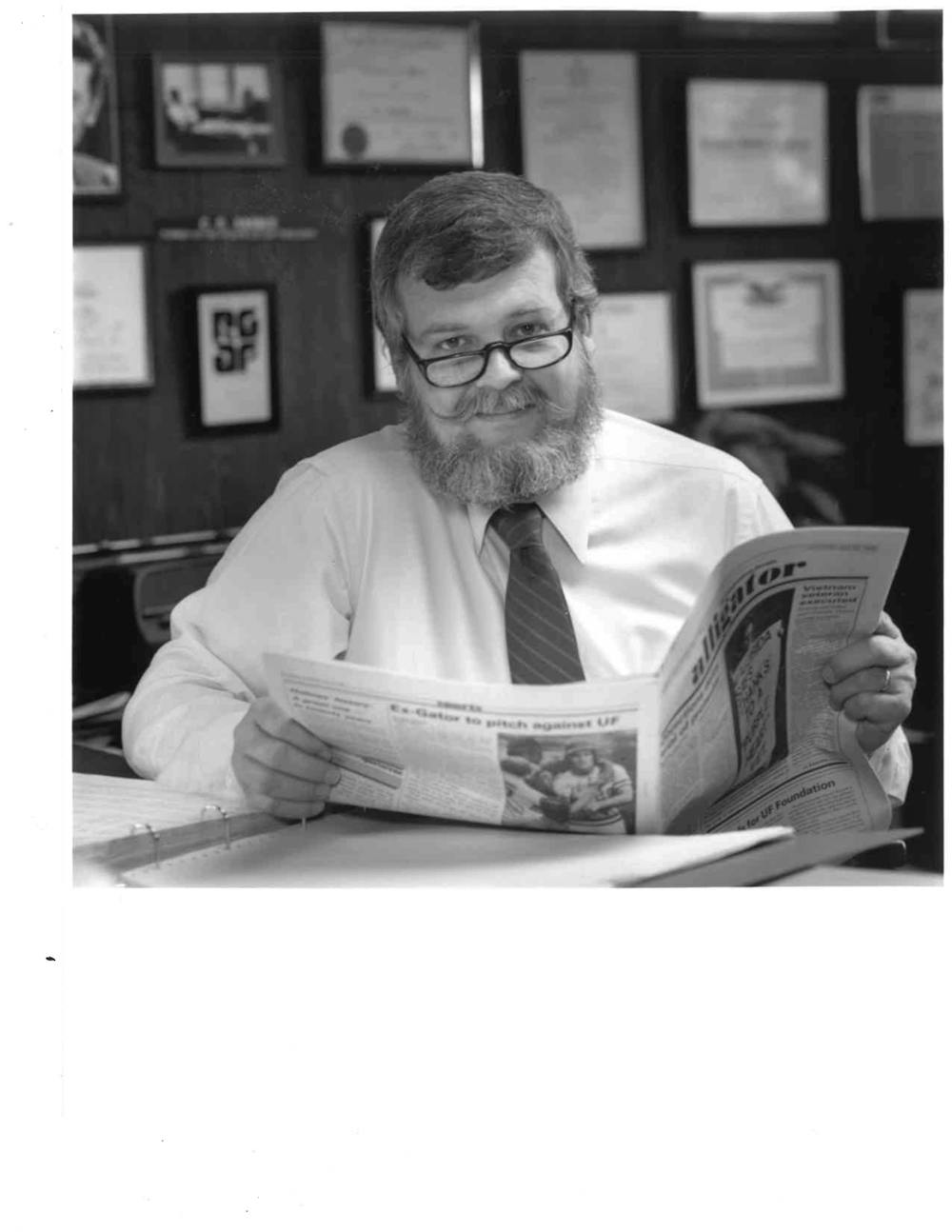
Charles Edward “Ed” Barber, also known as “Mr. Alligator” or “Uncle Ed,” died March 29 at 86 years old.
Barber’s legacy in UF’s journalism community and at The Alligator stretches over 50 years. Alumni and former colleagues remember him as a mustachioed mentor, chili connoisseur and steadfast supporter of independent student journalism.
The South Florida native first became involved with The Alligator as a student reporter a year after enrolling at UF in 1962. After a brief career at the university, Barber became The Alligator’s general manager, president and treasurer in 1976. He resigned in 2007 after holding the position for over three decades.
Ron Sachs, a friend of Barber’s for 57 years and former Alligator editor-in-chief, described Barber as someone who “not-so-quietly” supported the paper’s student journalists.
“He’s the real hero and the story of The Independent Florida Alligator,” Sachs said.
Sachs credits Barber for keeping The Alligator afloat in the early years of its independence. The paper parted ways with the university in 1973, two years after its staff, under Sachs’ leadership, challenged a state law restricting publication of abortion information.
Barber stepped up to defend The Alligator behind the scenes, Sachs said, by coaching its student journalists. He also helped make The Alligator financially viable, monetizing the paper so students could be paid.
“The tradition lives on because of the example that Ed Barber set as a big brother, mentor, coach, who had never done anything in his own life except support college journalists,” Sachs said.
Matt Adams, who was on The Alligator’s staff from 1990 to 1993, said Barber backed up the paper in times of conflict and controversy — never wavering in his dedication to keep The Alligator strictly student-led.
“I would wish for anybody, in their whole lives, to love something as much as Ed loved The Alligator,” he said.
Family and early life
Born Oct. 30, 1939, Barber began working in journalism far earlier than other kids. At just 9 years old, he started a community newsletter in his Miami neighborhood. He’d go on to serve as editor of his Hialeah High School newspaper, The Record, during his senior year.
“Ed grew up dirt poor. … I mean, no shoes and one pair of coveralls,” said David Carlson, a friend of Barber’s for over three decades. “In the boondocks, out in the swamps, basically — they had an outhouse.”
After graduating high school, Barber joined the U.S. Coast Guard Reserve and went on active duty for six months. He also served in active reserves for another seven and a half years upon his return. Barber moved to Gainesville with his wife and high school sweetheart, Judith Tuck, in 1962 to pursue a UF degree.
Enrolling as a married military veteran, Barber studied journalism with a minor in history. He also held several positions at The Alligator — then known as simply The Florida Alligator — ending as executive editor before graduating in 1966.
In 1971, Barber began leading the Office of Student Publications at UF, where he oversaw The Florida Alligator, the student yearbook and literary magazine. He then moved to the University Press, the scholarly book publishing arm of the university. Barber held that role for three years before beginning his 30-year career at The Alligator.
In addition to being a dedicated journalist, Barber is also remembered by friends for his kindness.
Aside from his smile, which Carlson described as “sneaky,” Carlson will miss the fact he could talk to Barber about anything the most, he said.
Carlson, a retired professor in the UF College of Journalism and Communications, first arrived at UF in 1993. During the first week Carlson was in Gainesville, Barber paid him a call and invited him out to eat.
“I found him a kindred soul from pretty much the moment I got in his car to go out to lunch,” Carlson said.
Even after Barber moved to Tallahassee, they made sure to pay each other visits, he said.
“I remember him once bringing my wife and me dinner right after we had bought a house,” Carlson said. “It was the fall, and he had a lot of trouble with pollen in the fall … so he showed up wearing a mask, or maybe even two masks.”
Magdalena Davila, Barber’s wife, described him as compassionate and caring. The two married in 2009 after Tuck, his wife of 44 years, died in 2004.
Davila recalled times at restaurants when Barber would gather the finished dishes at the end of the table to make cleaning up easier for their waiters. He would also leave notes at restaurants thanking waiters for their service.
“He always thought about other people, was always grateful, always thankful for everything,” she said. “That was the kind of man he was.”
Apart from The Alligator, Barber served as president and publisher of The High Springs Herald, which was owned by The Alligator’s parent company, beginning in 1990. The community weekly paper was sold in 2007 and has since shut down.
In 2006, Barber became the president and managing director of the Alligator Alumni Association. He held the position until his death.
Memories from Alligator alumni
Tom Julin, an Alligator alumnus who first met Barber in 1975 as The Alligator’s layout editor, called him a “wonderful person.” Barber was the single most important influence on the paper’s continued survival, he said.
“Without Ed Barber, there probably would be no Independent Florida Alligator,” Julin said.
Barber had the vision for The Alligator to be completely student-run, he said, recognizing that high-quality student journalism requires the “adults” to step back.
Lynda Mitsakos worked at The Alligator with Barber in the ‘70s, while the paper was going through all the growing pains of becoming independent. Barber united The Alligator when it went through rough patches, Mitsakos said.
“He just built the paper back up,” she said.
Barber made an impact on everyone, Mitsakos said, and he kept in touch with Alligator alumni even when he moved to Tallahassee.
To some of those alumni, Barber was also known for handling mistakes among the staff with care.
Beth Kassab worked at The Alligator with Barber from 1996 to 2000. She said Barber was always present to help students learn and ensure The Alligator’s continued existence.
Kassab recalled when she was an editor and there was an error in a story. She said Barber handled the mistake in a remarkable way, providing support while still letting the students navigate the situation.
“He tended to know people's names in the newsroom, but not on a level where he would walk through and try to flout his position there,” she said.
Eric Estrin, a news editor for The Alligator in 1974, remembered when he was assigned a story on panhandlers in Gainesville. His editor wanted him to pose as a panhandler and write about his experience.
Estrin panhandled outside of McDonald’s, he said, because he read people are more inclined to give away money when they are full. He cracked a joke in the article about McDonald’s and its customers that didn’t land well.
McDonald’s, offended by the piece, canceled a large advertising contract with The Alligator. Despite this, Estrin said, Barber didn’t chastise him about the mistake.
“Ed was so cool about it,” he said. “I just really appreciated that it was just a place for students to learn and grow and to do it at their own pace without pressure from him.”
Barber practiced extreme discipline to allow students to run the publication, said Dennis Kneale, a news editor for The Alligator in fall of 1978 and winter of 1979.
“He sat there through generation after generation of editors of the paper who made mistakes,” Kneale said. “If they wanted his advice, he gave it, and if they didn’t ask it, usually he kept it to himself.”
Kneale recalled Barber advocated for The Alligator through many controversies. At one point, a campus group organized the theft of thousands of newspaper copies after The Alligator promoted a Student Government party not endorsed by the group in the paper.
Once independent from UF, The Alligator became “a thorn in the administration’s side,” Kneale said, and the university likely “wanted The Alligator to die.” However, Barber kept the publication afloat.
“Ed always was able to revive the thing,” Kneale said. “He leaves that behind as a legacy.”
Apart from his role at The Alligator, Barber was known for his white handlebar mustache. Later in his life, he grew a long white beard to dress up as Santa Claus for children’s entertainment, Kneale said.
After Barber retired from The Alligator in 2007 for health reasons, Trish Carey picked up the role of general manager. She previously worked under Barber as an advertising director and assistant general manager.
Filling Barber’s shoes wasn’t possible, Carey said. Putting into words what exactly journalism meant to Barber is an equally difficult task.
“He’s a journalist, 100% journalism,” she said. “And he lived it, breathed it, and he passed that onto many, many, many students.”
Memories from university connections
His colleagues also remember the diplomacy Barber maintained between the university and The Alligator, even when the two came into disputes over the paper’s content.
Steve Orlando, interim vice president for communications and marketing at UF, worked with Barber in two very different ways. As a student journalist in the ‘80s, Orlando remembers Barber’s “absolutely larger than life” presence in The Alligator’s office.
Like many former staffers, Orlando recalled Barber’s long-running chili cook-off tradition, when staff members brought their own recipes for their co-workers to sample and vote on. Barber also kept the staff fed with the occasional pizza.
When Orlando later took a communications role at UF, he began serving as a liaison between the paper and the university. His respect for Barber never wavered — even when the two entities had what Orlando called “our differences.”
“At the end of the day, we always had tremendous respect for The Alligator and especially for Mr. Barber, because he always did the right thing,” he said.
What would be the best way for student journalists to honor Barber’s legacy, according to Orlando?
“Meeting their deadlines,” he said.
When asked if The Alligator would exist today without Barber, former Alligator board member and retired UF journalism professor Jean Chance took a five-second pause before responding.
“Gosh, I think it’s questionable,” she said.
Chance worked on The Alligator’s staff in the late 1950s, “before there was an Ed Barber there,” and she watched the paper grow into its newfound independence under his leadership.
Through confrontations with leaders at Tigert Hall, Barber served as a “good diplomat,” maintaining relations with UF while fiercely protecting the journalistic ethics he valued.
She recalled a time when university leaders wanted to remove The Alligator’s orange distribution boxes from campus due to complaints they were “ugly.” Over the course of several meetings, the paper and university found a compromise to get some of their boxes back on campus and into students’ hands.
“Ed was just a good, honest person who represented everything about what being a good journalist is and what the student newspaper should reflect,” Chance said.
Barber’s memorial service will take place Saturday, April 4 from 3 to 5 p.m. at the Forest Meadows Funeral Home in Gainesville. His final resting place will be at the Jonesville Cemetery. Any donations will be sent to the American Civil Liberties Union.
Contact Leona Masangkay at lmasangkay@alligator.org, Sofia Meyers at smeyers@alligator.org and Zoey Thomas at zthomas@alligator.org.

Zoey Thomas is a UF media production senior and the Spring 2026 editor-in-chief of The Alligator. She has previously been data editor and engagement managing editor, as well as a reporter for three semesters. She was also a intern at the Orlando Sentinel. In her sparse free time, Zoey enjoys reading a good book, going for a run or waking up her roommates with the sound of her espresso machine.
Sofia Meyers is a journalism junior and The Alligator's Summer 2026 university editor, her second consecutive semester in the role. Previously, she served as general assignment reporter on the university desk and city/county commission on the metro desk. In her free time, she enjoys playing pickleball, reading and baking.

Leona is a second-year journalism student and the Spring 2025 University Administration reporter. They previously worked as the Santa Fe reporter. In their free time, Leona enjoys going to the gym, watching Marvel movies and traveling the country for music festivals.


