

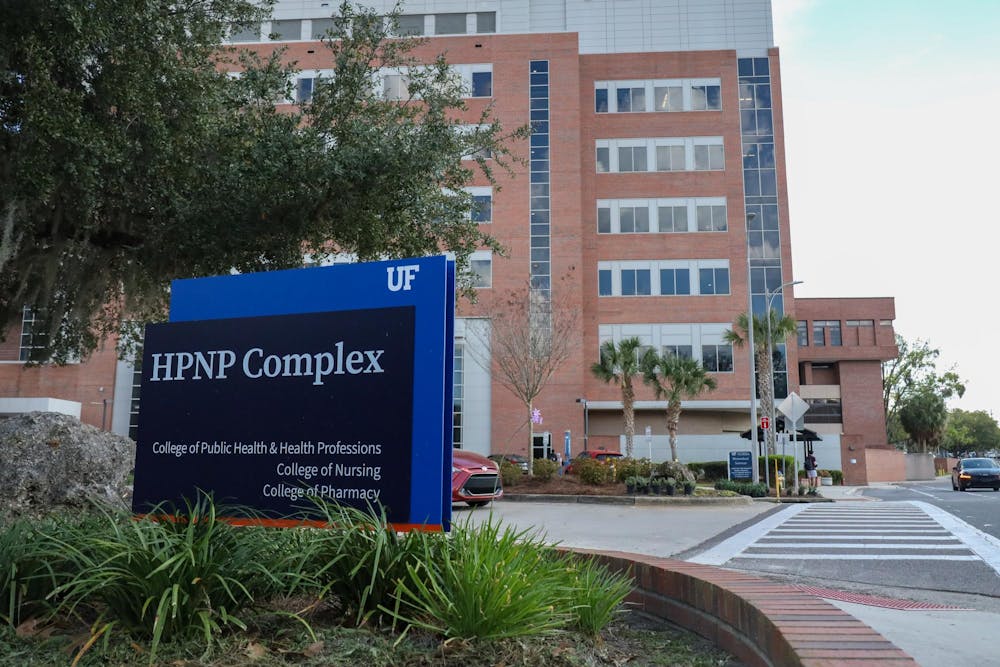
National Institutes of Health Director Jay Bhattacharya visited UF’s public health and health profession auditorium to speak with its research community about innovation, funding and restoring the public’s trust in science Wednesday afternoon.
The lecture packed the room with about 300 scientists, professors and students clad in suits and business professional attire. Conversations buzzed across the room before falling to a hush as Bhattacharya was introduced.
Bhattacharya became a divisive figure following his criticism of public health policy during the COVID-19 pandemic and the termination of NIH research grants funding research on health disparities, climate change and gender.
He is the 18th director of the NIH, the nation’s medical research agency. Prior to his appointment, he was a researcher and medical professor at Stanford University.
NIH scientists raised concerns about Bhattacharya’s leadership in a letter sent last year, writing that his newly introduced policies “undermine the NIH mission, waste public resources, and harm the health of Americans and people across the globe.”
Bhattacharya’s lecture covered three NIH priorities: making research funding more equitable, encouraging scientists to replicate past studies to build public trust and building competitive support systems for researchers.
According to Bhattacharya, the NIH needs to do more to answer Americans’ questions about health issues.
“The word is ‘idiopathic hypertension,’ right? What does that mean — idiopathic? That means ‘I don’t know what causes it.’ What the hell?” Bhattacharya said. “The American people are trusting us with hundreds of billions of dollars so that we can help them with their problems.”
He said the way the NIH has historically funded research disincentivizes scientists to take risks, leading to less innovation and making the United States less competitive at the international level. He added early-career researchers at lower-ranked universities may struggle to receive proper funding.
“If you want to find the high-risk, high-award ideas, you got to find the people outside of the top 20 [universities] where those ideas are and support those institutions,” he said.
In 2025, UF spent a record $1.33 billion on research, but funding cuts from terminated NIH grants left at least three undergraduate research programs with less funds and uncertain futures.
The lecture was followed by a “fireside chat” with David Norton, UF’s vice president for research.
According to Norton, hundreds of questions were submitted in advance for the Q&A session, but only a few were selected.
Bhattacharya addressed topics including his transition from academia to government, the future of NIH funding, emerging technologies like artificial intelligence in medicine and how researchers should navigate uncertainty around federal funding amid setbacks from last year’s government shutdown.
Suman Sonty, a 24-year-old UF medical student, said the COVID-19 pandemic impacted her freshman year at UF. Observing discourse surrounding public health made her more interested in keeping up with the news, which is why she attended the lecture.
During the COVID-19 pandemic, Bhattacharya coauthored the “Great Barrington Declaration,” an open letter calling for lifting lockdowns and reopening schools. The letter received support from President Donald Trump.
Bhattacharya was appointed as interim director of the Centers for Disease Control and Prevention by the Trump administration last month. His appointment worried several leading medical leaders, including former CDC employees, who questioned his ability to run the CDC and NIH simultaneously.
“It was hard not to think about what the direct impact of what he was saying was going to have,” Sonty said. “When I was listening to him speak, it was like running through my head, ‘Okay, how will this directly impact the projects that I have going on?’”
Sonty said she is involved in several research projects, including one studying the impact diets have on adolescent mental health. In the summer, she will be involved in a project researching the long-term health of people with congenital urinary tract illnesses.
She came to the event with Nellie Crlenjak, a 25-year-old UF medical student.
Crlenjak said Bhattacharya’s ideas sound bold.
“The potential could be great, but it's hard to process it,” she said. “We don’t know what the impacts of these decisions will be yet.”
Contact Julianna Bendeck at jbendeck@alligator.org.
Contact Angelique Rodriguez at arodriguez@alligator.org. Follow her on X @angeliquesrod.
Julianna Bendeck is a first-year journalism student and the Summer 2026 criminal justice reporter. She previously worked as a contributing writer and race and equity reporter at The Alligator. Outside the newsroom, she enjoys reading, surfing the web and playing video games.

Angelique Rodriguez is a journalism freshman and the Summer 2026 El Caiman Editor. She has spent two semesters at The Alligator as a University Reporter and El Caiman Reporter before becoming an editor. When she's not working, you can find Angie reading, hanging out with friends, or rewatching her rotation of favorite shows.


