
Culture wars on campus have become an unavoidable part of daily life for me here. They shape the environment in ways that are impossible to miss.
On any walk to class or the library, I pass anti-abortion activists with graphic signs, religious preachers proclaiming salvation, men carrying messages about a woman’s place being in the home or student groups representing opposing sides of the Israel-Palestinian conflict.
Rather than creating the feeling of a politically vibrant campus, it often creates one marked by tensions and confrontation.
To be clear, universities should be places where free expression is protected. UF treats outdoor campus spaces as public forums for protest and speech, in line with the First Amendment and Florida law. In principle, that protection matters.
Universities should not silence views simply because they are controversial, unpopular or offensive. A campus without disagreement is not a university at all.
Coming from Trinity College Dublin, I am used to campuses shaped by protest. Trinity has seen walkouts and demonstrations around the war in Palestine and Iran, the Boycott, Divestment Sanctions movement, and sexual assault awareness. The university has sometimes responded by tightly managing how politics appears in shared spaces, including restricting campus access throughout major protests and enforcing rules against flags and banners.
But the politics I encountered there were usually attached to particular causes and framed through a more liberal language of human rights, solidarity and justice. I have never seen any shock tactics and confrontation there that so often define campus life at UF.
At UF, there is a real difference between defending free speech and accepting a campus culture in which the loudest, most provocative voices dominate shared spaces. That is where the issue becomes more complicated.
UF received a grade of “D” in the 2026 College Free Speech Rankings produced by the Foundation for Individual Rights and Expression, with students reporting they did not always feel comfortable expressing their own views.
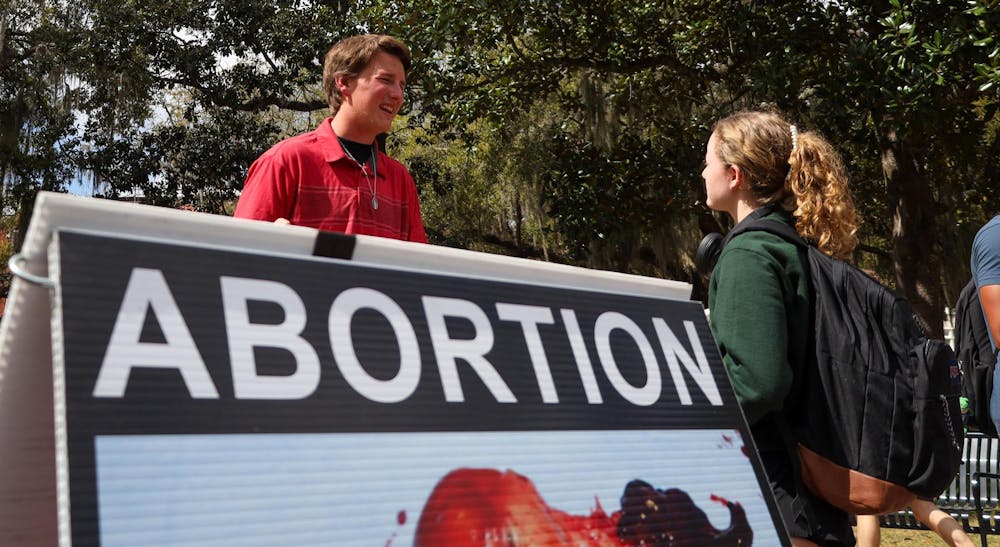
Part of this may be because campus politics increasingly rewards spectacle over substance. One of the clearest examples is the presence of anti-abortion campaigners such as Created Equal, who display large, graphic images of aborted fetuses in central areas of campus.
Those behind these demonstrations would argue their aim is to provoke moral reflection. Yet for many students — myself included — the effect is less persuasive and is deeply unsettling. When activism relies on shock and intimidation, it becomes harder to see it as an invitation to debate.
Then there is the circus surrounding Myron Gaines, a male supremacist speaker, who was invited to campus by Uncensored America — a person and organisation I had never even heard of before they arrived at UF. In many ways, his appearance proved my point better than I could.
His comments were not intelligent, well-argued or informed; they were crude, underdeveloped and clearly designed to provoke. But that is exactly how this campus culture often works: If you are outrageous enough and loud enough, you can dominate attention, regardless of how weak your argument actually is.
Gaines shouted statements including “I don’t know why these women are here; is there a kitchen nearby?” and “bring back slavery.” Those statements are not contributions to debate. They are provocations masquerading as ideas.
The same can be said, in a different way, of the religious preachers who are a constant presence on campus. While less visually aggressive, they also contribute to a sense that public campus life is increasingly shaped by ideological display.
Their presence is protected, and they have every right to speak. But, when students are repeatedly confronted with highly charged political and moral messaging in the ordinary course of their day, it’s evident that some would struggle to create an opposing or authentic opinion on certain matters.
The Israel-Palestinian conflict adds another layer to this atmosphere. Pro-Israel and pro-Palestinian student groups maintain visible presences on campus, often in close proximity to one another.
On one level, this reflects the pluralism universities are supposed to foster: multiple groups, multiple identities, multiple arguments, all coexisting in the same public square — and there is value in that openness.
At the same time, the intensity surrounding issues like this can make campus life feel emotionally and politically charged in ways that leave less room for uncertainty, reflection or quiet disagreement.
Students can begin to feel that they are expected to take a clear position immediately, when in reality, many are still trying to think through complex questions for themselves.
The issue is not that difficult views exist on campus. The issue is that the most extreme and theatrical voices are too often the ones that set the tone, and this creates a culture of noise, not debate.
Universities should defend free expression, but they should also care about the kind of intellectual environment students are being asked to live in. Right now, that environment feels less like a place of education and more like a permanent contest for attention.
Contact Evelyn at eocarroll@alligator.org. Follow her on X @evelynocarroll.
Evelyn O’Carroll is a junior Political Science and Social Policy student from Trinity College Dublin, currently on international exchange for this semester. She writes a column documenting her experiences of studying abroad at the University of Florida.