

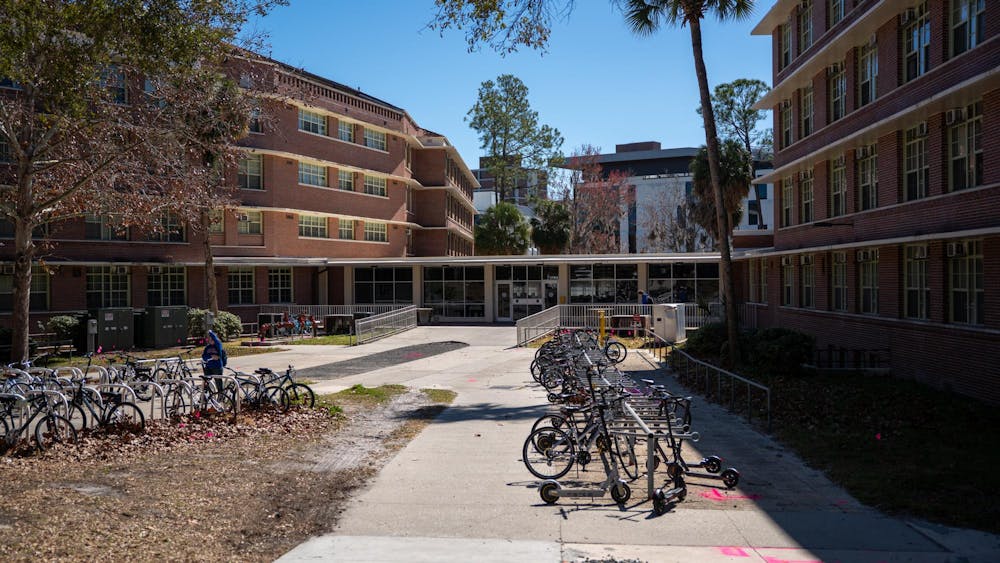
This year, the west side of campus has a new look. Trusler, Simpson and Graham halls have been demolished.
Both the memories and the foundations of the dorms were ripped from the ground. In their place stands mounds of sand, a blank space in the former campus landscape.
Meanwhile, as the dorms were being torn down, about 7,500 freshmen flocked to campus. UF was aware the class of 2029 would be a behemoth. It wasn’t just Florida, either — this class was acknowledged as the peak of high school graduates nationwide; a “cliff” of underenrollment will follow.
In response to this influx of students, UF has created a paradoxical, poorly thought-out solution. As more students come in, fewer dorms are available.
And the logic makes sense, doesn’t it? Take, for example, when a city knows it will host a Super Bowl. The hotels of that city start closing rooms, correct?
No. But for some reason, UF decided to. As it took in more students than ever before, it also took away several dorms.
Improving the number of student housing units is a priority for UF, but its approach to this is misaligned. Its 10-year, $1.1 billion plan will increase the number of student beds from 9,316 to 12,493.
But that growth is expected to happen by 2035. For reference, a student entering college in 2035 would have only been born nine years ago.
Herein lies the problem with UF’s approach to improving campus housing: It requires a great detriment to current students.
The theft of dorms won’t stop, as Tolbert and Rawlings are expected to have the same fate by late 2029 as Graham Area did in Fall 2025.
As these dorms are torn down, students resort to finding spaces off-campus. For some, this is a better option; they prefer the refuge from campus, their own kitchens and a private bathroom. For others, however, this option is not only more expensive but undesirable.
For some, living on-campus is the ideal version of college. It’s in these oft-loathed communal bathrooms and shared kitchens that many friendships can be made, and dorm locations offer walkability to classes, student events and libraries.
While these factors can be found elsewhere, on-campus housing provides them in unparalleled ways.
UF is a school set on keeping college traditions alive, from a century-old Homecoming to a book on student life given to every freshman. The best conversations between current Gators and alumni are those relating to these traditions.
Among these conversations is a question of dorms. Gator alumni from southwest Florida to Washington have asked me whether X dorm still exists, or if Y dorm still has communal bathrooms.
These dorms are a part of the Gator tradition, and UF’s decision to destroy them before replacing them with more living spaces reflects a decision made by university leadership's elites, a decision with no regard for students.
Contact Timothy Dillehay at tdillehay@alligator.org. Follow him on X @timothydilleh.
Timothy Dillehay is a political science and history sophomore and a Spring 2026 Opinions Columnist for The Alligator. He writes on issues related to university administration and student government. In his free time, Timothy enjoys journaling, reading comics and classics, and reviewing films on his Letterboxd.


