

Read other stories from the "These stories were not AI-generated" special edition here.
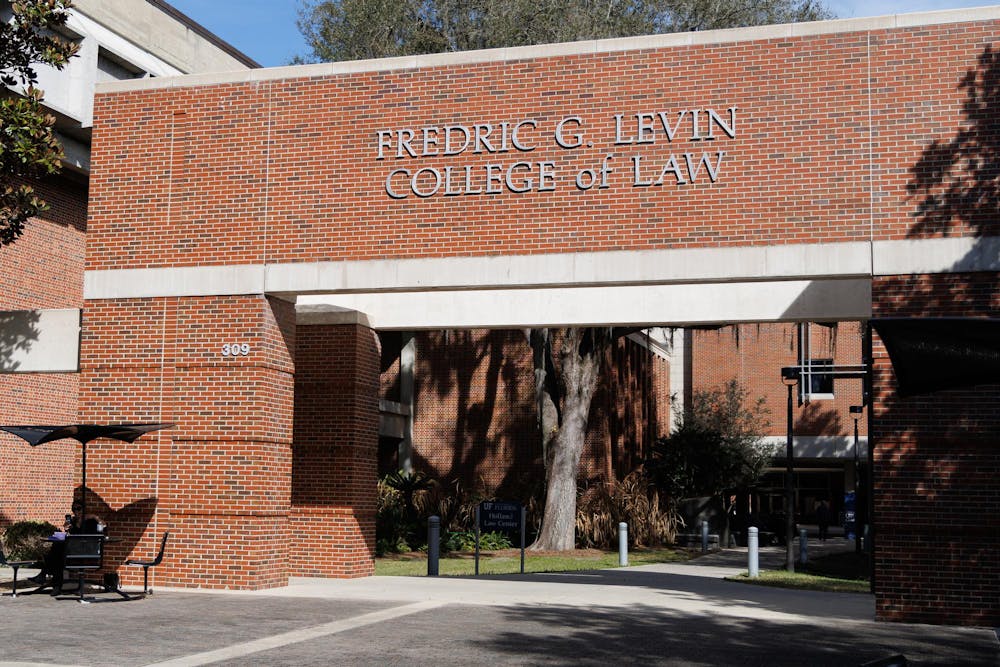
In law school, most students spend their time reading cases, preparing for cold calls and writing briefs. But in one classroom at the UF Levin College of Law, students are learning something unexpected: coding.
Professor Thinh Nguyen, director of the Innovation and Entrepreneurship Clinic at Levin, is helping prepare future attorneys for the shift toward artificial intelligence. In his class, students use Python to delve into coding principles, learning the ideas behind present and future AI use.
“It's not about teaching applications and tools,” Nguyen said. “It's about teaching ideas, principles, techniques that will withstand all the changes that are coming.”
Nguyen said understanding the technical side of AI is essential for future lawyers who will be shaping policy and regulations. While professors like him are reshaping how law is taught, students at UF are already experiencing the effects of AI in their day-to-day education.
In the first part of Nguyen’s class, students learn AI fundamentals and the technical ideas behind it. By the end of the course, students apply those ideas to policy issues like privacy, security and autonomy.
“By the time we get to it as a class, we share a deeper understanding of the technology and how it works and what it is capable of and … what the problems are,” Nguyen said.
Ultimately, his goal is to prepare students not just to use AI, but to lead in a world shaped by it. The students he teaches, he said, will one day shape legal policy governing the technology.
“When it comes time for them to be leaders, they can ask the right questions, and they can understand the answers to come at them,” he said, “instead of being naive that these models are perfect.”
For Trent Lane, a 24-year-old UF law student, AI has become an increasingly visible part of the classroom. Lane, who said he had an early interest in AI, recently took a course on how AI interacts with multiple legal fields, from intellectual property to criminal procedure and employment law.
For example, in his trademark law class, he’s learning about how lawyers are questioning how to trademark something created by machine learning.
The integration of AI into education is “a mixed bag,” Lane added. Some professors prohibit technology and require handwritten notes, while others encourage the use of laptops and AI tools.
In one legal drafting class, Lane said, his professor created a customized AI tool with ChatGPT to help students draft contracts with correct formatting and proper language, but with guardrails to prevent AI from writing the contract itself.
Despite these innovations, ethical concerns remain central, Lane said.
“Everywhere you go, there's kind of an understanding of we have a duty,” Lane said, “and we're not going to violate anything by using AI in improper circumstances.”
As executive articles editor for the Florida Law Review, Lane said the publication has strict policies prohibiting the use of AI to process submissions in order to protect authors’ work from being used to train AI or generated elsewhere.
He also addressed concerns about AI replacing legal jobs. Lane said many aspects of transactional law are already standardized or automated, meaning AI may change, rather than eliminate, legal work.
“I think it'll definitely take some jobs, but I think it's more secure than people think,” he said.
UF law student Cecilia Carbone agreed AI is unlikely to replace lawyers entirely in what she called a “client-focused industry” driven by empathy, not just intelligence.
Carbone said one of the reasons she chose UF Law is because it is on the “cutting edge of everything,” especially compared to other schools.
“We've been being trained on AI within the legal industry, and whereas other schools I know have not,” she said.
As routine tasks become automated, she said, new lawyers may be expected to take on more complex work earlier in their careers. That shift, she said, could make the field more competitive, but also more innovative.
“With innovation, with growth like this, you also see growth in types of law because now, AI law is a possibility,” Carbone said. “We're seeing all these different sorts of law pop up.”
She pointed to the rise of specialized fields such as food law, which has expanded in recent years alongside an increase in related litigation.
Rather than eliminating careers, she believes AI will shift the type of work lawyers do.
“I don’t think it’s going to take away lawyer jobs,” Carbone said. “I think it’s going to eliminate some of the grunt work that summer associates and junior associates do, but that just means that you need to be a better lawyer, right?”
Mia Giannicchi is a contributing writer for The Alligator.