

Editor's Note: This story has been updated to reflect James Uthmeier is paid $100,000 a year.
From Alexander Hamilton to “The West Wing,” Florida Attorney General James Uthmeier detailed his view of the legislative process, judicial power and what he considers its excesses at a speaking event Monday evening.
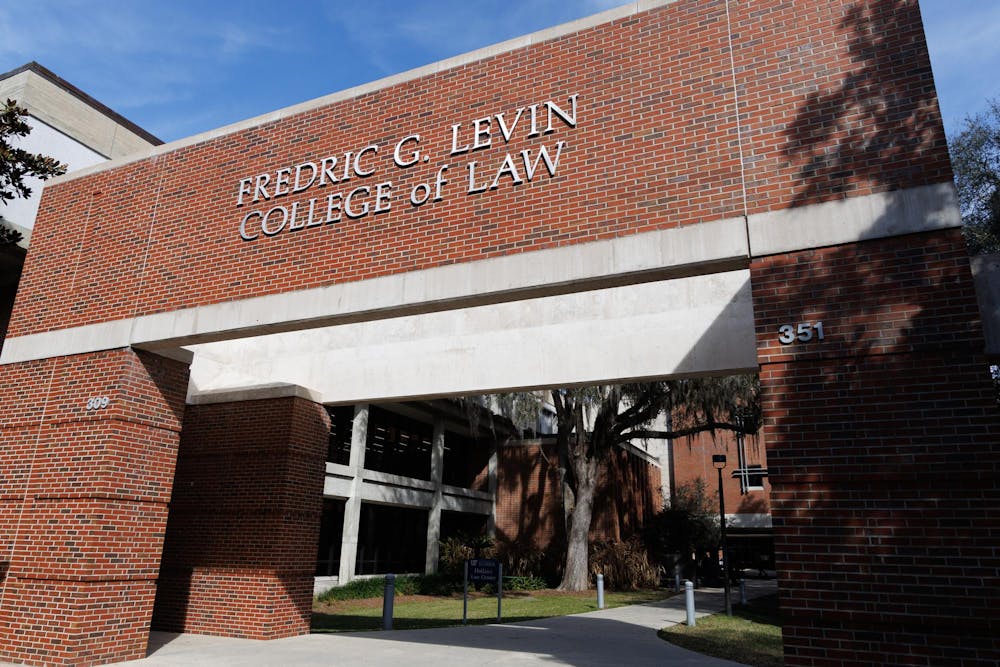
Uthmeier, an adjunct professor at UF’s law school, led a discussion regarding the separation of powers in the Levin Law School’s Bailey Room. Florida Supreme Court Justice Adam Tanenbaum joined him, as did Solicitor General David Dewhirst, who stepped in for U.S. District Judge Jordan Pratt.
The event’s title, “Conversation on the Separation of Powers,” mirrors the topic of the course Uthmeier teaches once a week at UF on federalism and the separation of powers.
Uthmeier recently came under criticism after a Miami Herald investigation revealed he earns over $100,000 a year for teaching the class, making him the highest-paid adjunct in the college by $20,000.
Uthmeier, seated between his two colleagues, spoke the least among them, serving as something closer to a moderator than a lecturer.
Instead, Tanenbaum and Dewhirst did most of the talking.
Dewhirst defined the tone for the evening early on. As solicitor general, Dewhirst oversees appellate litigation. He previously served as Gov. Ron DeSantis’ senior adviser.
“The closer we tie ourselves to those original impulses and understandings of the Constitution, the better off we are,” Dewhirst said.
He criticized the way Florida’s amendment process allows for a legislative go-around. Under Article 11, Section 3 of the Florida Constitution, electors can put constitutional amendments on the ballot if they gather a sufficient number of signatures.
Dewhirst pointed to that as an example of legislative surrender, using the failed Florida Amendment 3 that would have legalized recreational marijuana, from the 2024 election cycle, as an example.
“One [negative effect] is a bought and paid-for approach,” he said. “If you have an interest out there that has a lot of money, they can buy their way into the constitutional process.”
Tanenbaum criticized the emphasis law schools across the country put on case law — the body of judicial rulings that establishes legal precedent. Doing so, he said, teaches law students that laws come from courts, not the Legislature.
“When the Supreme Court says something, it’s as if the oracle, or something on high, something from Mount Olympus or Mount Sinai — oh, the Supreme Court has spoken,” Tanenbaum said in a criticism of what he interprets as judicial overreach and an excess of deference to court rulings.
Congress, they said, should take the real lead in defining and interpreting law, whereas courts should merely address whether harm caused to a party in a legal suit was legal.
Though Uthmeier did little talking, he did offer some statements.
He appeared to agree with his co-speakers, whom he called “some of the most intellectually honest and courageous lawyers in the profession.”
Like Tanenbaum, he said “judges don’t make the law; they interpret the law.”
Throughout the conversation, he asked Tanenbaum and Dewhirst five rounds of questions on topics like the Founding Fathers and their intentions, the extent of judicial review and how to address controversies over judicial jurisdiction.
Neither the students in attendance nor the speakers raised questions or comments regarding controversies surrounding Uthmeier. When asked to speak about the event itself, all declined to comment.
Contact Avery Parker at aparker@alligator.org.
Avery Parker is an English and History senior and the Spring 2026 El Caimán editor for The Alligator. He previously worked as The Alligator's University desk editor, as well as a reporter for the University and Enterprise desks. He doesn't know the meaning of the word "freetime," but he can usually be found deep in an archive reading 19th century documents or tending to his four cats.


