

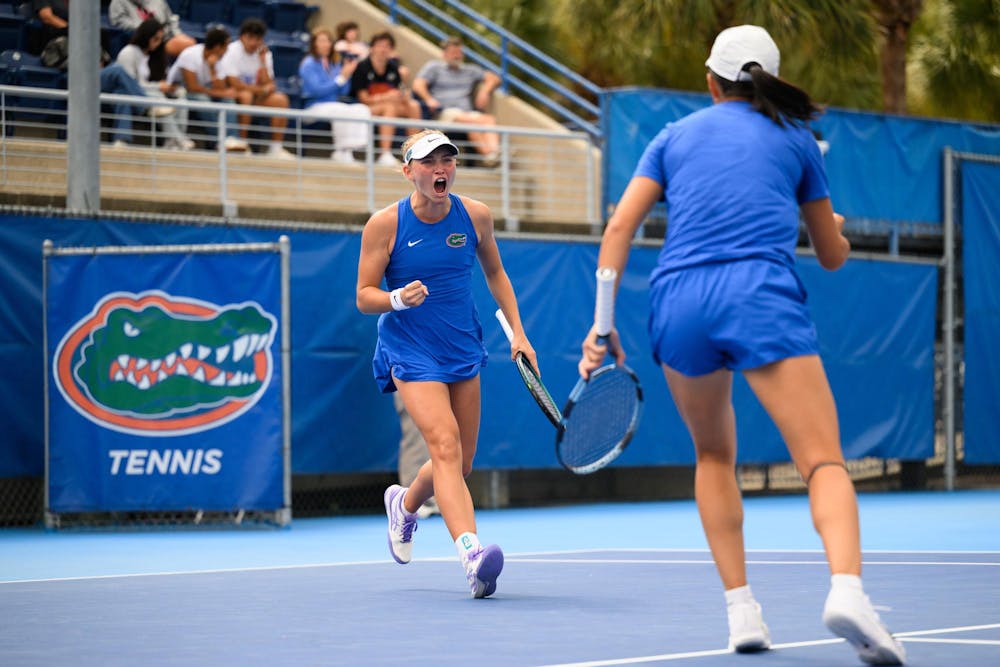
Opening the 2026 campaign, Florida women’s tennis carried one undeniable power under its belt: the mastery of doubles. Clinching the doubles point in five consecutive matches to kick off the season, the Gators had a newfound strength pushing them forward.
However, that strong point suddenly shrank when conference play began, and the Gators shouldered the responsibility of rebuilding confidence in the home stretch of the season.
Performances
One doubles team found its rhythm off the bat. Riding a five-game winning streak since the season opener, Brooke Black and Valery Gynina were the driving force behind Florida’s doubles success. The freshman-junior duo communicated in Russian on the court, building a unique bond that translated to victories.
“I think it gives us a lot of confidence,” Black said Feb. 13 after the pair earned its fourth straight win against Troy. “We’ve only gotten better with every match.”
But that rapid improvement came to a halt. The SEC opener against then-No. 13 Auburn marked the first match where the Gators didn't see it through in doubles.
Florida’s then-No. 23 pair of Xinyi Nong and Nikola Daubnerova fell to Auburn's Ava Esposito and DJ Bennett in a 6-3 contest. The duo of India Houghton and Lucie Pawlak soon followed, ultimately taking a 6-3 loss to the Tigers’ Ekaterina Khairutdinova and Ashton Bower.
Gynina and Black saw their win streak narrowly survive, as their match against Auburn was cut short at 5-4. But their struggle to close out the victory uncovered an early-season weakness: unforced errors.
The Gators were safe for the next two matches, starting with a doubles win against Bethune-Cookman. Facing an opponent with only two doubles teams, Florida was automatically awarded the second doubles point upon winning the first match.
In their next doubles showing against Arkansas, the Gators regained momentum against a conference opponent. Gynina and Black dominated Arkansas’ Jimena Gomez Alonso and Brooke Schafer in a 6-2 decision. Florida’s Houghton and Pawlak met a similar fate, edging Arkansas’ Arina Babenko and Panagiotidou 6-4 to secure the doubles point.
The Gators’ next match against then-No. 11 Oklahoma uncovered a pattern the team followed several times throughout the season: winning the match despite losing the doubles point.
Then-No. 23 Nong and Daubnerova faced the No. 1 doubles team in the nation, ultimately falling 6-4 to Gloriana Nahum and Roisin Gilheany. In their first loss of the 2026 season, Gynina and Black couldn't close out the match against then-No. 44 Edda Mamedova and Evialina Laskevich, losing 6-4.
Despite the disappointment in doubles, Florida went on to claim a close 4-3 victory over the Sooners. For the first time all season, the Gators proved they didn't need the initial advantage to find success in singles.
“We lost the doubles point, and we still came back to win,” head coach Per Nilsson said post-match. “That's hard to do against a really good team.”
Just as quickly as they recovered, the Gators fell the next weekend facing their highest-ranked opponent yet. They lost the doubles point to then-No. 4 LSU and were ultimately swept 4-0.
As competition got tougher, Florida’s doubles roster struggled to keep up with top opponents. The Gators had trouble communicating and staying on the same page as their partners.
But Florida’s match against then-No. 30 Ole Miss saw the Gators come back from losing the doubles point once again. With hard defeats from Gynina and Black and then-No. 19 Nong and Daubnerova, the Gators didn't let the early disadvantage upset them. Florida went on to win every singles point, defeating the Rebels 4-1.
Throughout the season, the Gators continued to see matches where they lost the doubles point and still pulled out a victory. Florida’s results were a rare phenomenon in collegiate tennis. Teams that lose the doubles point only successfully rally to win the overall match a quarter of the time at most, according to NCAA statistics.
So, what was the Gators’ secret to winning matches without claiming the doubles point? The mentality not to give up.
“We’ve won without it, and we’ve lost without it,” associate head coach Axel Damiens said. “They understood that it doesn't matter.”
The coaching staff continuously stressed that losing the dual matches shouldn't affect their confidence going into singles.
And the players reciprocated that mentality. In the Gators’ match against then-No. 11 Tennessee, Black dominated Catherina Aulia in a 6-2 contest after losing the doubles point 7-5. Gynina did the same in a match against Mississippi State’s Thes Ntondele Zinga, taking a three-set 6-3, 4-6, 6-2 victory after a doubles loss.
However, while winning or losing the doubles point may not have impacted the Gators, the court they were playing on certainly did. Competing on another university’s home courts with little fan support, the Gators’ confidence dimmed.
“I love playing at home,” Pawlak said. “It makes such a huge difference when we're away.”
The results proved that. The Gators boasted a 10-1 overall record at home. In three of the five matches when Florida lost the doubles point and made a comeback victory, the Gators were accompanied by cheers from fans filling the Alfred A. Ring Tennis Complex stands.
Doubles teams
Taking five straight doubles losses in the mid-season, Gynina and Black, who were once responsible for taking the Gators to victory in doubles, hit a season-low record.
Struggling with unforced errors and returning serves, Gynina and Black were rapidly trending downward. Black also suffered a minor injury in April, making her nervous to keep playing and forcing her to miss two matches.
But as the season progressed and the team focused on practicing its doubles showing, Gynina and Black got back in their groove. The duo recorded a four-game winning streak near the end of the season, defeating top opponents like Auburn’s then-No. 19 Angella Okutoyi and Mema Refaat.
For the graduate-freshman pair Houghton and Pawlak, the journey looked different. Having missed out on playing together in the fall, Houghton and Pawlak began building a relationship at the beginning of the spring.
And the lack of foundation showed.
“They had zero chemistry together in the beginning,” Nilsson said, “to the point where they didn't want to play with each other.”
Houghton and Pawlak’s struggle reflected in their results, as the pair couldn’t clinch a victory until the third match they played together. Determined to help Houghton and Pawlak, Nilsson had a plan to drive them to success.
“We had a meeting with both of them individually and told them ‘Look, you have to try to have some chemistry,’” Nilsson said.
From there, Houghton and Pawlak built a strong foundation in doubles. The tandem recorded a five-game winning streak in March, each earning SEC honors in the process.
“From the beginning of the season to the end, we improved and got so much closer,” Houghton said. “We felt like a different team.”
Meanwhile, Florida’s top doubles team, Nong and Daubnerova, had a standout first season as a duo. They climbed the ITA rankings to become the No. 14 doubles team in the nation, making important moves against top opponents.
Nong and Daubnerova earned their season-best win, defeating Auburn’s No. 2 DJ Bennett and Ava Esposito in a dominant 6-4 contest. In the Gators’ match against South Carolina, Nong and Daubnerova swept the No. 9 duo of Buchwald and Friedman to finish them 6-1.
Ending with an 18-14 doubles record in the 2026 campaign, Nong and Daubnerova proved they deserved the No. 1 court. But the pair won’t play together again, as Nong graduated from UF in the Spring.
Reflecting on the season's doubles performances, Nilsson emphasized the importance of a strong doubles showing, even though it only adds one point to the scoreboard.
“It's not the end of the world,” Nilsson said. “But as a coach, when you lose the doubles point, it scares you because now we can't afford any slip-ups.”
Improvement
Determined to make a comeback in what was once their specialty, the Gators worked on improving their doubles showing.
“We went back to simple,” Damiens said. “Just having fun and playing with each other.”
Florida focused on the basics and avoided overcomplicating their play. The results showed the effort to improve was there.
Against then-No. 13 Vanderbilt, Florida dominated doubles in one of its strongest matches of the season. Gynina and Black took a 6-2 victory over the Commodores' then-No. 10 Valeria Ray and Bridget Stammel, giving the Florida duo their highest-ranked win of the season. On court three, Houghton and Pawlak finished the job with a 6-3 win over Erin Pearce and Mia Yamakita, giving Florida the doubles point for the first time in three matches.
The Gators took that momentum to the next weekend, where they claimed a hard-fought doubles point over Missouri. Then-No. 19 Nong and Daubnerova swept Laea Quaglia and Gia Octa, 6-2, while Houghton and Pawlak went 6-1 over Alex Ackman and Zoe Lazar. Having the doubles point advantage, Florida entered singles comfortably and closed out the match with three more wins, finishing 4-0 against the Tigers.
Fresh off the win over Missouri, the Gators secured the doubles point against Arkansas for a third weekend in a row. Houghton and Pawlak finished 6-0 for the first time in the season against Jimena Gomez Alonso and Alexandra Panagiotidou. Extending Florida’s dominance, Gynina and Black went 6-1 over Brooke Schafer and Arina Babenko to give the Gators the doubles point.
Winning the doubles point in four of their last six matches, the Gators managed to bring back some of the doubles momentum they carried in the early season.
Looking ahead
With Houghton and Nong graduated, Florida has to build two new doubles teams this season.
Luckily for the Gators, they rely on a young roster to keep them competitive. Florida has the summer to make minor tweaks to each doubles pairing.
One thing is clear from the 2026 season: The Gators have the potential to take their doubles performances to the next level.
“We’re going to try to do a good job this fall,” said Nilsson. “We have a lot of players that we can work with.”
Contact Sofia Alamo at salamo@alligator.org. Follow her on X @alamosofiaa.

Sofia Alamo is a Sports Journalism freshman at UF and the university’s Women’s Tennis beat reporter. Her favorite sports are soccer and tennis, and she aspires to be a sports broadcaster in the future.


