

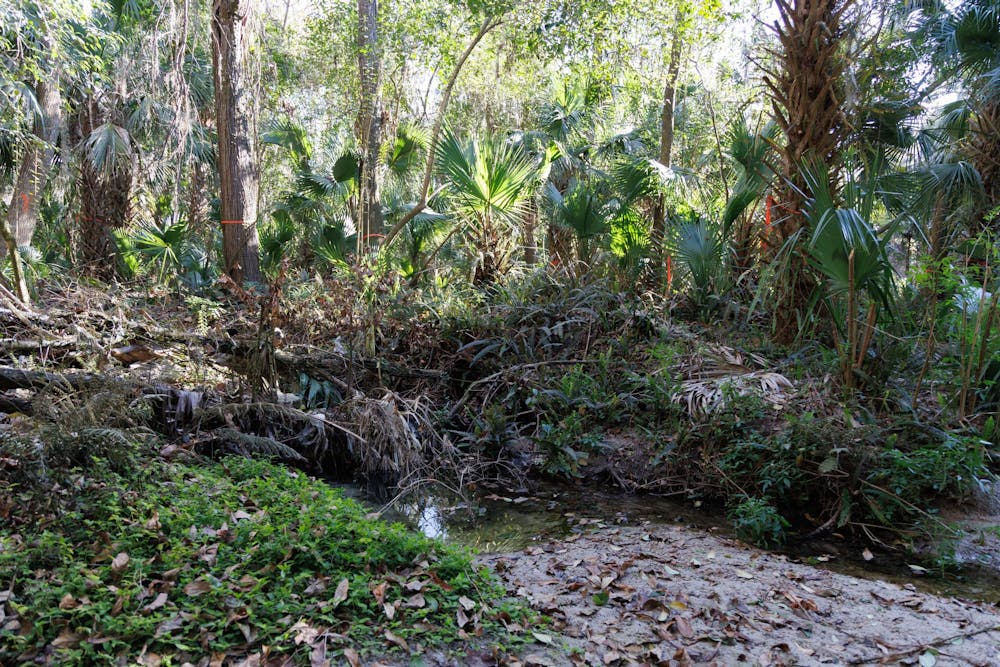
Public discussion regarding the Graham Woods Stormwater Improvement Project has largely focused on one question: How can cutting down trees be part of an environmental restoration project?
This is a fair question. However, the choice facing UF today is not between preserving Graham Woods and destroying it. Rather, this critical campus project stands to both repair failing infrastructure and restore a damaged watershed critical to the health of a landscape that holds immense value for our community and the Lake Alice ecosystem.
This project, which follows the publication of the 2024 Lake Alice Watershed Plan, has aggressive and far-reaching goals, including stabilizing eroding slopes, repairing failing stormwater management systems, reducing sediment entering the watershed, removing invasive plant species and reestablishing native vegetation.
So, how did we get here? The Lake Alice Watershed Study identified Graham Woods as a priority area for restoration because of extensive erosion, failing infrastructure and public safety hazards.
Over time, increasingly concentrated stormwater flows have drastically reshaped the landscape, carving deep channels through the site, destabilizing streambanks, damaging vegetation and carrying excess sediment downstream toward Graham Pond and Lake Alice. These detrimental conditions must be addressed to stem further environmental decline and reduce the area’s current safety risks.
We have local examples where a stormwater project like this has been beneficially implemented.
Gainesville’s Sweetwater Wetlands Park is a wetland-based stormwater treatment system that also serves to restore the area’s natural hydrology. In addition, Gainesville’s Depot Park was built upon an enhanced stormwater system that reduces major pollutants while also incorporating public recreation amenities to create a beloved space in our city center.
A robust discussion surrounding the potential challenges and opportunities related to the Graham Woods Stormwater Improvement Project has taken place with knowledgeable and engaged members of the campus community in accordance with university governance, including review by the Faculty Senate Infrastructure Council.
While tree removal is understandably one of the most visible and controversial aspects of this project, it’s only one piece of a larger story. The ecological processes degrading Graham Woods are unlikely to resolve on their own, and a growing body of research suggests restoring damaged wetland systems will improve biodiversity, water quality and habitat function.
A comprehensive landscape plan will also be incorporated, which specifies all native plantings and the removal of invasive and exotic plant species. These activities, including shoreline and wetland plantings, will help filter runoff, improve water quality, reduce future erosion and strengthen wildlife habitats.
As the group charged with caring for and maintaining our campus grounds, infrastructure and facilities, we deeply believe the trees in Graham Woods matter. They contribute to the character of our landscape, providing habitat and shade and creating a sense of place many community members value. Graham Woods will ultimately be enhanced by this necessary work — and it’s worth restoring precisely because it’s such a valued part of our campus.
The ultimate measure of this project’s impact will not be limited to a single metric, but whether future generations inherit a healthier Lake Alice watershed, a safer natural area and a more resilient ecosystem than we have today.
Mark Helms has served as the assistant vice president for the Facilities Services Division at UF since 2016, providing oversight for operations, maintenance, housekeeping, grounds and utilities for UF buildings, common areas, streets, sidewalks, landscaping and utility systems. Prior to his role at UF, he was the director of facilities operations and interim associate vice president/chief facilities officer at Virginia Tech.
Email: fscommunications@ad.ufl.edu


