

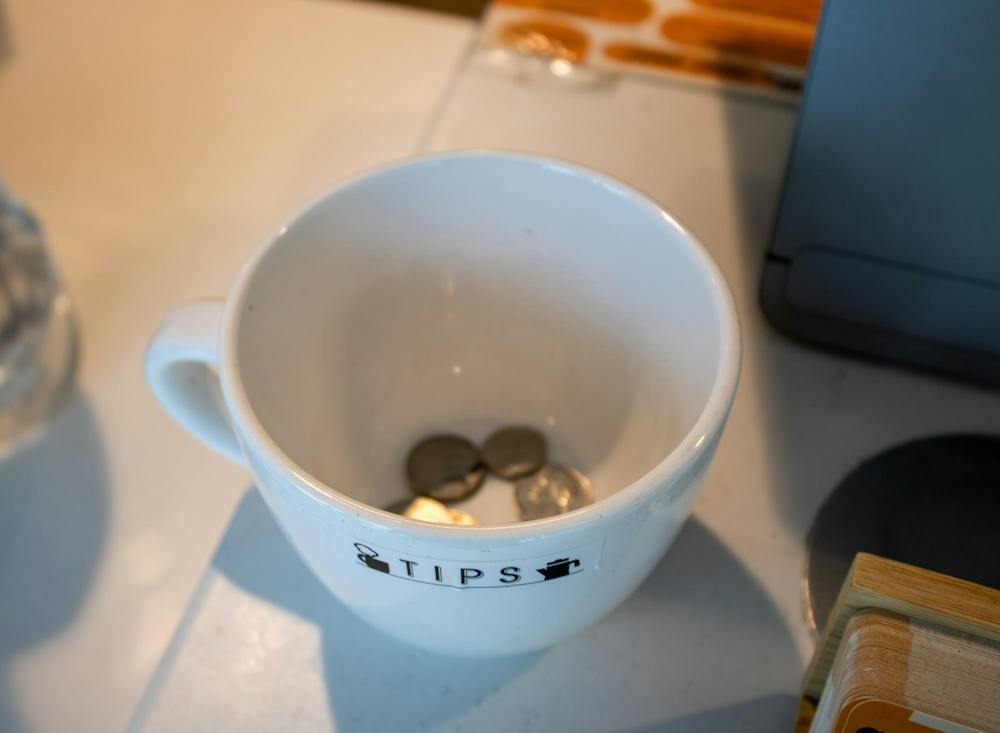
You step up to the counter to order a coffee, smoothie or burger, and as you prepare to pay, the card reader spins around to face you.
"It’s just going to ask you a quick question," the cashier says.
Suddenly you’re staring down options for 18%, 20%, 25% or the dreadful "No Tip" as the cashier stands and waits. In just two seconds, a drink run has morphed into a test of your moral character.
Tipping fatigue is completely real, and I feel like almost everyone has felt this tension at the register. But there’s a difference between being annoyed by a checkout screen and misunderstanding why that screen exists in the first place.
In her column, “Why am I paying your employees?”, Shirin Khizzar argues customers shouldn’t feel guilty pressing “No Tip” at counter-service restaurants because those workers already receive a standard hourly wage. She frames tips for sit-down restaurant servers as the only way to pay rent while writing off tips for counter workers as funding for "a new pair of shoes."
I agree with Khizzar on one point: Workers shouldn’t have to rely on customers to make rent. Where I disagree is her assumption that counter workers are already insulated from that problem simply because we receive an hourly wage.
As someone who actually works behind the counter of a smoothie shop, I think that assumption misses what those wages and tips look like in practice. Those tips are not buying me a new pair of sneakers or funding a fun weekend. They go straight to rent, utilities and groceries. Tips fill the gap hourly wages fail to cover.
The original column operates on the comfortable assumption that because fast-casual employees earn an hourly base wage instead of a traditional server's sub-minimum wage, our bills are somehow automatically handled. On paper, making $14 an hour might sound good to someone who doesn’t have to budget around it. In reality, a base wage means nothing when you can’t even get the hours you need to survive. Most of the time, the hours you get scheduled aren’t the hours you actually work.
Management rarely cuts your hours all at once; it happens slowly. Corporations think we don’t notice, but we do. They slowly shave off an hour each week until an average 30-hour week quietly shrinks down to a 20-hour one.
Even those 20 hours are never guaranteed. Employers don’t build weekly schedules around whether employees can afford rent or basic necessities. They build them strictly around daily labor percentages. The moment foot traffic slows on a weekday afternoon, managers start sending staff home early. What would usually be a seven-hour shift is suddenly cut in half, wiping out the hours you budgeted. That instability is the reason I have to work a second job just to stay afloat.
The pay gap between sit-down dining and counter service is something I see every day. My roommate works as a traditional restaurant server. On good nights, she can make $300 in tips alone, while I bring home $140 for roughly the same number of hours. How does that make sense when the physical work behind the counter can be just as demanding?
Fast-casual shifts run on skeleton crews with just two people covering the entire store. One is in the front taking orders and endlessly blending drinks, and one is in the back making food. Imagine trying to close, clean, restock and prep while dealing with whoever walks in late. Servers and counter workers both perform demanding physical labor, but counter staff are often treated like their work is somehow less deserving of compensation.
This inequity becomes glaring during large rushes. We recently had a customer place a $200 catering order in the middle of a rush only to leave a $10 tip for the two of us making everything. That came out to $5 each for two exhausted workers who just pushed out an entire store's worth of food. A 15-20% tip on a $200 restaurant bill would be $30-$40, but the two of us splitting that catering order received 5% total.
On an everyday smoothie run, a standard 15% tip is barely $1.50. When someone orders multiple drinks with heavy modifications, they are asking for extensive manual effort from two people doing everything they can to keep up. Leaving a small tip is not a luxury gift; it’s basic recognition of the hard work that goes into making your order.
The original column did not include the voice of a single counter worker. It relied strictly on an interview with a restaurant server, completely underrepresenting the thousands of food workers who survive on base pay paired with pooled digital tips. If the author had asked anyone who relies on this payment structure, she would have seen our financial struggles look just as bad as a server’s, if not worse.
Khizzar also argued tipping should stay in place because it gives servers the opportunity to have "good days" and make a lot of extra money. Shouldn't we prioritize ensuring every frontline worker earns a livable wage before we celebrate an unstable gamble for excess cash?
When a server earns hundreds of dollars on a prime weekend shift, the excess becomes the difference between buying a new pair of shoes or not. Meanwhile, counter workers are trying to make rent. Customers can’t determine who’s making enough to survive and who isn't. They leave servers generous tips so they can make extra money but then feel zero need to tip at a smoothie shop simply because of the counter between us.
Having to rely on customer generosity to make up for cut hours and low wages is a broken system. Workers should not have to gamble on customers’ charity on a random Tuesday afternoon just to make ends meet. We need consistent schedules and livable base wages across the board so that basic survival does not depend on someone's mood.
I understand the frustration with facing a tip screen when you’re ready to check out. The prompts feel relentless. But taking that annoyance out on the worker handing you your order is not the solution.
Customers don't have to love tipping culture. But before deciding the worker behind the counter doesn't need a tip, remember an hourly wage doesn't tell the whole story.
Contact Angel Perez at perezangelmanuel04@gmail.com


