
Read other stories from the "These stories were not AI-generated" special edition here.
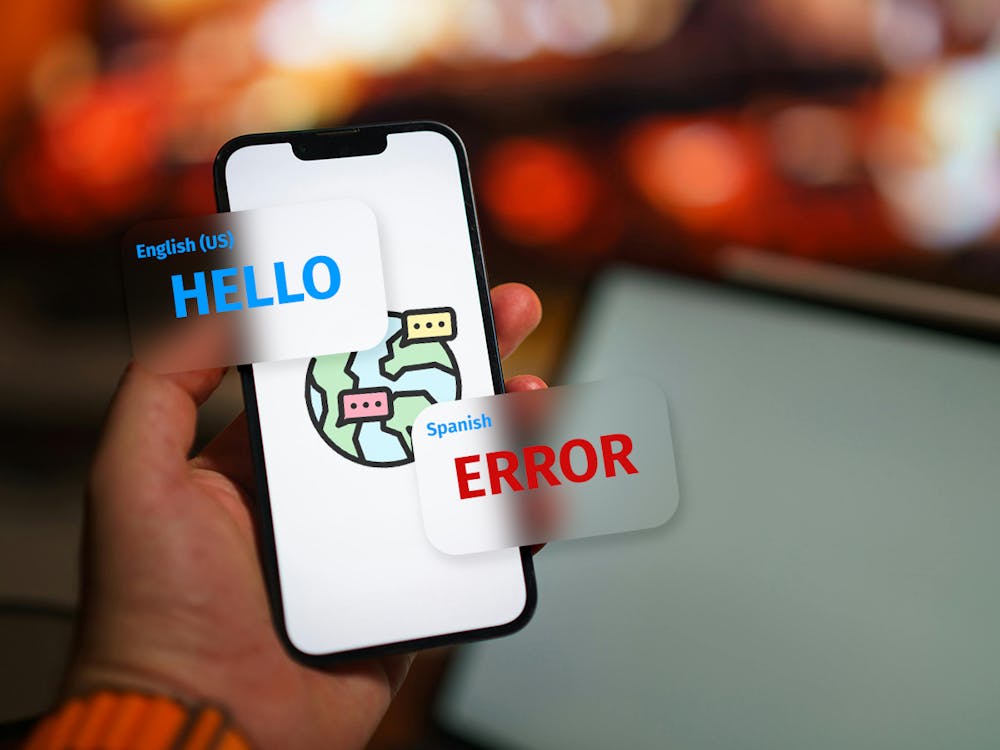
Claudio Ferrer is a native Spanish speaker. That doesn’t stop the 18-year-old UF electrical engineering freshman from getting a little extra translation help from ChatGPT.
Ferrer came to the U.S. from Havana when he was 11. He speaks Spanish every day with his closest friends, parents and girlfriend.
Sometimes, though, he uses artificial intelligence for language translation help. He doesn’t use it to write entire paragraphs or essays, he said. But when he writes academic papers, scholarship or internship applications, he asks ChatGPT how to say certain professional words or phrases in English. It’s to find elevated alternatives to sound more professional, he said.
“When I am thinking of a phrase that sounds good or professional in Spanish and cannot figure out how to make it sound the same in English, I usually ask ChatGPT about it,” Ferrer said.
Occasionally, ChatGPT will give him a translation that isn’t exactly what he is looking for. For the most part, though, Ferrer said it helps him find an adequate equivalent to what he is thinking in Spanish.
He said he doesn’t see any harmful effects of AI in language translation.
“I don’t see anything bad about it,” Ferrer said. “I think it’s great.”
Some language experts and translators agree AI is helpful in language translation, if used in moderation. Other students and faculty criticize the technology for its inability to retain cultural knowledge and say human translation can never be replaced.
Russell Scott Valentino, a professor and chair of Indiana University’s Slavic and East European languages and cultures department, as well as the former president of the American Literary Translators Association, said he has used computer-assisted translation in his work.
Valentino teaches language translation workshops and a class called “How to Translate Anything.” He uses computer-assisted translation and teaches it as a part of the courses.
Many of today’s professional freelance translators use AI and computer translation, he said. In translating texts with a specific vocabulary, like that relating to law, AI and machine translation develops a sort of memory for a lot of terms, making for quick and easy translation, he said.
Sometimes, Valentino said, people use AI and machine translation to translate a text and then give it to a professional translator, who will give it a second look and correct the text to elaborate on the nuances, stylistic choices and accuracy.
“When you get to the level where you’re doing something very specific with translation and you’re thinking about audience, AI can only do so much,” Valentino said.
AI has a tendency to make mistakes, Valentino said, so it’s necessary to check if it’s misreading a text. It happens often, especially with specialized texts, he said. If a medical record needs to be translated, for example, it needs to be done carefully due to the potentially serious consequences of a mistranslation.
The hardest texts for AI to translate, he added, are the culturally specific ones.
Valentino said many words exist in a cultural context. If translated to another language, the meaning could change, potentially becoming offensive.
“So, somebody tells a joke. Can AI make it be funny? Is it worth translating the joke? Is it in poor taste? All of those are kind of human questions,” he said.
AI may also struggle with poetry or idioms, more so than simple texts like emails, said Brent Henderson, a professor and chair of UF’s department of linguistics.
People who natively speak Spanish or Haitian Creole can benefit from AI when it comes to translating city government sites and straightforward texts, Henderson said. For the Gainesville and UF community, the most common countries of origin in foreign-born residents are Cuba, Haiti and Colombia.
“I don’t think AI will ever fully replace the need for human translators … but being able to make more knowledge available in more languages for people seems like a really good thing,” he said.
UF linguistics doctoral student Adam Bishop, however, is more skeptical about AI translation. Humans can much better translate the meanings of texts, he said.
“I think there is something very good, very beautiful about human translation,” Bishop said. “A human translator will always be better able to think about alternative ways of phrasing things, ways of conveying poetic forms than an AI translator will ever be.”
He said he recently read an article about AI transcription of thousands of medieval texts that were translated over the course of months, faster than a human could ever do, but about one in every 10 words were transcribed incorrectly.
Building a dependency on AI is “very harmful” given the technology’s potential for mistakes, Bishop said.
Jeffrey Killman, a Spanish language professor at the University of North Carolina at Charlotte, teaches technical translation, translation technologies and translation theory, and he has researched language translation and interpretation.
In Spanish to English language translation specifically, he said, AI and machine translation is easier and more accurate because they are common languages.
AI isn’t understanding text — it’s processing text, Killman said. Because machines don’t understand language and its context in a dynamic way like humans do, users should expect mistakes.
As a Spanish speaker, Killman said he can see the benefits of easy and quick translation, especially with the decades-long increase in America’s native Spanish-speaking population. It can be a guide, he said, but there’s no guarantee that the translation will be accurate.
If people are not made aware of the potential risks of using AI to translate, Killman said, there could be a harmful increase in relying on it.
“It’s being relied on and really shouldn’t,” he said.
Contact Angelique Rodriguez at arodriguez@alligator.org. Follow her on X @angeliquesrod.

Angelique Rodriguez is a journalism freshman and the Summer 2026 El Caiman Editor. She has spent two semesters at The Alligator as a University Reporter and El Caiman Reporter before becoming an editor. When she's not working, you can find Angie reading, hanging out with friends, or rewatching her rotation of favorite shows.